• TalkBass has been independent since 1998. Add your voice.
    Create a free account to reply to discussions, view embedded media, and browse with fewer display ads.
    Join freeLog in
    Want zero display ads or expanded classifieds tools? Compare plans.

Amps & Preamps-explain like I’m six

dannylectro

Gold Supporting Member
Aug 2, 2010
1,117
1,592
Hartsdale, NY
So… I’m a very long time bass player and basically always use a traditional rig: bass->basic pedalboard->amp.

I own a 1st gen Subway preamp that I really never use, though occasionally I use it for headphone practice. I read many, many TB threads regarding preamps, and while I understand their use in silent stage, worship-type settings where I wouldn’t be using a traditional amp/cab, and instead depending on house monitors, in-ears, etc. I don’t get why they are used in traditional setups like mine.

My question: if I’m plugged into an amp, such as a Mesa 800D, which has a versatile preamp built-in, and a distinctive “baked-in” sound of its own, why would I want/need any of the external preamps (Mesa, Sansamp, Broughton, etc.) for my rig? Especially if I have a pedalboard with a variety of effects I can use when needed?
 
My question: if I’m plugged into an amp, such as a Mesa 800D, which has a versatile preamp built-in, and a distinctive “baked-in” sound of its own, why would I want/need any of the external preamps (Mesa, Sansamp, Broughton, etc.) for my rig? Especially if I have a pedalboard with a variety of effects I can use when needed?
You don't, unless you want some tone shaping.
 
if I’m plugged into an amp, such as a Mesa 800D, which has a versatile preamp built-in, and a distinctive “baked-in” sound of its own, why would I want/need any of the external preamps

Maybe that "baked in" sound isn't working for a particular song or project. Or you just want a different flavor. You can run a preamp pedal into the effects return of your 800D, bypassing the built in preamp section your amp and just use the power section. It's just an option!

EDIT: to add further, maybe you’re running ampless, but you still want the sound and feel of an amp in your headphones. Or you’re stuck using a back line rig - running your preamp into the power section at least gives you something closer to a known quantity
 
Last edited:
So… I’m a very long time bass player and basically always use a traditional rig: bass->basic pedalboard->amp.

I own a 1st gen Subway preamp that I really never use, though occasionally I use it for headphone practice. I read many, many TB threads regarding preamps, and while I understand their use in silent stage, worship-type settings where I wouldn’t be using a traditional amp/cab, and instead depending on house monitors, in-ears, etc. I don’t get why they are used in traditional setups like mine.

My question: if I’m plugged into an amp, such as a Mesa 800D, which has a versatile preamp built-in, and a distinctive “baked-in” sound of its own, why would I want/need any of the external preamps (Mesa, Sansamp, Broughton, etc.) for my rig? Especially if I have a pedalboard with a variety of effects I can use when needed?
I agree, you don't need a preamp in your situation.
The preamp trend/hype is bigger than it deserves IMHO.

You don't, unless you want some tone shaping.
The Mesa 800D has a lot of tone shaping options already, you should precise "[unless you want some tone shaping…] that you can't already have with your amp, or if you want to change the tone for a specific song with a footswitch"
 
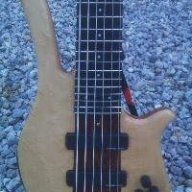
I'm on my 5th custom built with Cliff Bordwell. 30" 4 string. Under 7 pounds. 3 Dagtstar bisonic pickups with 6 way Freeway switching. Roasted Maple neck and fretboard. Reso-o-lite tuners, hipshot bridge, and this top:

View attachment 7492058
I guess we should give a thumbs up. How is this related to the OPs question though? Do we need this exotic wood instead of a pre-amp or in addition too. Maybe you were trying to start another thread or replied to the wrong one?
 
IT's a gear site. There will always be things you do not need or do not want that will be discussed. The compressor and Di/preamp thread is insanely long IMO there's sheep following culture -- l the top best ones all sound the same and the little fractional differentiation translates to hundred if not thousand of dollars delta. If you want put the preamp on the AUX and then get an ABY pedal so you could differentiate the preamp tone vs the amp eq

The ongoing theme is that Ampeg's own preamps cannot emulate their own amps compared to the other pedals. Maybe it is just to justify the price of those pedals or we are just repeating all the bass influencers opinions or if that is what Ampeg really wants or maybe Ampeg modelled it after some ampo that these influencers do not have access to. After all they want to sell you SVTs if they can.

Nothing wrong with stacking a preamp before the amps own preamp. You may get interesting results. I say do it and learn from it. Less is more and you can always cut.
 
I guess we should give a thumbs up. How is this related to the OPs question though? Do we need this exotic wood instead of a pre-amp or in addition too. Maybe you were trying to start another thread or replied to the wrong one?
Oops. I had 2 tabs open. Posted this in wrong one.
 
  • Like
Reactions: dannylectro
I guess we should give a thumbs up. How is this related to the OPs question though? Do we need this exotic wood instead of a pre-amp or in addition too. Maybe you were trying to start another thread or replied to the wrong one?

I fear you may be one inch away of deflagrating a discussion on tonewoods for preamp enclosures.
 
I own a 1st gen Subway preamp that I really never use, though occasionally I use it for headphone practice. I read many, many TB threads regarding preamps, and while I understand their use in silent stage, worship-type settings where I wouldn’t be using a traditional amp/cab, and instead depending on house monitors, in-ears, etc. I don’t get why they are used in traditional setups like mine.

My question: if I’m plugged into an amp, such as a Mesa 800D, which has a versatile preamp built-in, and a distinctive “baked-in” sound of its own, why would I want/need any of the external preamps (Mesa, Sansamp, Broughton, etc.) for my rig? Especially if I have a pedalboard with a variety of effects I can use when needed?

Part of the confusion likely stems from the fact that the term "preamp" is applied to a wide range of pedals that have quite different features and applications, some of which are basically just overdrive pedals and others are full substitutes for the preamp section of a bass amp (full EQ, DI out, output level sufficient to optimally drive a power amp, etc.).

A lot of the people you see talking about using a preamp on their pedalboard along with a bass amp and other pedals are probably not talking about something like the original Subway DI, which skews heavily toward the "substitute for the preamp section of a bass amp" side and does not have a footswitch to turn it on and off if run through the front of a bass amp for tone flavoring purposes like people might due with a lot of "amp in a box" style pedals. I personally use a Subway DI into a power amp as a replacement for a bass amp, rather than in conjunction with one. Since it is on my board, if I were gigging or recording in a situation where I wouldn't be using my own power amp and cab setup, I could run the Subway DI into the board or into the effects loop of a bass amp (bypassing the bass amp's preamp) to get something closer to my normal sound rather than wholly using backline. You could certainly run a Subway DI into a bass amp, but most likely if you were doing so it was because there was something about the stock sound of your bass amp you didn't like that you felt was improved by using the Subway's coloration and/or EQ. In contrast, there are lots of other "preamp" pedals with footswitches and often gain that people use as overall overdrives or tone coloration devices to supplement their bass amp's stock tone that can be freely turned on and off.
 
More knobs = more trouble, IME. My guiding philosophy is to not add anything to the signal chain unless I know I need it.

If you like the baked in sound of an amp's built-in pre, don't put another pre in front of it.

If you have a pre that gets "your sound" in any situation, consider plugging it in to the FX return on amps to bypass the built-in pre and avoid the combinatorics of multiple EQs and gain stages, and you can DI out of the pre for house and mons and/or powered cabs.
 
in the old days preamps had one use: boost a signal from instrument level (or mic level ) to line level to go into a mixing board, or a power amp section. ( and buffer the instrument signal to prevent down stream impedance altering tone .) Different manufacturers had different circuit designs for this. Over time certain models of preamp became desirable for their unique sound coloration. This caused the "pre-amp" to morph from a utility application to a dedicated tone coloring application, and "preamp pedals" were born. With advent of usable amp and cab modeling the category morphed even further, allowing for the "ampless" trend to take off.

Now you can buy a preamp with its original "instrument to line level buffer" feature buried under EQ, Gain stages, drive sections, amp and cab models, power windows an antilock front disc breaks.

Effectively in 2026 "preamp" pedals are preamp plus tone shaping, and the tone shaping is the primary concern.
 
Last edited:
Is tone shaping sort of the sum total of EQ, drive/saturation (adding harmonics), and compression? I imagine that's an oversimplification
Not an oversimplification at all. It can be any or all of those.
But of course, "tone shaping" is not a concise technical term, just a category of effect. @logdrum explains these well in this post
 
  • Like
Reactions: dannylectro
Not an oversimplification at all. It can be any or all of those.
But of course, "tone shaping" is not a concise technical term, just a category of effect. @logdrum explains these well in this post

Perhaps the question is whether or not one could get the desired tone (shaped or otherwise) from combining EQ (which handles pre-amp EQ and cab IR to some degree), drive for slight saturation or more, and compression for the other kinds of dynamic impacts of the tubes, etc. I'm just thinking in terms of general shapes, not super-specific, spot-on emulations-- but just getting a nice, pleasing tone.

My fretted bass (to me) sounds pretty amazing without anything-- straight into DI into channel. I do use EQ, I rarely use drive, and never use compression unless the circumstances demand it (which they rarely do). My fretless probably need more attention visa vis EQ.
 
  • Like
Reactions: dannylectro
Part of the confusion likely stems from the fact that the term "preamp" is applied to a wide range of pedals that have quite different features and applications, some of which are basically just overdrive pedals and others are full substitutes for the preamp section of a bass amp (full EQ, DI out, output level sufficient to optimally drive a power amp, etc.).

Quoting this for emphasis.

I think of the preamp at its foundation is a device to get the signal level to line level. The adjacent features start to accumulate quickly in the pedal world. You can start with something like a Night Owl Edison which is a preamp and all it does is run your signal through a tube and allow you to adjust the output level (it might do something to the impedance but I’m uncertain). The v2 added a boost/grit switch for character. If you look at the Sushi Box listings under the preamp category you can see how fast a similar concept can grow. More is pretty similar to the Edison (features) and adds a bass cut. Greenhouse adds an effects loop. Finally gives you gain and level, and adds a HPF and a DI. Mayday is similar to Finally but with more EQ options. Elementary has a different EQ options but giving up the DI out. Emerald is like Elementary but with more gain, and also no DI. And that’s all from one small builder. Expand that to the market full of options all sold as “preamps” and it can take a bit to figure out how to compare and contrast them all.
 
  • Like
Reactions: dannylectro