• TalkBass has been independent since 1998. Add your voice.
    Create a free account to reply to discussions, view embedded media, and browse with fewer display ads.
    Join freeLog in
    Want zero display ads or expanded classifieds tools? Compare plans.

Another Cure for G-String Twang

iiipopes

Supporting Member
May 4, 2009
12,893
10,355
Like many players, I have always been cursed with G string twang. I have tried string through, different bridges, flipping the P-pickup orientations, and many other things. Most of them involve significant alterations to the instrument, like drilling the bridge plate, which I am tired of doing.

Then for some reason I was contemplating the headstock of my custom P/J, and it hit me: put another string retainer at the bridge.

I got my Ibby out. I measured. I measured again. I compared the hardware. It looked like it would fit. I ordered a string retainer.

When the retainer got here, I drilled it out to the same diameter as the mounting hole in the bridge plate and my bridge screws so I could reuse the same bridge mounting screw. I then chucked it up in a vise and took a file to it to take off the excess part of the side or edge of the retainer so it would fit right up against the bridge. I then assembled everything and restrung the G string. Success! By installing the string retainer, it functioned at the bridge just like it does at the headstock: moving the hinge point of the string forward and putting just enough more downforce over the saddle or nut to secure everything. Twang is gone. It looks like it has always been there.

Obviously, this will only work on plate bridges with the mounting screws in the right place. But it is less than $5.00 for the part including shipping on eBay. It takes about ten minutes with a drill and file, and is completely reversible.

Fender '70's plate bridges with the really long G adjustment screw when Fender moved the bridge back come to mind as another application.
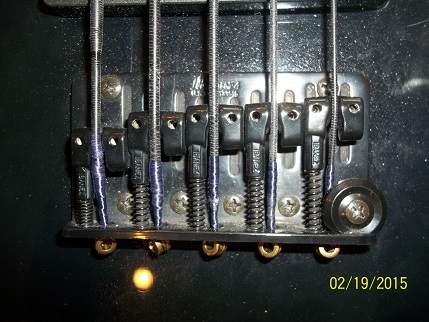
BridgeWithRetainer.JPG
 
Gotta give you props for creativity. :thumbsup:
Thanks.

Also, look at the B string saddle. I had to trim the intonation screw and the spring so it would not bind. the screw tap in an Ibanez saddle does not go through the saddle, like it does on Fender and Fender-style saddles, so if you don't have enough rear travel, the screw will bottom out and the lowest string will not intonate until the screw and spring are trimmed.
 
Last edited:
Confused. I thought your claim in another thread was that the twang you hear is because of the P pickup's orientation? This fix implies that it is a bridge issue that is common to your Ibanez as well as Fenders?
Both. All the above. And it also applies to all other basses as well that don't have a proper break angle over the G string saddle. My sound tech said I sounded better with the 40CS than the 40P5, in that bass, so I switched pickups back, and had to find another way to cure twang. And it wasn't so much that the twang completely went away, but that the inverse coil positions equalized the tone string-to-string. If they are all equally bright, then you turn down the treble and you have no twang relatively speaking.

Other solutions: I had another 2011 Ibby SRA305 that I drilled the bridge plate, installed a string ferrule on the back and ran the string straight down through the body right behind the saddle. This increased the downforce over the saddle and stabilized the string. On another bass, I have a Pressurewound G string, which the windings have been slightly flattened and are therefore not as bright, but the same wrap wire, as Progressives, so overall tone is consistent. As do violin players with their E string, I used to put a small piece of string envelope folded over between the saddle and the G string, but this tended to damp sustain, which, of course, is not an issue for violin players. Rotosound Trubass have a G string with a lot more tension than the rest of the set. More tension means more mass, which usually means a slightly less flexible string, and therefore less overtones, less twang. This is one reason a common flatwound set is 50-100. On my double bass, I have a really dark G string and a Spiro E string and Bel Canto A & D. When I play other basses, I find myself subconsciously moving my hand marginally closer to the fingerboard to tame tone. I have also had other basses in decades past I had to leave the tone knob at 8 or 9. I have even left on a dead G-string when changing the other strings, but that can also negatively effect sustain, and increase risk of breakage.

Yes, I believe the fix in this thread would especially apply to those Fenders that were made in the '70's with the bridge moved back and have a really long intonation screw. Moving the bridge back increased the distance from the anchor to the saddle and lowered the break angle over the saddle to almost nothing, and the instruments from this era I have played twang badly. YMMV.

There are many ways to tame G string twang. That is why the title of the thread is Another way to tame twang. I hope this helps.
 
Last edited:
  • Like
Reactions: Matthew_84
Both. All the above. And it also applies to all other basses as well that don't have a proper break angle over the G string saddle. My sound tech said I sounded better with the 40CS than the 40P5, in that bass, so I switched pickups back, and had to find another way to cure twang. And it wasn't so much that the twang completely went away, but that the inverse coil positions equalized the tone string-to-string. If they are all equally bright, then you turn down the treble and you have no twang relatively speaking.

Other solutions: I had another 2011 Ibby SRA305 that I drilled the bridge plate, installed a string ferrule on the back and ran the string straight down through the body right behind the saddle. This increased the downforce over the saddle and stabilized the string. On another bass, I have a Pressurewound G string, which the windings have been slightly flattened and are therefore not as bright, but the same wrap wire, as Progressives, so overall tone is consistent. As do violin players with their E string, I used to put a small piece of string envelope folded over between the saddle and the G string, but this tended to damp sustain, which, of course, is not an issue for violin players. Rotosound Trubass have a G string with a lot more tension than the rest of the set. More tension means more mass, which usually means a slightly less flexible string, and therefore less overtones, less twang. This is one reason a common flatwound set is 50-100. On my double bass, I have a really dark G string and a Spiro E string and Bel Canto A & D. When I play other basses, I find myself subconsciously moving my hand marginally closer to the fingerboard to tame tone. I have also had other basses in decades past I had to leave the tone knob at 8 or 9. I have even left on a dead G-string when changing the other strings, but that can also negatively effect sustain, and increase risk of breakage.

Yes, I believe the fix in this thread would especially apply to those Fenders that were made in the '70's with the bridge moved back and have a really long intonation screw. Moving the bridge back increased the distance from the anchor to the saddle and lowered the break angle over the saddle to almost nothing, and the instruments from this era I have played twang badly. YMMV.

There are many ways to tame G string twang. That is why the title of the thread is Another way to tame twang. I hope this helps.
It does help. Thank you!
 
Very cool, thanks for sharing. I never noticed that much twang on my 71 P "long screw" but I have noticed it more on some of my other basses, more so with rounds than flats.

What other strings do you find have a low TF? (Twang Factor.)
 
What other strings do you find have a low TF? (Twang Factor.)
It is really all relative. If all the strings are bright, then they are just bright. If all the strings are dark, then they are all dark. Actually, it is easier to state the issue in reverse: just about every round wound set I have ever played in almost 40 years has a twangy G string, because of the physics of strings: the G string, being lesser diameter, is inherently more flexible, and therefore vibrates in its overtones more readily.

The last twenty or so years string manufacturers have worked on their E strings, with different ratios, multiple wraps, and narrower final ribbon wrap on flats to maintain as much overtone character as possible. The last few years manufacturers have been trying everything new and different, like cobalt and different steel alloys.

It is time for manufacturers to work on taming the G strings to the same sustain and tonal signature as the other strings in a set.
 
very cool, a clean way to fix that "slap" of a too-loose saddle.

(another reason i like my through-body bridge, the steeper break angle avoids this issue entirely)

as for this part...
Also, look at the B string saddle. I had to trim the intonation screw and the spring so it would not bind. the screw tap in an Ibanez saddle does not go through the saddle, like it does on Fender and Fender-style saddles, so if you don't have enough rear travel, the screw will bottom out and the lowest string will not intonate until the screw and spring are trimmed.
...may i suggest re-checking the intonation on that B? @Zooberwerx hipped me to this, and it's borne out for me, that those fat but taper-wound strings end up needing way less compensation (since the thin bit is more flexible at the bridge witness point), and often end up sitting in front of the next string, not behind as you have it (and as would be normal for a regular non-tapered string).
 
@Zooberwerx hipped me to this, and it's borne out for me, that those fat but taper-wound strings end up needing way less compensation (since the thin bit is more flexible at the bridge witness point), and often end up sitting in front of the next string, not behind as you have it (and as would be normal for a regular non-tapered string).

...and I got that tidbit from Roger Sadowsky.

That's a neat mod (string retainer) and I can certainly see how it would help eliminate extraneous noise originating in the string's afterlength. I like to think I'm fairly well versed in most aspects of set-up but I never realized that was a problem. Hey, first time for everything!

Riis
 
May I suggest re-checking the intonation on that B?(and as would be normal for a regular non-tapered string).
I have tried La Bella, D'Addario, and many other strings on this bass, including conventional rounds, both SS & nickel plated. This is where it sets up on this bass. I tend to set my action high and "dig in," which produces more string stretch, hence, more compensation needed. This is one of my ideosyncracies of my playing. On my custom P/J, I even need Delft-style nut shims to keep the first few frets intonated properly. I keep my tool box handy at all times, and I keep a digital tuner on my headstock on at all times during a gig so that if I have the slightest intonation difficulty I can take care of it between sets. That is where it is. No further intonation adjustments have been necessary for the B string on this bass after setting it up with this brand, model and gauge of string, The La Bella .135 black nylon tape B string, even after changing it out a couple of times over the course of time and many gigs, to make sure it keeps its articulation as precise as possible. One last detail: I tune it up to C, one fret up, so it is not so floppy and feels more like the rest of the strings. It is as stable as the day is long. Thanks.
 
That's a neat mod (string retainer) and I can certainly see how it would help eliminate extraneous noise originating in the string's afterlength.
It's not the noise in the afterlength. It is the overall sound quality of the G string. Getting more downforce on the string helps with solidifying the fundamental and taming extraneous overtones. Acoustic guitarists have known this for years, and plan on the eventual necessary neck reset as the top bellys out.
What Does A Sharper Saddle Break Angle Do For Tone? in Technical Info Forum
And so have banjo players, who have to find the balance of tension and tone:
Banjo Newsletter
And there is much discussion on the double bass side of the forum about what is the optimum break angle over the bridge, how that translates into tone and sustain driving the top of the bass, and how the tailpiece and afterlength should set and regulated.
 
I gotcha now: break angle. I had a similar experience but it had nothing to do with "twang" as the strings in question were modestly-worn Chromes. My G string saddle (G&L 1505) was "on the deck" and string height was okay but the break angle(s) was fairly shallow. Now, normally I could have used the thru-body option but that was rendered inaccessible via my "DIY High Mass Bridge" project but that would not have addressed the lack of travel on the G string saddle. Per protocol, I added a shim (overkill @ just shy of 1 mm) to end-of-pocket and made the necessary bridge saddle compensation. As a result, I ended up with full travel and improved break angles on all saddles.

The retainer mod would be perfect for set-neck & neck-thru instruments, as well, where the options above are not available. Overall, it appears that success resides with shortening the distance between the tailpiece and saddle. For that fact, a bridge with staggered tailpiece segments would do the same job. The closest thing I can think of is the monorail bridge system whereas placement can be manipulated / staggered to maintain the desired tailpiece / saddle relationship.

Riis
 
  • Like
Reactions: /\/\3phist0
I gotcha now: break angle. I had a similar experience but it had nothing to do with "twang" as the strings in question were modestly-worn Chromes. My G string saddle (G&L 1505) was "on the deck" and string height was okay but the break angle(s) was fairly shallow. Now, normally I could have used the thru-body option but that was rendered inaccessible via my "DIY High Mass Bridge" project but that would not have addressed the lack of travel on the G string saddle. Per protocol, I added a shim (overkill @ just shy of 1 mm) to end-of-pocket and made the necessary bridge saddle compensation. As a result, I ended up with full travel and improved break angles on all saddles.

The retainer mod would be perfect for set-neck & neck-thru instruments, as well, where the options above are not available. Overall, it appears that success resides with shortening the distance between the tailpiece and saddle. For that fact, a bridge with staggered tailpiece segments would do the same job. The closest thing I can think of is the monorail bridge system whereas placement can be manipulated / staggered to maintain the desired tailpiece / saddle relationship.

Riis
Indeed. Individual bridges can be offset to get more or less break angle with the individual string compensation. My custom P/J has offset string through ferrules for more break over the G string, less over the E string, and the A and D strings adjusted accordingly. Adding a neck shim is the same as an acoustic guitar neck reset I linked above, and is another solution. I did that on my fanned fret guitar: increased neck angle, bridge block, and a complete redesign of the bridge and string anchor relationship to get consistent break angles.

Finally, yes, shortening the afterlength, on the same relative plane will increase break angle. This comes from Euclidian geometry, which along with introductory physics and trig functions will compute the additional downforce gained. Yes, it is all math. I still use my TI-30 calculator to determine these details.

Lakland has a bridge plate that has offset string-through-body ferrules to maintain a constant break angle over the saddles.
 
  • Like
Reactions: Zooberwerx
I went the other way. I removed the string retainer on the headstock and wind the strings down to the bottom of the posts. I find the G string sounds more like the others. I've done that on all my fender-style basses for a couple of years. Cost...free.
 
I went the other way. I removed the string retainer on the headstock and wind the strings down to the bottom of the posts. I find the G string sounds more like the others. I've done that on all my fender-style basses for a couple of years. Cost...free.
Yes, as I stated above, if all the strings are equally bright, then you simply turn down the tone or treble, and they are all relatively the same - no perceived twang. Just be careful you don't lose stability of the strings.
 
...just about every round wound set I have ever played in almost 40 years has a twangy G string...
Same here. IME and IMO, the single biggest contributor (tho there's others brought up in this thread and others) is the physical design of almost every G bass string: it's a guitar string.

I once had a very long and informative conversation with the late Bill Lawrence. He talked about several topics (pickups obviously and bridges) and at one point the topic turned to strings. He was lamenting the fact that almost no one makes a true bass G string.

The general gist of the conversation: Essentially, every other string from D on down consists of a core wire, an inner wrap one or more outer wraps (up to desired diameter). Unwrap almost any G string, and you will find a core wire with a single wrap. This yields a twangier sounding string, relative to the others.

It's possible of course to make a G with two wraps, but in order to have the normal core diameter and add the extra wrap, it would need to be very fine (.005") and the construction becomes more expensive. Of course, if you're OK with a heavier G (.050" or higher) then it's doable without an inner wrap that is so fine and hard to work with, but few people want a G string this heavy.

The net result of all this is that almost all round wound bass strings have a twangy G. AFAIK, Thomastik is the only maker of a standard gauge G with an extra (albeit silk) inner wrap.