• TalkBass has been independent since 1998. Add your voice.
    Create a free account to reply to discussions, view embedded media, and browse with fewer display ads.
    Join freeLog in
    Want zero display ads or expanded classifieds tools? Compare plans.

anyone replaced a trussrod from an Ibanez SR?

I just got the bass I've always wanted just to find it had a very striped 4mm truss rod. i tried the ball type allen key, then a torx head. then this morning i cut about 15 mm off an allen key and welded it into the striped hole. i know, awesome idea right?. the key sheared off just below the socket. should have known. then i cut a slot in the remaining metal hoping for a screwdriver fix. not a chance.

start looking for a replacement neck for a SR805 (2013). not actually a thing you can buy. funny, replacing necks is the only good argument ive ever heard for bolt ons.

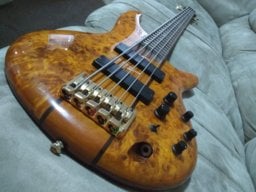
now i have no choice but to try and replace the part. holy cow man. remove fret board, replace with generic 2 way rod, glue it all back together.... sounds like a lot of work. but so far im out 600$ canadian and have no replacment options. part of me wants to throw it in the burn pile but its the one ive always wanted.. poplar burl amber finish w gold hardware and MK1s.... and they dont make them anymore. ***

anyone done this? how did the glue up go? standard stewmac rod? does it play different?
 
Yes, it can be done. I've replaced maybe 10 truss rods in Ibanez necks over the years. I'm not going to tell you that it's easy, that anyone can do it on the first try. It's getting into advanced-level repair work. You can do it, but it's going to require some homework and sweat.

Take a look through this thread, where Keith and I replace the truss rod in a vintage Alembic.

Replacing The Truss Rod In An Early Alembic

The basic process involves removing the fingerboard using gentle heat and careful slicing with a thin knife-like tool. Then getting the old truss rod out may require some chiseling and prying. Fitting the new truss rod in may require some routing and chiseling, depending what brand/type of replacement truss rod you get. Then the fingerboard is cleaned up and carefully glued back on. Done right, and with some luck, only minimal fret leveling work will be needed. Then, you have to smooth out the glue seams and touch up the finish, or completely refinish the neck. It's a fair amount of work.

That's the quick description. There are more details involved, and complications that can come up. Ibanez necks can be tricky because they are quite thin. Many repair shops won't touch them, and the ones that will may charge you $300 to $500.
 
Last edited:
IMG_20181021_231501962.jpg Here is some pics. notice where i cut into the wood a little on my 2nd attempt at getting a slot, rats. any info or tips before i try the old iron on it is much appreciated. i have done a couple (fretless through neck) builds from scratch but this is a new level of wood work for me. do i really need to refret it after? i can do a level and crowning.. but re freting? i might be better off carving a new one on my own.

Serial # is posted just in case someone has something laying around their shop that will fit that nech pocket? Maybe?

-edit, deleted pics of striped socket.
 
Last edited:
The biggest issue isn't getting the fingerboard off. The question is what condition the fingerboard is in once it's off. Sometimes they will curl up like a pretzel, or snap into several pieces. Some Ibanez necks have very thin fingerboards, which makes them quite fragile. Yours looks to be moderately thick, so you may not have much trouble with it. If the fingerboard comes off in one piece and fairly straight, then you may be okay with the frets.

The basic technique is to use a dampened (not soaking) washcloth. You don't want to soak the fingerboard; just use the steam to heat it. The neck needs to be clamped down somehow. Lay the cloth on the fingerboard, over the first couple of frets. Set a standard clothes iron on the washcloth. Keep re-dampening the cloth as it dries out under the heat.

Find some kind of a thin kitchen knife, like a 6" or 8" blade. As you heat the end of the fingerboard, put the knife right at the glue joint at the nut shelf (right above the truss rod end). As the glue softens, you should be able to work the edge into the glue joint and lightly push the fingerboard and neck apart. Slowly and gently. Do not try to push hard on the knife or pry them apart! That's how you can break the fingerboard. Slowly inch your way along, applying heat and sliding the knife forward. It took Keith about an hour to remove that Alembic fingerboard. Patience, patience.

After you get them apart, and have dealt with fitting the replacement truss rod, you'll have to sand the back of the fingerboard clean and flat. It's covered with molten ripples of glue. Down to the wood, but don't take off any wood. Same with the top surface of the neck. They need to be clean and smooth and flat. If they glue together lumpy, you'll have to level or replace the frets.
 
  • Like
Reactions: Spidey2112
What type of truss rod did you find in the ibanez necks?
Yes, it can be done. I've replaced maybe 10 truss rods in Ibanez necks over the years. I'm not going to tell you that it's easy, that anyone can do it on the first try. It's getting into advanced-level repair work. You can do it, but it's going to require some homework and sweat.

Take a look through this thread, where Keith and I replace the truss rod in a vintage Alembic.

Replacing The Truss Rod In An Early Alembic

The basic process involves removing the fingerboard using gentle heat and careful slicing with a thin knife-like tool. Then getting the old truss rod out may require some chiseling and prying. Fitting the new truss rod in may require some routing and chiseling, depending what brand/type of replacement truss rod you get. Then the fingerboard is cleaned up and carefully glued back on. Done right, and with some luck, only minimal fret leveling work will be needed. Then, you have to smooth out the glue seams and touch up the finish, or completely refinish the neck. It's a fair amount of work.

That's the quick description. There are more details involved, and complications that can come up. Ibanez necks can be tricky because they are quite thin. Many repair shops won't touch them, and the ones that will may charge you $300 to $500.
 
What type of truss rod did you find in the ibanez necks?

Recent ones ('90's and up?) are a standard DRDA (Double Rod Double Acting) design. It's made in house by Ibanez, obviously, and it's a shallow design. The two rods are right on top of each other. Ibanez necks are quite thin, so as a replacement, you have to use one of the low-profile types. And you need to check all the clearances carefully. There's variance on the width and depth of the end blocks between the various brands on the market. In some cases, you may need to slightly trim the slot in the neck or even add a slight cut into the bottom side of the fingerboard.

Be real careful about deepening the slot in an Ibanez neck, because the wood under the slot is very thin. Also, the neck is fairly fragile with the fingerboard off. Don't force the truss down into the slot and split it in half!

I remember working on at least one Ibanez neck that had a SRSA (Single Rod Single Acting, Fender-style) truss rod. I assume it was from the '80's or so.
 
  • Like
Reactions: Killed_by_Death
Ive used those low profile rods before, geez id hate to have to reroute the channel. do they not use normal wood glue to attach the fingerboard? i didnt think damp heat would unbind wood glue. I did learn as a kid how to put an illegal curve on a hockey stick with steam...it seems to me that what ever bow is in it when it dries & cools is the bow it will keep. if i can keep it straight during the removal it might stay straight. as for frets, if it gets too damp, the slot will swell.... then when it gets cool it will shrink, possibly leaving the frets loose. anyways, enough talk. Into the shop! (after i get home from work and feed everyone, walk dog etc.) ill keep you posted.
 
  • Like
Reactions: Spidey2112
So my thought process is removing the rod without taking off the fretboard. most specifically, i was wondering if the rod had an anchor. that's where my mind is headed.
Recent ones ('90's and up?) are a standard DRDA (Double Rod Double Acting) design. It's made in house by Ibanez, obviously, and it's a shallow design. The two rods are right on top of each other. Ibanez necks are quite thin, so as a replacement, you have to use one of the low-profile types. And you need to check all the clearances carefully. There's variance on the width and depth of the end blocks between the various brands on the market. In some cases, you may need to slightly trim the slot in the neck or even add a slight cut into the bottom side of the fingerboard.

Be real careful about deepening the slot in an Ibanez neck, because the wood under the slot is very thin. Also, the neck is fairly fragile with the fingerboard off. Don't force the truss down into the slot and split it in half!

I remember working on at least one Ibanez neck that had a SRSA (Single Rod Single Acting, Fender-style) truss rod. I assume it was from the '80's or so.
 
So my thought process is removing the rod without taking off the fretboard. most specifically, i was wondering if the rod had an anchor. that's where my mind is headed.

Possible, but not reasonable. The DRDA rod doesn't have an anchor, but it's tightly fitted and/or glued into the slot. It would probably take a lot of force to break it loose and pull it out. Also, it wouldn't pass across the TR access rout in the headstock. You'd have to rout out a trough in the headstock for clearance.
 
Hey Bruce, when you said "The two rods are right on top of each other" you mean like a stew mac hot rod?

Invalid Link Removed

I have never actually used one of those, Ive been using these with an anchor block that would not allow for the removal lengthwise.

https://www.amazon.ca/Double-Truss-...1540239498&sr=8-1&keywords=truss+rod+bass+610

Its a great idea but I think im stuck with fingerboard removal.

Hey, thanks for all your help fellows.


Spidey; ya im waiting on an email from the canadian parts dealer. That amber burl is the prettiest stringed thing i have ever seen.
 
If that were my bass, I would be tempted to remove material at the heel and try removing it from the headstock down. just thinking out loud. good luck with whatever is decided op.
Keep us posted.
Possible, but not reasonable. The DRDA rod doesn't have an anchor, but it's tightly fitted and/or glued into the slot. It would probably take a lot of force to break it loose and pull it out. Also, it wouldn't pass across the TR access rout in the headstock. You'd have to rout out a trough in the headstock for clearance.
 
If that were my bass, I would be tempted to remove material at the heel and try removing it from the headstock down. just thinking out loud. good luck with whatever is decided op.
Keep us posted.

You can also remove it from the back, converting it into a skunk stripe. Maybe you saw my MusicMan thread, where on the second page, I did that on two Pat Wilkins necks. It saves harming the fingerboard or frets. But you end up with a skunk stripe on the back. And the surgery is a little tricky. I do it in a special holding fixture in a milling machine.
 
I did see your thread. i have replaced a truss rod by drilling a hole in the heel and tapping the rod out of the headstock area. that bass had a tiltback headstock. i would remove that fingerboard as a last resort but that's me.
You can also remove it from the back, converting it into a skunk stripe. Maybe you saw my MusicMan thread, where on the second page, I did that on two Pat Wilkins necks. It saves harming the fingerboard or frets. But you end up with a skunk stripe on the back. And the surgery is a little tricky. I do it in a special holding fixture in a milling machine.
 
done. here is some measurements for the next guy. it's like you said; stacked one on top of the other. 9mm deep. 6mm wide. 640mm long. ive never heard of 640, might be using the hotrod at 610.


it was built so you could drill out the heel and tap it out from the back. But it was very tightly fit with a lot of glue. I had to pry and flex pretty good to get it out.


kayden.jpg
apart.jpg
width.jpg
depth.jpg
length.jpg
 
Last edited:
Ah great, nice work! Did you have much trouble getting the fingerboard to let go?

Yes, that's a typical design DRDA truss rod, although Ibanez makes it to their own particular length. I doubt that you could tap it out the back end, because the whole head end assembly is wider than the main length.

Find a replacement that fits. The length isn't critical, as long as the back end ends up within an inch of the end of the slot.
 
Looks like you could tap it out of the headstock.
Ah great, nice work! Did you have much trouble getting the fingerboard to let go?

Yes, that's a typical design DRDA truss rod, although Ibanez makes it to their own particular length. I doubt that you could tap it out the back end, because the whole head end assembly is wider than the main length.

Find a replacement that fits. The length isn't critical, as long as the back end ends up within an inch of the end of the slot.
 
No the board came off pretty easy. Took almost an hour. I had one of the kids run the iron. Getting the rod out was tougher. it was really in there.

Stew mac has one that will fit. $13. Plus about 35 in ultra priority two day airmail. I dont want to wait a month. I'll keep posting as this bass goes back together. See how out of level the frets are after the board removal.

Stay tuned