• TalkBass has been independent since 1998. Add your voice.
    Create a free account to reply to discussions, view embedded media, and browse with fewer display ads.
    Join freeLog in
    Want zero display ads or expanded classifieds tools? Compare plans.

Arauco, Okoume and Baltic Birch

Mystic Michael

Hip No Ties
Supporting Member
Apr 1, 2004
9,883
2,148
New York, NY
Do any of you custom cab owners have a good grip on the distinctions and differences between these three types of plywood, used frequently to build bass and guitar cabs? If so, could you expound a bit?

What I know is that Baltic birch is solid and heavy. Very durable, but can be tough to schlep around. Arauco and Okoume are frequently-used, lighter-weight alternatives, with Okoume being pricier than either Baltic birch or Arauco, but I know nothing about the sonic characteristics of either Arauco or Okoume.

Can someone provide a brief primer on these three woods, focusing on sonic traits, durability and cost? Would appreciate.

MM
 
Wood has a sonic trait in an instrument, because in an instrument it vibrates. It shouldn't have a sonic trait in a cab, because a cab's panels shouldn't vibrate. Birch is heavy, so it takes less thickness and bracing than lighter weight woods to prevent panel vibration. Using bracing to keep panels vibration free is labor intensive, which is expensive, so manufactured cabs tend to use heavier and thicker panels instead of lighter thinner panels with better bracing. There aren't any labor costs with a DIY cab, so the better DIY designs use lighter wood, thinner panels and better bracing. An example of a superior DIY design is the BFM Jack Lites, which are built with 1/8 and 1/4 inch birch.
 
Plywood of almost any variety, as long as it is void free can be used. The softer plywoods; specifically some of the poplars do not hold screws well and if they are chosen need to be braced and fastened well. I grew up making cabinets out of any leftover wood I could find in my father or grandfather's shop. Stuart "Dinky" Dawson was my introduction to using 12mm baltic birch and proving that 19mm (3/4") was not necessary. Dinky contracted me to build 18" Thiele subs for the Channel in Boston and he wanted them done with 12mm Baltic. I questioned the stiffness and durability and he assured me it would be just fine. It was. I have always glued, stapled and screwed all my cabs together no matter what material they were made of (barring my brief excursion into polymer coated "surfboard" type cabs....which by the way saved no weight but did stink up the shop:) Okume comes in different grades. I choose to use marine grade. No voids, marine grade adhesive, holds screws well and glue joints are solid. But after over 40 years building in baltic birch remains king and is all I'd use for a baffle. Please consider this is only my opinion.
 
Can someone provide a brief primer on these three woods, focusing on sonic traits, durability and cost? Would appreciate.

MM

There are a lot of cabs out there made out of MDF which is heavy and not very durable. In terms of plywood, the three you laid out:

  • Baltic Birch
    • Lighter than MDF
    • Stronger/more durable than MDF
    • Properly braced there should be no sonic difference from any other material
  • Aruco
    • Lighter than Baltic Birch
    • Not quite as strong/durable as BB
    • likes to warp.
    • Properly braced there should be no sonic difference from any other material
  • Okoume
    • Lighter than Aruco
    • Strong enough to make cabs out of
    • benefits from a strong coating as it can dent easily
    • Properly braced there should be no sonic difference from any other material
As the cabs in question, the differences in weight become less meaningful. Taking 20% off of a 25 pound cab is only 5 pounds. 20% off of a 100 pound cab is 20 pounds. The the cost/weight benefit gets narrow as the cab gets smaller.

Decrease in weight relative to what? To Baltic birch? No difference in tone relative to what? To Baltic birch? If so, what was the difference in price relative to Baltic birch?

MM

The raw cost of the Okoume is significantly more expensive than Baltic birch or Aruco, and will depend on the location where it is sourced. i.e. buying wood in the mid west may have different cost margins than the PNW. The weight will depend on the particular lots you are looking at as the weight of a single sheet of ply is not 100% consistent.

Once again, we're not talking tone woods here. (Even that has a lot less to do with an electric instruments tone than other portions of its build.) Properly built, there should be no impact in material of construction.
 
Decrease in weight relative to what? To Baltic birch? No difference in tone relative to what? To Baltic birch? If so, what was the difference in price relative to Baltic birch?

MM

The decrease in weight was compared to the default wood used - Baltic birch. I was told by the cab builder that there was no tone difference - there was not a big difference in price - do not remember off the top of my head. The builder was David Luke (@dawind99 - see post #5) - he is happy to answer questions, and can give you the exact weight difference, as well as his current prices. But everyone I know who has bought his cabs like them, and consider them a good investment.
 
Julian (@CL400 Peavey) was right on the money.

In my opinion Baltic Birch is the "Gold Standard". Its not not outrageously heavy like MDF, and its strong, tough and reasonably priced.
Arauco is pretty much crap in my opinion, I don't like to use it.
Okoume is about 20-25% lighter than Baltic Birch and more than 3 times the cost. It is strong, but softer than BB, and more easily marred. Its commonly used in marine applications.
I've got no problem using it, but in my (admittedly cheapskate) opinion its not worth the extra cost in most of the cabinets that I build. The Greenboy cabs are already compact, there isn't enough weight to be saved to justify the cost, especially in the single woofer cabs.
But to answer the original poster's question, the wood in a (properly designed) speaker cabinet should be seen and not heard. The cabinet should not make any contribution to the sound leaving the enclosure. Of course the the construction and overall design will have a huge impact, but the goal there is to prevent the cabinet from resonating and making (unwanted) sound. To that end, the species of wood used is irrelevant.
 
Satisfactory results can be obtained with a variety of plywoods (I have at least a dozen types in my database that I use for design purposes), but each type needs structural analysis based on it's specific properties, and the bracing differences might be significant. I have used a fairly rudimentary finite element analysis approach which covers the major mechanical vibration modes and how they are most effectively controlled without creating other bothersome issues.

The modeling of these systems can quickly grow unwieldy, because the equations are essentially created out of a series of diaphragm models coupled together. So each resonant frequency (both amplitude and phase) affects the other. The result looks like a string of electronic filter equations, complete with filter frequency, polarity (cut/boost) and Q. Sometimes, changes can be made in bracing that makes a problem coefficient go away, these are welcome solutions.
 
Plywood of almost any variety, as long as it is void free can be used. The softer plywoods; specifically some of the poplars do not hold screws well and if they are chosen need to be braced and fastened well. I grew up making cabinets out of any leftover wood I could find in my father or grandfather's shop. Stuart "Dinky" Dawson was my introduction to using 12mm baltic birch and proving that 19mm (3/4") was not necessary. Dinky contracted me to build 18" Thiele subs for the Channel in Boston and he wanted them done with 12mm Baltic. I questioned the stiffness and durability and he assured me it would be just fine. It was. I have always glued, stapled and screwed all my cabs together no matter what material they were made of (barring my brief excursion into polymer coated "surfboard" type cabs....which by the way saved no weight but did stink up the shop:) Okume comes in different grades. I choose to use marine grade. No voids, marine grade adhesive, holds screws well and glue joints are solid. But after over 40 years building in baltic birch remains king and is all I'd use for a baffle. Please consider this is only my opinion.
Can you tell me the correct staple or nail to use for glued assembly of 12mm BB boxes? I have several nail guns I can use.
 
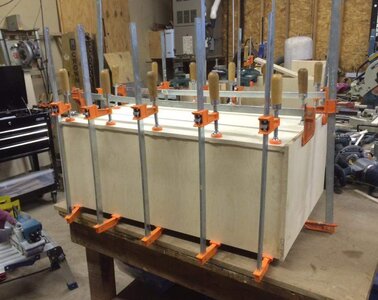
I don't use any fasteners other then a few 23ga "pin" nails. I use dados and lots of clamps. Also, I generally use "PL Premium" urethane adhesive, and "Tite Bond" for some non critical joints. With glued construction the fasteners only help to align thing she and don't do anything after the glue cures. Clamping is important, you could use drywall screws and remove them and fill the holes after the glue cures if you don't have enough clamps.
 
  • Like
Reactions: wcriley
Satisfactory results can be obtained with a variety of plywoods (I have at least a dozen types in my database that I use for design purposes), but each type needs structural analysis based on it's specific properties, and the bracing differences might be significant. I have used a fairly rudimentary finite element analysis approach which covers the major mechanical vibration modes and how they are most effectively controlled without creating other bothersome issues.

The modeling of these systems can quickly grow unwieldy, because the equations are essentially created out of a series of diaphragm models coupled together. So each resonant frequency (both amplitude and phase) affects the other. The result looks like a string of electronic filter equations, complete with filter frequency, polarity (cut/boost) and Q. Sometimes, changes can be made in bracing that makes a problem coefficient go away, these are welcome solutions.

Get your PDE's, wave equations, and approximation techniques fired up.
 
  • Like
Reactions: agedhorse
I don't use any fasteners other then a few 23ga "pin" nails. I use dados and lots of clamps. Also, I generally use "PL Premium" urethane adhesive, and "Tite Bond" for some non critical joints. With glued construction the fasteners only help to align thing she and don't do anything after the glue cures. Clamping is important, you could use drywall screws and remove them and fill the holes after the glue cures if you don't have enough clamps.
Would love to see a photo of one of your builds, with all the clamps in place.
 

Attachments

  • clamp.jpg
    clamp.jpg
    79 KB · Views: 165
I thought @Mike Arnopol was getting a noticeable tone difference between the varying ply woods on his MAS builds.

=wr=

If he didn't design the bracing specific to each material, I would expect this result.

In fact, by using different materials, or even a combination of materials and bracings, it's possible to alter the results in beneficial ways (in some instances).
 
I thought @Mike Arnopol was getting a noticeable tone difference between the varying ply woods on his MAS builds.

=wr=

If he didn't design the bracing specific to each material, I would expect this result.

In fact, by using different materials, or even a combination of materials and bracings, it's possible to alter the results in beneficial ways (in some instances).

OK. This goes directly to my initial reference to "sonic characteristics" of the various plywoods. I recognize that the selection of "tonewoods" is a common aspect of guitar and bass guitar construction - not of cabinet building. Yet clearly the differing degrees of plywood hardness, rigidity and weight, etc. all have a bearing upon the frequency response, tone and timbre of the finished product. That's all I meant.

Are we not all on the same page? :eyebrow:

MM