

Enjoy the benefits of a premium membership!
Upgrade Account
-
TalkBass has been independent since 1998. Add your voice.
Create a free account to reply to discussions, view embedded media, and browse with fewer display ads.
Join free Log in
Want zero display ads or expanded classifieds tools? Compare plans.
You are using an out of date browser. It may not display this or other websites correctly.
You should upgrade or use an alternative browser.
You should upgrade or use an alternative browser.
Are arm contours actually functional?
- Thread starter KidAmnesia
- Start date
More options
Who Replied?
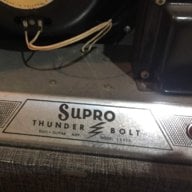
Slab bodies do not work for me... And binding is VERBOTEN on my instruments - no.can.do!!
I'm not a luthier so take this for what it's worth (I just wandered in here while dreaming up my next custom build) but for me and playing style while sitting contours are a must. Once upon a time I tracked a couple days in the studio with a Warwick Star Bass II and sitting for that long while the non-contoured edge of that bass dug into my forearm was significantly more uncomfortable that I thought it would be.
Now, standing up and playing…I play too low for the lack of a contour to be very noticeable at all.
Now, standing up and playing…I play too low for the lack of a contour to be very noticeable at all.
Last edited:

The contour also makes a difference if wearing the bass high enough to be using the tug bar and playing everything with your thumb.
Play a slab body original / reissue P-Bass or late 60s / early 70's Tele bass and you might be surprised how much you miss the forearm contour over a few hours of playing time…
This is exactly why is don't play my Tele Bass more often. The lack of a back contour also makes a big difference.

Jazzdogg
Less barking, more wagging!
Arm contours and bevels are almost omnipresent on basses (or at least FSOs and their derivatives) since 1954; but do they actually work?
I don't think I ever played a bass in a position where my forearm rested naturally on the contour. It either rests on the side of the body, over the bevel, or it misses the area completelly. The only way to beneffit from it I found is to use a really short strap and play it more like a guitar either with a pick or fingerstyle close to the neck; which I asume was how Leo imagined people would play his basses when he redesigned the Precision in '54, but not something the vast majority of bass players does.
Am I missing something? I get it's more comfortable than the original slab body with quite sharp edges, but isn't a nice roundover on the edge actually more ergonomic for a "modern" playing position?
I have re-shaped and refinished a few electric basses, and the so-called tummy tuck and forearm contours on my basses ended up being markedly different from the factory contours - probably because I kept playing them during the shaping process, and didn't start final sanding or apply finish until I was satisfied with the way each bass felt on the strap.
The first bass I altered was a P-bass I bought new in '73. I changed it after playing it for about a decade because I knew I could improved the shape for better balance, comfort, and appearance.
No one else has played these basses, so I can't comment on whether the way I've contoured them would make them comfortable for other bassists.
Both basses lost weight during the shaping process; I should have taken before and after photos and weight measurements, but I didn't; maybe next time.

Last edited:
It's just SO easy to add arm and waist bevels into a new design.
"Jagsquire" The utilitarian short scale ultra-light customizable homebrew
I will try my best to never own or play another instrument without them.
On a more serious note, I know someone personally that had nerve damage in his forearm that required surgery to correct. That said, play what your sense of style dictates.
"Jagsquire" The utilitarian short scale ultra-light customizable homebrew
I will try my best to never own or play another instrument without them.
On a more serious note, I know someone personally that had nerve damage in his forearm that required surgery to correct. That said, play what your sense of style dictates.

edwinhurwitz
Supporting Member
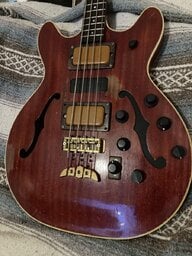
They work. The difference between my Starfire, with its right angles, and my contoured basses is immediately obvious. What's not so different is how my arm is affected by rubbing on the top of the bass, contoured or not, for hours if I am not wearing a long sleeve shirt. That area can get quite inflamed and swollen.

A smooth edge beats a sharp edge any day of the week, as it relates to the playing comfort of an instrument over any length of time.
Contouring also subtly reduces the mass of an instrument, which is almost invariably a benefit, as well as resulting in a more organic shape.
The joy of playing an instrument isn't restricted to its tone.
Contouring also subtly reduces the mass of an instrument, which is almost invariably a benefit, as well as resulting in a more organic shape.
The joy of playing an instrument isn't restricted to its tone.
I love the contours that Music Man uses on their Stingray Special 5 String basses. I think these 5 string body contours should be the standard and therefore the same for all MM Stingrays. But with that said, the four sting MM Stingray Specials have less of a contour which are ok but could be better. In my opinion, the 5 string contours are a much better fit, look good and are comfortable. However, I've been told on TB more than once that my opinion is wrong.
Last edited:

Arm contours and bevels are almost omnipresent on basses (or at least FSOs and their derivatives) since 1954; but do they actually work?
I don't think I ever played a bass in a position where my forearm rested naturally on the contour. It either rests on the side of the body, over the bevel, or it misses the area completelly. The only way to beneffit from it I found is to use a really short strap and play it more like a guitar either with a pick or fingerstyle close to the neck; which I asume was how Leo imagined people would play his basses when he redesigned the Precision in '54, but not something the vast majority of bass players does.
Am I missing something? I get it's more comfortable than the original slab body with quite sharp edges, but isn't a nice roundover on the edge actually more ergonomic for a "modern" playing position?
Try playing a Rick 4001 for 2 years 5 nights a week playing 4 sets a nigh with the bass body centered on my belt buckle. Your opinion may change.

Maybe to take off weight? Even when I play weird stuff that uses fretboard plucking into tapping and some strum stuff my forearm never touches that contour; only the back. I think it looks cool. But for me: Zero functionality.


My arm doesn't touch when standing so contours are superfluous. But even while seated it's no problem w/ bound slab basses. But it's different for everybody.

Yes, there is a certain point (Better that there be a pointed pun than there be funny-bone punishment). I saw it on the tele — what would be the point otherwise? Getting in arm's way? Not such a good idea.


I have two 1954 Fender P-Basses. 1954 was the year Fender contoured the body of the P-bass. My bass from 3-54 is a slab body, and my bass from 10-54 is contoured. I love both, but the contoured body is more comfortable, especially sitting down. Standing up much less of a difference, but noticeable. I notice mostly on my forearm. The contoured body is lighter too.
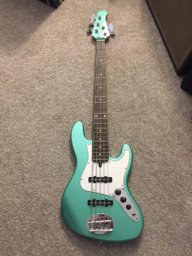

This one works!Arm contours and bevels are almost omnipresent on basses (or at least FSOs and their derivatives) since 1954; but do they actually work?
I don't think I ever played a bass in a position where my forearm rested naturally on the contour. It either rests on the side of the body, over the bevel, or it misses the area completelly. The only way to beneffit from it I found is to use a really short strap and play it more like a guitar either with a pick or fingerstyle close to the neck; which I asume was how Leo imagined people would play his basses when he redesigned the Precision in '54, but not something the vast majority of bass players does.
Am I missing something? I get it's more comfortable than the original slab body with quite sharp edges, but isn't a nice roundover on the edge actually more ergonomic for a "modern" playing position?
Attachments

Last edited:


