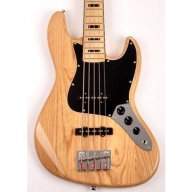
My issue with 5 strings is not the thicker neck, but rather the wider neck. Much more comfortable on a Jazz width. Narrow string spacing I'm fine with, so my fiver has as narrow a nut as I've found (but ordinary bridge spacing). Feels good enough to play it without much discomfort ... but it's never gonna feel like home the way a J does, just ergonomically. Learning curve not steep at all, for me. Seems to be a lot of variation on how people take to it.

Enjoy the benefits of a premium membership!
Upgrade Account
-
TalkBass has been independent since 1998. Add your voice.
Create a free account to reply to discussions, view embedded media, and browse with fewer display ads.
Join free Log in
Want zero display ads or expanded classifieds tools? Compare plans.
You are using an out of date browser. It may not display this or other websites correctly.
You should upgrade or use an alternative browser.
You should upgrade or use an alternative browser.
Aversion to five strings: actual dislike, or unfamiliarity?
- Thread starter MacaroniShrek
- Start date
More options
Who Replied?

A four-string electric bass and a five-string electric bass (or a six for that matter) are different instruments.
A five is usually a bit bigger obviously in the neck and fingerboard, requires a different muting technique than a four, may be much harder for guys who anchor their right hand thumb to reach across five instead of four, and really require a little more amp and cab to push the occasional low C's and D's realistically on a big stage. Anybody that tells you 'it's just a bass with an extra string' may be factually accurate in a small way, but otherwise that's BS: They're two different animals.
So it's enough different from a four-string (at first until you live with it long enough for it NOT to feel different) that it is a bit disconcerting at first. You can tell yourself all day long that it's still the same four strings, they just 'moved down' one string, but you just have to put in the time to make the mental jump.
That is, only if you want to make the mental jump.
I'd buy one IF what I see as advantages are also advantages to you (far easier transposition, playing more 'across' the fingerboard and less vertically, 'up and down' the fingerboard, and the occasional tasty low notes), and/or you feel drawn enough to get one and put in the time.
If not, find a nice four string that's an upgrade and get it. There's no implied test of musical manhood by playing 'more strings', though you'd think that reading any number of 'Should I Get a Five' posts here in TB.
The only good answer when it comes to buying anything new (or new to you) is 'Does This Help Me Make My Best Music?' What works best for you is the right answer, and if a four suits you best, there you go.
I converted to fives in the late 80's and never looked back, because it suited much better the way I wanted to see and address the fingerboard, I always felt out of place on a four-string, something was missing for me. That was the right answer for me, and I'd urge you to simply find the right answer for you, whatever that ultimately turns out to be.
A five is usually a bit bigger obviously in the neck and fingerboard, requires a different muting technique than a four, may be much harder for guys who anchor their right hand thumb to reach across five instead of four, and really require a little more amp and cab to push the occasional low C's and D's realistically on a big stage. Anybody that tells you 'it's just a bass with an extra string' may be factually accurate in a small way, but otherwise that's BS: They're two different animals.
So it's enough different from a four-string (at first until you live with it long enough for it NOT to feel different) that it is a bit disconcerting at first. You can tell yourself all day long that it's still the same four strings, they just 'moved down' one string, but you just have to put in the time to make the mental jump.
That is, only if you want to make the mental jump.
I'd buy one IF what I see as advantages are also advantages to you (far easier transposition, playing more 'across' the fingerboard and less vertically, 'up and down' the fingerboard, and the occasional tasty low notes), and/or you feel drawn enough to get one and put in the time.
If not, find a nice four string that's an upgrade and get it. There's no implied test of musical manhood by playing 'more strings', though you'd think that reading any number of 'Should I Get a Five' posts here in TB.
The only good answer when it comes to buying anything new (or new to you) is 'Does This Help Me Make My Best Music?' What works best for you is the right answer, and if a four suits you best, there you go.
I converted to fives in the late 80's and never looked back, because it suited much better the way I wanted to see and address the fingerboard, I always felt out of place on a four-string, something was missing for me. That was the right answer for me, and I'd urge you to simply find the right answer for you, whatever that ultimately turns out to be.
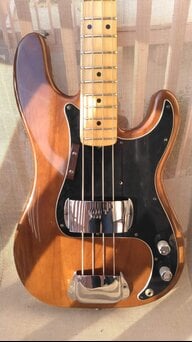

This is my story, but I stress that I'm me and nobody else is, so everyone else's mileage may vary, etc...
After learning to play on 4 string basses, I bought an Ibanez SR 5er and for about 20 years it was the only bass I owned. But when I got a Fender Jazz 4 string a few years ago, within 10 minutes of plugging it in I was playing better than I ever had on the 5. I was never bad on the Ibanez, but it wasn't until I got the Fender that I realised I was never good on the Ibanez.
Just a month or so ago, I got a cheap used Squier 5er and (after a decent setup and some new strings) I'm really enjoying it. I certainly feel much more comfortable on the Squier than on the Ibanez. Neck geometry (width, thickness, curve profile) and string spacing really do make a difference. So for me it's not so much "4 or 5" but rather making sure if I have a 5, it's the right 5.
My advice is that if you want a 5, go and try out some 5s (which you have). Try a lot of different ones. Spend as much time with them as you can. Try a Yamaha RBX375 as it's going to be very similar to the 4 you're playing now and that familiarity will help. But if you don't bond with any of them, that's OK. You don't have to get one. Nobody (even here on Talk Bass) is going to force you to get one. Plenty of great bass players have recorded plenty of brilliant tracks on 4 string basses.
After learning to play on 4 string basses, I bought an Ibanez SR 5er and for about 20 years it was the only bass I owned. But when I got a Fender Jazz 4 string a few years ago, within 10 minutes of plugging it in I was playing better than I ever had on the 5. I was never bad on the Ibanez, but it wasn't until I got the Fender that I realised I was never good on the Ibanez.
Just a month or so ago, I got a cheap used Squier 5er and (after a decent setup and some new strings) I'm really enjoying it. I certainly feel much more comfortable on the Squier than on the Ibanez. Neck geometry (width, thickness, curve profile) and string spacing really do make a difference. So for me it's not so much "4 or 5" but rather making sure if I have a 5, it's the right 5.
My advice is that if you want a 5, go and try out some 5s (which you have). Try a lot of different ones. Spend as much time with them as you can. Try a Yamaha RBX375 as it's going to be very similar to the 4 you're playing now and that familiarity will help. But if you don't bond with any of them, that's OK. You don't have to get one. Nobody (even here on Talk Bass) is going to force you to get one. Plenty of great bass players have recorded plenty of brilliant tracks on 4 string basses.

I decided to go ahead and take the plunge so, I bought a Jackson five string, a couple of years back. I wanted a FSO, but I wanted it to have 24 frets.
Well, the JS3 was the years they changed how they do the horns on those basses and my fingers couldn't reach the 24th fret as a result. Deal-breaker for me. I love my 24 fret basses and guitars.
It turns out the Spectra (Jackson) probably would have served my wants/needs, but I really wanted that Fender shape. Of course, Fender might be starting to get into fivers, but they ridiculously old-fashioned when it comes to 24 frets.
Anyway, I've been getting the itch again lately so, I ordered an SR305E, but it's on back-order. It should be in in JUN sometime.
I will share my journey with this thread and I want to give five fingers (high five) to @twofingers for his usual helpful and succinct advice!
Well, the JS3 was the years they changed how they do the horns on those basses and my fingers couldn't reach the 24th fret as a result. Deal-breaker for me. I love my 24 fret basses and guitars.
It turns out the Spectra (Jackson) probably would have served my wants/needs, but I really wanted that Fender shape. Of course, Fender might be starting to get into fivers, but they ridiculously old-fashioned when it comes to 24 frets.
Anyway, I've been getting the itch again lately so, I ordered an SR305E, but it's on back-order. It should be in in JUN sometime.
I will share my journey with this thread and I want to give five fingers (high five) to @twofingers for his usual helpful and succinct advice!
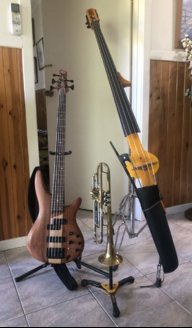
To clarify, I meant Ibanez SRs, not Stingrays as I don't think there was ever a Stingray 6.
WRT the Ibby SRs, very similar in thickness, shape and profile, just a bit wider with each extra string.
Most Ibanez SR 5ers are thin front to back - not too different from the SR series 4 strings - and are quite narrow with a 44mm nut width which is not much different to a 4 string Precision. Bridge string spacing is mostly 16.5mm or a touch over 5/8 of an inch. I love the fact that the strings are close together as it means I am faster with my plucking and picking hand, its easier to skip strings with a pick and my fretting hand doesn't have to stretch as much (especially my way-too-short-for-a-bass-player little finger). Others here will tell you they are way too cramped! There are a few SR 5ers with wider (47mm?) nuts and 18mm bridge string spacings but still thin front to back. I would hang out and try to find one to try if you can. Also the SR605e gets some pretty big raps with SR500 quality woods and build and Nordstrand Big Break (Big Split) humbucking soap-bar pickups; they light and not expensive for what you get. Good luck!
In pursuit of upgrading from my Yamaha RBX 374 I have taken multiple trips to local music stores and have tried about 50 or so basses at different price points.
I have tried multiple five strings as an upgrade option and I have not liked any of them.
I think I can largely attribute this to two things. The thicker necks and tighter string spacing.
Did anyone have the same reasons for disliking 5'ers and learn to love them? Is this something that you can get used to over time?
There have really only been two basses that have really caught my attention in terms of comfort and playability in this search. An Ibanez SR500e and a Schecter C-4 GT. Both have pencil thin necks and slim profiles. Maybe I'm just so used to the thin Yamaha neck that those feel more like home?
I feel like I can really only justify my purchase if it's offering something drastically different from the Yamaha.
I'm considering that if I get more time with a fiver, maybe that will be my new home and I can learn to love it? Any experience on this will help. Thanks.
Two reasons for me...
the big one believe it or not is the lack of symmetry. Odd numbers mess with my head and the symmetry of a 4 string bass is more appealing to me than the asymmetry of a 5 string.
Second is I just have not found a 5 string where the Low B sounded good.
Two reasons for me...
the big one believe it or not is the lack of symmetry. Odd numbers mess with my head and the symmetry of a 4 string bass is more appealing to me than the asymmetry of a 5 string.
I have a touch of CDO, as well.
I've never noticed five-string basses to have thicker necks than four-string basses. Wider as in distance across the fingerboard from lowest to highest string, sure, but not thicker front to back.I think I can largely attribute this to two things. The thicker necks and tighter string spacing.
Of course some are thicker than others, but that's true for four-string necks too.
Regarding string spacing, there are definitely five-string (and even six-string) basses around with the same spacing as traditional Fender four-strings. My preference is a slightly narrower spacing than a four, but not too narrow: Stingray 5 spacing works well for me.
Last edited:

My experience is I found 6 strings was too many strings, and sometimes 4 was too few strings, for the metal band I was in for 10 years and so I settled on 5. We played in Drop C so I needed that low string. That said, now that I'm playing mostly non metal music or standard tuned stuff similar to Megadeth, 4 strings are fine again. I currently own 6 four strings and 3 five strings- it used to be the opposite. So really, there is no wrong answer just buy a bass you like. Could be a 4 string precision, could be a 5 string Stingray, but just get something nice you'll enjoy.
It's simple.
If you figure out how to use that 5th string, and you enjoy using it, you'll figure out how to adjust to a 5er.
If you don't figure out how to integrate it into the music you play, and you don't write new music using it, either, you'll never "bond" with a 5er because you have no reason to.
If you figure out how to use that 5th string, and you enjoy using it, you'll figure out how to adjust to a 5er.
If you don't figure out how to integrate it into the music you play, and you don't write new music using it, either, you'll never "bond" with a 5er because you have no reason to.

In pursuit of upgrading from my Yamaha RBX 374 I have taken multiple trips to local music stores and have tried about 50 or so basses at different price points.
I have tried multiple five strings as an upgrade option and I have not liked any of them.
I think I can largely attribute this to two things. The thicker necks and tighter string spacing.
Did anyone have the same reasons for disliking 5'ers and learn to love them? Is this something that you can get used to over time?
There have really only been two basses that have really caught my attention in terms of comfort and playability in this search. An Ibanez SR500e and a Schecter C-4 GT. Both have pencil thin necks and slim profiles. Maybe I'm just so used to the thin Yamaha neck that those feel more like home?
I feel like I can really only justify my purchase if it's offering something drastically different from the Yamaha.
I'm considering that if I get more time with a fiver, maybe that will be my new home and I can learn to love it? Any experience on this will help. Thanks.
It's a bit frustrating when you first make the switch: muting needs work, notes in unfamiliar places as you adjust to teh fact that the first big string you see is not an E but a B... thicker necks etc. But 5 string basses come in all shapes and designs. Most have narrower string spacing than your usual 4 strings, but some do not or only marginally. String spacing threw me off the most, personally. Then found a Lakland 5502 whose neck just felt right and the spacing was familiar, so I enjoyed that bass the most. These days my 5 strings are all relatively cheap, two wide spacing and one narrow spacing and I'm happy either way.
I would recommend not just buy a 5 string bass and learn to love it... but try as many basses as you can until one feels like "yeah, I can love this one", you know what I mean? Making the switch takes some effort at first, but using a bass that feels right to you makes the effort a lot less painful.
Good luck in your journey!


The Ibanez SR series 5's are the only one I find myself consistently picking up and holding onto at a guitar store. I have smallish hands, so all the rest feel like uncomfortable baseball bats, but I still havent pulled the trigger on it. Unless you play a lot of drop tunings, I dont see the need, but its become pretty ubiquitous to see them on stage. I get the hand position advantage, but maybe Im just too old to learn a New Trick.

Being a fairly recent convert from guitar to bass, initially I was absolutely sure I could only play short-scale instruments. Trying to play a 34" neck seemed extremely difficulty and uncomfortable after 45+ years of guitar. But my son had a Yamaha bass (34") that just seemed so nice compared to other basses that I felt I had to give it a shot. I forced myself to ONLY play that instrument for a couple a weeks and I found that the adjustment was actually pretty easy once I quit switching. Now I own and regularly play short and long scales, and the scale of the bass does not even register to me any more.
GC has a generous return period. I would just go ahead and buy a 5 you think you will like (too bad Yamahas seem in short supply during these covid times), and play NOTHING but that instrument during the return period. By the end you will know if it's for you. If it's not working, take it back. Just don't try to switch back and forth and compare. Play nothing but the 5 for a couple of weeks and see what happens.
GC has a generous return period. I would just go ahead and buy a 5 you think you will like (too bad Yamahas seem in short supply during these covid times), and play NOTHING but that instrument during the return period. By the end you will know if it's for you. If it's not working, take it back. Just don't try to switch back and forth and compare. Play nothing but the 5 for a couple of weeks and see what happens.
I have a touch of CDO, as well.
its kind of nuts...5 strings trigger my OCD, stingray headstocks (3 tuners on 1 side, 1 tuner on the other do not).
Peloton rides ? My resistance HAS to be an even number.
Salt and pepper ? Salt HAS to be added before pepper...

Sounds like you're a perfect candidate for a 6 then.the big one believe it or not is the lack of symmetry. Odd numbers mess with my head and the symmetry of a 4 string bass is more appealing to me than the asymmetry of a 5 string.
LOL.I have a touch of CDO, as well.

Similar experience here, (with a different outcome tho) played 4's for 25 yrs or so… had never found a 5 that I liked, until October of 2014, I played a 1995 Modulus Quantum 5 (17.5mm bridge spacing) and I was blown away by it- the looks, feel and what a glorious tone! I ended up buying it & have only played 5's and 6's since then.. 5's aren't for everyone tho, but for me it was "time" to move forward and transition to the 5. Which, incidentally, took about one week for me to get comfortable with. Ultimately tho, play what gives you the most satisfaction and makes you happy.


