

Enjoy the benefits of a premium membership!
Upgrade Account
-
TalkBass has been independent since 1998. Add your voice.
Create a free account to reply to discussions, view embedded media, and browse with fewer display ads.
Join free Log in
Want zero display ads or expanded classifieds tools? Compare plans.
You are using an out of date browser. It may not display this or other websites correctly.
You should upgrade or use an alternative browser.
You should upgrade or use an alternative browser.
Based off of my information, should I get P Bass with a maple or rosewood fretboard?
- Thread starter Sean775
- Start date
More options
Who Replied?

The source book does say the story may be apocryphal, but more than likely Don suggested it and Leo did agree after seeing the wear:I'm pretty sure I read (in a book) that it was Don Randall, Fender's marketing guy, who pushed Leo to offer rosewood boards because other companies were doing it and he wanted to stay competitive, so Leo finally gave in. I thought the TV thing was the logos that changed in the CBS era.
The Fender Stratocaster

Seeing as how this is not a fact at all, it calls into question the whole piece.
Some manufacturers simply "seal" the maple with Tung oil or Tru-Oil or whatever. My EBMM Sterling and my Cirrus necks are oil-finished maple and they feel just like bare wood - which is to say, simply awesome.
Not sure where you got that initial quote as something I posted.
I take it that there was supposed to be a link?It's much more than a handful. Start with this - research what Roger Sadowksy says about maple fretboards.
i'm a fan of ebony ... but i like harder/darker unfinished fret boards ... i find them easier to maintain .. tone , that's why we have EQ's ..!!
once the finish on a maple neck starts to get roughed up and dirty ... well , it's harder to deal with than cleaning/oiling up the unfinished wood ..! i use ' F-one ' oil to clean and condition all my fretboards .! ( macassar ebony , regular ebony , rosewood )
once the finish on a maple neck starts to get roughed up and dirty ... well , it's harder to deal with than cleaning/oiling up the unfinished wood ..! i use ' F-one ' oil to clean and condition all my fretboards .! ( macassar ebony , regular ebony , rosewood )
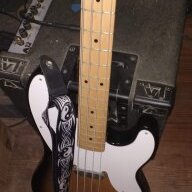
This might not be an answer that a lot of people think about, but I usually go with maple because it is considered to be "Of least concern" of endangerment. Rosewood on the other hand is "Threatened" of becoming endangered. As some others have mentioned, the finger board wood is going to have somewhere between squat and diddly to do with the sound. It can have a small impact on the feel, so go ahead and try one of each out. If you still can't feel a difference, opt for either which one you think looks better or the one you feel more ethically comfortable with.
What I would do is go to a store that has basses with both boards and try them to see which I like best. I have and have had basses with both maple and rosewood boards and enjoy playing both. The only thing I can say for sure about maple boards is IMO maple boards are easier to see in poor lighting. I have tinnitus so bad, that I can't tell the difference in tone between a maple or rosewood board.

- Jun 6, 2012
- 4,837
- 6,859
- Disclosures
- I don't wait 30 minutes after eating, to go swimming.
Here's what I suggest in all seriousness. Play a few of each and get the one that you like the best.

I bought it brand new in 2000. Maple boards were somewhat uncommon then, at least in the stores in my neck of the woods. Sometimes I wish it was maple for aesthetic reasons but the bass does everything so well that I don't dare change it.Gosh, they must be out there, but I'm not used to seeing a rosewood board on natural ash
Haha I used to have a MIJ P from the mid 80s that had all black everything including the hardware and back of the neck. I used to make the spinal tap reference all the time. It's a shame that the bass itself was kind of a dog tone and playability wise because it looked awesome.I'd swap the necks around and get a cream pickguard so I'd have a beige bass for a beige day* plus one that was none more black.
(* Song name parody)


Here's what I suggest in all seriousness. Play a few of each and get the one that you like the best.
This. Every bass has a unique voice. We can debate what contributes more to that voice, but it pays to try them out.
If you play a bunch of different P's, then you'll hear a bunch of different variations from each. Every instrument is individual.
Some of the most sage wisdom I ever got came from a player who had been playing for over 40 years at the time I was just starting out. He suggested that I play as many basses as I could (close my eyes so appearance wouldn't influence me as much) and decide which one felt best in my hands and sounded best to my ears. Many years later I came to realize how helpful his suggestion was.
I play an old rosewood P-Bass. I just did a setup on a friend's new USA P-Bass - also rosewood. His new P-Bass is much brighter than mine! Way too bright for my taste. (Same woods - radically different tone!)
And lastly, don't forget that the number of basses you need is always one greater than the number you have...
Some of the most sage wisdom I ever got came from a player who had been playing for over 40 years at the time I was just starting out. He suggested that I play as many basses as I could (close my eyes so appearance wouldn't influence me as much) and decide which one felt best in my hands and sounded best to my ears. Many years later I came to realize how helpful his suggestion was.
I play an old rosewood P-Bass. I just did a setup on a friend's new USA P-Bass - also rosewood. His new P-Bass is much brighter than mine! Way too bright for my taste. (Same woods - radically different tone!)
And lastly, don't forget that the number of basses you need is always one greater than the number you have...


I take it that there was supposed to be a link?
A link to help people research? No, I hope we are not that lazy. I linked to Roger discussing fingerboards here in my quoted post. There is plenty more for any one to look up if they are interested.
Based off of my information, should I get P Bass with a maple or rosewood fretboard?

Whatever looks better to you, they'll both sound the same,
or at least if they sound different it wont be because of the fretboard wood.
Could not be further from the truth. I have a P bass which came with a rosewood neck and I replaced the neck with a maple neck and I can definitely tell the difference.
It is brighter, and rocks out much better. And I'm using the same set of strings for both, so it's not the strings.
If you like warm, stay with rosewood.
Yep, I get high end audio equipment, I understand why people spend lots and lots of money on what is important to them, and that is the point. If you look on this thread you'll see player after player say "I can't hear a difference" and lots of your peers have spent a hell of a lot of money on their basses. It only matters if you can hear it or not, that is all that has been said on this thread. If you can't hear it, as many experienced, gifted and knowledgeable bassists on this very thread have said, then it stands to reason that the influence of the fretboard material is quite small in the grand scheme of things, small enough as to be of little to no actual importance to the majority of players who haven't developed their ears to the degree required, which one must expect would be greater still than the number of non-musicians listening to the music.
And I maintain that, were it as significant an influence as is suggested one would be able to identify it in a blind test. Ears alone should be able to pick out the sonic fingerprints of the wood used on a bass in isolation were they as prevalent and rigidly consistent as is often made out. If maple gives a bright, scooped tone with a sharp attack, then that should be clear to hear without seeing the bass, no?
This is a circular argument. I literally answered every question you posed in detail and you still come back to the blind test. So I am just going to assume you didn't read what I said or just want to discuss this over and over. You think a blind test is the answer. That tells me you think that if I get it right I am right and you are wrong or vice versa. Its not how it works, as I already explained before. If you have the gear and want to do a blind test to satisfy your argument, go for it. It will not change the fact that multiple luthiers all share similar opinions on tone wood characteristics and hear things the same way. You can simply email them and ask if you'd like. Or you could go to Taylor directly like I did and learn from Bob.
I already picked a squier out of an american in some other silly test, so if you want to do a test that everyone does over headphones and can't feel - lets do it. It will be fun.
I'd imagine you have a quality signal chain and proper gain staging? The strings are both going to be the exact same and brand new? The outputs on each instrument will be recorded at the exact same volume?
Honestly there is an easier way to do this if the answer is yes. You can simply track the basses and then see if they null.
Last edited:
Could not be further from the truth. I have a P bass which came with a rosewood neck and I replaced the neck with a maple neck and I can definitely tell the difference.
It is brighter, and rocks out much better. And I'm using the same set of strings for both, so it's not the strings.
That is apparently hearsay even though everyone says maple is brighter, we still have guys who want to do blind tests to prove this.
Whenever musicians or audiophiles argue over whether or not there is a difference between A and B, then I think if there is any difference it probably doesn't matter. This is especially the case with something like a bass guitar. Sure, maybe in very careful listening environments you might be able to discern some slight difference, but that will all go away the second you add another instrument.
I am basing my information off the fact that I used the same body but different necks, and they were both fender necks.That is apparently hearsay even though everyone says maple is brighter, we still have guys who want to do blind tests to prove this.
Whenever musicians or audiophiles argue over whether or not there is a difference between A and B, then I think if there is any difference it probably doesn't matter. This is especially the case with something like a bass guitar. Sure, maybe in very careful listening environments you might be able to discern some slight difference, but that will all go away the second you add another instrument.
If this was the case then records would all be made on $100 preamps. Again, sound is the sum of all parts. That is why the details matter to a lot of us.


