• TalkBass has been independent since 1998. Add your voice.
    Create a free account to reply to discussions, view embedded media, and browse with fewer display ads.
    Join freeLog in
    Want zero display ads or expanded classifieds tools? Compare plans.

Bass position while sitting.

While sitting, you prefer to play the bass placed

  • On your thigh

    Votes: 53 67.1%
  • In your lap

    Votes: 26 32.9%

  • Total voters
    79
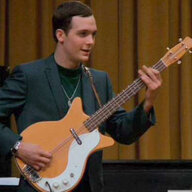
I wear the bass on my hip when standing. Never had an issue playing while seated.
Ringo Joins In.png
 
By classical position, you mean the one I use?
To be fair, your original choices are kind of confusing. Your “lap” is both legs and you also have two thighs. Maybe you could have tried classical vs rock position. Or maybe bass leg or opposite leg. Even right/left leg would have made more sense if you told us if you’re lefty or rightie. Lap & thigh are not opposites.
 
For me, I gravitated towards the "on the right thigh" position because it's easier for me to reach the first fret. I have short arms in proportion to my torso, so that gives me the most comfortable position to reach fret one (or tune the bass) without straining.

Either works...I mean, didn't Jamerson record "What's Going On?" while laying on his back? :laugh:
 
For me, I gravitated towards the "on the right thigh" position because it's easier for me to reach the first fret. I have short arms in proportion to my torso, so that gives me the most comfortable position to reach fret one (or tune the bass) without straining.

Either works...I mean, didn't Jamerson record "What's Going On?" while laying on his back? :laugh:
Yes, reaching thise low frets is the advantage of the thigh position.
 
I've always played with the bass on my right leg, but lately I've been trying the classical guitar position (no footstool though; I find it uncomfortable) to give me better reach for those low notes higher up the neck. With the bass on my left leg in the classical guitar style, my short little pinky can actually reach the 12th fret of the B and E strings. The downside is that the first position is much less comfortable to play in.

On the right leg, the low notes are much easier to reach and play for extended periods of time. But with my shiny new 5-string, I can play those F's and Bb's at the sixth fret instead of the first, so I may very well stick with playing on the left leg going forward. I've noticed a lot of the guys who play with the bass on their right leg and can still easily reach all those low notes on the higher frets have much bigger hands than I do. Maybe the classical guitar style is better suited to players like me with smaller hands.

Last benefit to having the bass on the left leg is that it feels very similar to when I play standing up with the headstock tilted up so it's level with my shoulders. Having the bass on my right leg, I find I tend to keep the bass pretty horizontal, and that's where I start having problems with poor pinky reach.
 
Traditional wisdom, is to have the bass in the same position to your body as when you're standing. For me, that doesn't work because my bass hangs lower than my lap. I rarely play sitting down, but when I do the bass is more on my right thigh than my left thigh - I suppose that's what you're calling lap in your poll. I play righty.

Bottom line is: wherever it's comfortable for you is the correct position.
 
  • Like
Reactions: totalnoob
I rarely play sitting down, but when I do the bass is more on my right thigh than my left thigh - I suppose that's what you're calling lap in your poll. I play righty.
I'm a righty, too, and no, when I'm playing sitting down the bass is on my left thigh, or more exactly between the legs with some weight shared by both thighs, like @gebass6 nicely illustrates in that photo above.

Classical guitar position, so I'm not all hunched over when playing seated.
Good point, that position gets one to have their back straight, or so it seems.
 
  • Like
Reactions: SteveCS
but the left hand has to reach so far out and up that it gets really uncomfortable after a little while.

because it's easier for me to reach the first fret.

Yes, reaching thise low frets is the advantage of the thigh position.

The downside is that the first position is much less comfortable to play in.

Without wishing to opine on right or wrong, but I'm not sure I fully buy the "too much reach" argument. On my left thigh with raised foot (or on the strap), the nut and fingerboard end are both ~14" from my shoulder joint. On the right thigh the end of the fingerboard is 19" away and, because of the almost horizonal and forward position of the bass compared to about 45° in the other stance, the nut is ~17" away. Plus access to the upper end is impeded by my torso and the fingers are forced into an extreme angle across the centreline. Just about works with frets but not a chance without. I guess the right thigh works if the bulk of the part is in 'the lower 12'.
 
Last edited:
Classical guitar position is different from bass guitar position. Your muscle memory wants to play in the classical position. I was taught to use a strap with the curve of the bass gently resting on your thigh. Having the strap too short can cause back pain, so it's better if the weight is balanced between the thigh and shoulder. Having the strap too long can result in the bass body slipping. Your right thigh should be parallel to the floor and your left leg should be slightly extended. The bass should sit at a 25 - 30 degree angle from your chest. Many bass guitar players who started on the upright bass like to have it in a more classical position. Take a look at some of the old Rolling Stones videos. Bill Wyman had a very unique way of holding the bass with the neck almost vertical and it looked really cool.
 
I do a lot of studio/live work that requires tracking for sometimes prolonged periods, rehearsing with a band, and solo practice. Unless playing live, I like to sit. I don’t always play/practice seated with a strap. When I don’t, I try to ensure the bass is in my lap (I suppose favoring the right leg), snug, as close to and parallel to my torso as possible. To mimic as much as possible standing and using a strap. When playing/practicing seated WITH a strap, my strap is set so that the bass is in the same position seated or standing. It just barely touches my lap, and rests snugly parallel to my torso. This is for ergonomics and familiarity of position. Both ergonomics and familiarity of position, to me, will ensure that the playability of the instrument, and the position/reach to the notes is always consistent.
 
Last edited: