• TalkBass has been independent since 1998. Add your voice.
    Create a free account to reply to discussions, view embedded media, and browse with fewer display ads.
    Join freeLog in
    Want zero display ads or expanded classifieds tools? Compare plans.

Basses Affect Your Playing...

I’ve always maintained that what we hear and think of as “the bass” is not just the instrument. It’s the instrument, the amp, and the player. Change any one of those three elements and you have a different “bass.”

Can’t speak for everyone, but whatever instrument I’m playing has a definite effect on what and how I play. And I completely agree with @Inara about how different basses can provide inspiration to break you out of a musical rut or nudge you off a plateau you may be stuck on. New toys make for new directions. Otherwise why bother?
 
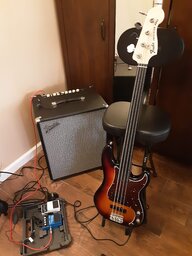
I was sitting here playing some Rick Danko lines, using this modded up Fender J, when I was reminded of my theory that the bass affects your playing. I play more or less, more aggressively, more calmly etcetera etcetera depending on which bass I use.

What do you say? Am I just justifying why I need more basses?

I can't say. But I do know that sometimes the instrument plays you. I do one thing on a Jazz, I do a different thing on a Precision. I used to claim that this was not true, until I heard myself using one and then on the other. It was a studio gig for a children's music compilation. :D
 
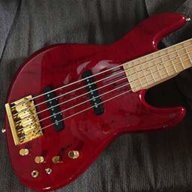
This one makes me play like a grizzly bear surfing on a shark while firing a belt fed machine gun.

6B38EE39-85E7-4AD2-8B67-236E7A5C4ADD.jpeg
 

Attachments

  • 4F88FFF2-4F36-4467-BDC9-7B994DC98B4E_1_201_a.jpeg
    4F88FFF2-4F36-4467-BDC9-7B994DC98B4E_1_201_a.jpeg
    131.2 KB · Views: 26
I was sitting here playing some Rick Danko lines, using this modded up Fender J, when I was reminded of my theory that the bass affects your playing. I play more or less, more aggressively, more calmly etcetera etcetera depending on which bass I use.

What do you say? Am I just justifying why I need more basses?
Yes, you are. You're anthropomorphizing a tool, and while it's charming and sentimental, ultimately the way each bass makes you feel you must play is in your head.

But who am I to tell somebody else how to spend their money?
 
  • Like
Reactions: mikewalker
Every bass I play puts me in a different frame of mind.

This thread reminds me of this Paul McCartney quote: "Because the Hofner's so light you play it a bit like a guitar all that sort of high trilling stuff I used to do think, was because of the Hofner. When I play heavier bass like a Fender, it sits me down a bit and I play just bass".

http://www.macca-central.com/macca-archives/bassplayer.htm
 
Agree fully.
There is no way I can wear my Thunderbird at a playable height when on stage. Must be really low. Sometimes it tells me to use a pick.
My Yammy Jazz-ish BB404 makes me want to slap the crap out of it all the time.
My eight string makes me want to dig in and riff some evil grooves
My Spector...It's pretty clinical right now. Haven't had it that long to develop a relationship with it yet..
 
  • Like
Reactions: mikewalker
I have a certain way I want my basses set up but even if they may at first feel similar, ie. string height, fretting a note, it becomes immediately clear that certain basses that are made to be thumpers (great for funk) and you can put more force and play them more aggressively if you want (ie. the Stingray, the P basses), and then there are others that are definitely far more responsive to even the most subtle touch, great for a more finesse kind of playing (my Tune bass, the Ibanez SR500, Fender Urge) .
 
It absolutely affects MY playing. Some basses sound best with a light touch. Some sound best when digging in. Some basses are "fast" and some are... not.

But more importantly, it affects my writing. There's no way I would come up with the same stuff on a Höfner and a Thunderbird (or to take it to the extreme, a Fender VI).

Of course, part of the equation is choice of strings. I wouldn't approach two 100% identical P-basses the same way if one was set up with Roto 66 steels and the other one with LaBella flats.
 
The basses I really dislike are those that make me crave anchovies on pizza. I can think of nothing more vile than fish bait on pie, yet there are basses that cause me to crave that very thing when I play them. I suspect it's divine retribution for my attempt to renegotiate the terms of my recent gift of a $2500 USD bass industry stimulus grant. Yes, I know it came from God and I should have just accepted it and given thanks, but how many basses does one really need? and what is the underlying motivation for creating a glut of basses while amp makers struggle?
 
  • Like
Reactions: luciens and bmusic
I was sitting here playing some Rick Danko lines, using this modded up Fender J, when I was reminded of my theory that the bass affects your playing. I play more or less, more aggressively, more calmly etcetera etcetera depending on which bass I use.

What do you say? Am I just justifying why I need more basses?
I tend to approach playing differently with different instruments. As someone who enjoys composing and recording, thats a fun thing. This holds true for me with guitars as well, and even some amps.
 
  • Like
Reactions: roccobass and Kro
Every bass guitar I own has its own character, yes. And they do make me come up with different lines/riffs...
But some have a wider palette of usable sounds then others.

Besides the tonal aspect there's different types too. I have a fretless 5 and a fretted 8 with octave strings. Of course they make me play differently.

Also, some basses are more responsive to your playing then others. My Warwick is very forgiving because it seems to have natural compression going on but this also means it kinda always sounds the same, I blame the Ovangkol it is made of. Anything Maple or Ash will generally respond much more to how soft or hard I play and "speak" more easily.

So I have always thought I needed a number of different basses to keep being inspired and able to play different styles.

HOWEVER since a couple of weeks I own a used market Fodera NYC Empire 5 (which is basically a Jazz with a really good preamp and one I could afford). This is the first bass that seems to be able to pull off just about anything. The mind got boggled good by it. It is articulate yet gels properly in the mix, growls really aggressively when I dig in, becomes piano like mellow with a light touch, gives me that Marcus Miller spank when I slap it. Has enough mids going on to punch through mixes well. I am completely in love with this bass so now thinking of actually selling the others (Warwick Dolphin, Zon Sonus, Zon Legacy, Ric v63) as I do not think I will be playing them much anymore. Have found a holy grail? Maybe. I am not making any hasty decisions though and will hang on to them till after that "NBD" rush has calmed down a bit.

So my answer is this:

A lot of basses affect your playing because they simply don't do the other stuff well.
BUT there are basses out there that can cover a LOT of ground in the total bass landscape and keep you coming up with new sounds and playing styles.
 
Yes, you are. You're anthropomorphizing a tool, and while it's charming and sentimental, ultimately the way each bass makes you feel you must play is in your head.

I don’t see where he’s anthropomorphizing or saying “must” anywhere in his post. His point (if I’m reading it the way he intended) is that the tool defines certain parameters that affect how he uses it. That’s not the same thing as endowing it with an artificial persona or attributing sentience to it.

Environmental and physical realities affect behavior since living organisms will attempt to change what environmental factors they can to make them more congenial to the organism. Otherwise (far more often) they adapt to those they can’t. And if even that fails they eventually learn to tolerate them.

Then there’s the matter of what makes for a “good tool.”

Good tools are: wide, deep, and indulgent. They cover the full scope (width) of the task(s) they were made to perform. They cover the range (depth) of all likely use cases. And they’re transparent an display adaptive (indulgent)behavior towards the user. They become extensions of the user’s mind and body rather than a completely separate object one needs to continually and consciously manipulate to bring about the desired result.

There’s a whole field of design engineering dedicated to addressing issues like: transparency, interface, fluidity, and ergonomics - each of which is its own field of study as well. The goal is basically to make our technology and tools disappear from out consciousness and become extensions of ourselves. A well designed tool becomes a mirror of its user, as electronics guru Don Lancaster once put it. So I don’t see what the OP was saying as indulging in romanticism or anthropomorphic fantasy. I think it’s more Darwinian than anything. We don’t turn our tools into people. We (like The Borg) assimilate them. We make them part of our collective.

21F5EC6C-E05D-40BC-96B2-EE9060B7EA88.gif


Who knows? In time we may even come to love our tools. :laugh:
 
Last edited:
  • Like
Reactions: dbsfgyd1