

Enjoy the benefits of a premium membership!
Upgrade Account
-
TalkBass has been independent since 1998. Add your voice.
Create a free account to reply to discussions, view embedded media, and browse with fewer display ads.
Join free Log in
Want zero display ads or expanded classifieds tools? Compare plans.
You are using an out of date browser. It may not display this or other websites correctly.
You should upgrade or use an alternative browser.
You should upgrade or use an alternative browser.
basses for newbies (SX batch build thread)
- Thread starter chunger
- Start date
- Status
- Not open for further replies.
More options
Who Replied?
Of the 2 colors I like the cream better.
On the scale length discussion...
30-31" = short scale
32" = medium scale
However... some Aria Pro IIs out of the Matsumoko factory were 820 mm, which I believe is 32.25".
On the scale length discussion...
30-31" = short scale
32" = medium scale
However... some Aria Pro IIs out of the Matsumoko factory were 820 mm, which I believe is 32.25".

If you're going for non-traditional features like multi-piece necks, weight-reduction chambering, and awesome hardware/electronics, why not go for less traditional finishes?
I'd really, really appreciate seeing colors that other companies don't offer Orange, yellow, green, bright blue... all colors that Fender, Squier, SX, et al don't do.
Metalflake or glitter finishes would be cool, but a burst that differs from regular 2 or 3-tone... something like Rickenbacker's Walnut or Autumnglo would be sweet.
I'd really, really appreciate seeing colors that other companies don't offer Orange, yellow, green, bright blue... all colors that Fender, Squier, SX, et al don't do.
Metalflake or glitter finishes would be cool, but a burst that differs from regular 2 or 3-tone... something like Rickenbacker's Walnut or Autumnglo would be sweet.

I'd just love to see quality basses at quality prices.
Seems with the fancy $100 bridge and the Nordy's and the neck inserts, and the hollow body work, Plekking, etc... - we're kinda getting up there in price, eh?
Seems with the fancy $100 bridge and the Nordy's and the neck inserts, and the hollow body work, Plekking, etc... - we're kinda getting up there in price, eh?
I'd just love to see quality basses at quality prices.
Seems with the fancy $100 bridge and the Nordy's and the neck inserts, and the hollow body work, Plekking, etc... - we're kinda getting up there in price, eh?
2 "lines" will be made.
Chunger Standard will be low price right off the factory. . . Korean hardware and pickups. Decent fret work from the factory (a quantum leap better than stock SX and better than most Fenders I've seen). From what I've seen in test sample, this'll be a solid instrument right way, and a great platform to mod on.
Chunger Modified will start out identical (except a different sticker on the headstock) and possibly have the more ideal weight bodies set aside for Modified. And will have all the fancy pants stuff. The Modifieds will be graded like I'm already doing, but I'll probably offset the prices between the grades more steeply so the standard grade ones become more affordable. It seems most folks who demand a professional grade or premium grade instrument are. . . well, professionals and they are IME willing to pay for the value that the differentiation brings. Right now, an SX is still an SX. . . even a premium grade one still carries the "cheap bass" stigma and you can only mark it up so much before it's ridiculous. I think in this area, my spec basses will be a little different and I'll have a bit more wiggle room. And, we'll have to see how the batch pans out. SX's have produced a large percentage of really great basses.
I have a feeling the Standard line will sell more and plan the first batch accordingly.
Chambered bodies was out of necessity. On average, unless you're able to hand-select your pieces, Alder sourced from the Pacific Northwest has become too heavy. The only options were to 1) Change tonewoods or 2) chamber the bodies. After playing basswood and other types of body core materials, I was not happy.
The laminated 1/4 sawn necks also drove the price up. . . going to graphite would have crossed the price/performance line for me at this point. . . for 5 strings, I will not build without reinforced necks. So, I'm staying with 4's and the 3 piece necks to improve stability. In the field, these SX's move more than I like and have required more frequent re-tuning on the setups than I feel is appropriate for a newbie. . . but such is the case with most production instruments of this type.

Will the modified series have graphite reinforcement bars? I'm someone who likes to do very little tweaking of the neck if any, and I'm willing to pay extra for that option.2 "lines" will be made.
Chunger Standard will be low price right off the factory. . . Korean hardware and pickups. Decent fret work from the factory (a quantum leap better than stock SX and better than most Fenders I've seen). From what I've seen in test sample, this'll be a solid instrument right way, and a great platform to mod on.
Chunger Modified will start out identical (except a different sticker on the headstock) and possibly have the more ideal weight bodies set aside for Modified. And will have all the fancy pants stuff. The Modifieds will be graded like I'm already doing, but I'll probably offset the prices between the grades more steeply so the standard grade ones become more affordable. It seems most folks who demand a professional grade or premium grade instrument are. . . well, professionals and they are IME willing to pay for the value that the differentiation brings. Right now, an SX is still an SX. . . even a premium grade one still carries the "cheap bass" stigma and you can only mark it up so much before it's ridiculous. I think in this area, my spec basses will be a little different and I'll have a bit more wiggle room. And, we'll have to see how the batch pans out. SX's have produced a large percentage of really great basses.
I have a feeling the Standard line will sell more and plan the first batch accordingly.
Chambered bodies was out of necessity. On average, unless you're able to hand-select your pieces, Alder sourced from the Pacific Northwest has become too heavy. The only options were to 1) Change tonewoods or 2) chamber the bodies. After playing basswood and other types of body core materials, I was not happy.
The laminated 1/4 sawn necks also drove the price up. . . going to graphite would have crossed the price/performance line for me at this point. . . for 5 strings, I will not build without reinforced necks. So, I'm staying with 4's and the 3 piece necks to improve stability. In the field, these SX's move more than I like and have required more frequent re-tuning on the setups than I feel is appropriate for a newbie. . . but such is the case with most production instruments of this type.
no. right now, I don't have graphite in either one. It is possible, but it would have driven prices up higher than I would like. If I move to 5 string, it'll become less of a luxury, more of a necessity. 3 piece quartersawn, however is a major jump up from single piece flatsawn.
Got to try an SX for the first time today at GC...it sounded and played like crap. It definitely needed some chungerfication. Although the biggest problem was really just the strings. Why don't guitar shops replace the strings on their basses?
2 "lines" will be made.
Chunger Standard will be low price right off the factory. . . Korean hardware and pickups. Decent fret work from the factory (a quantum leap better than stock SX and better than most Fenders I've seen). From what I've seen in test sample, this'll be a solid instrument right way, and a great platform to mod on.
Chunger Modified will start out identical (except a different sticker on the headstock) and possibly have the more ideal weight bodies set aside for Modified. And will have all the fancy pants stuff. The Modifieds will be graded like I'm already doing, but I'll probably offset the prices between the grades more steeply so the standard grade ones become more affordable. It seems most folks who demand a professional grade or premium grade instrument are. . . well, professionals and they are IME willing to pay for the value that the differentiation brings. Right now, an SX is still an SX. . . even a premium grade one still carries the "cheap bass" stigma and you can only mark it up so much before it's ridiculous. I think in this area, my spec basses will be a little different and I'll have a bit more wiggle room. And, we'll have to see how the batch pans out. SX's have produced a large percentage of really great basses.
I have a feeling the Standard line will sell more and plan the first batch accordingly.
Chambered bodies was out of necessity. On average, unless you're able to hand-select your pieces, Alder sourced from the Pacific Northwest has become too heavy. The only options were to 1) Change tonewoods or 2) chamber the bodies. After playing basswood and other types of body core materials, I was not happy.
The laminated 1/4 sawn necks also drove the price up. . . going to graphite would have crossed the price/performance line for me at this point. . . for 5 strings, I will not build without reinforced necks. So, I'm staying with 4's and the 3 piece necks to improve stability. In the field, these SX's move more than I like and have required more frequent re-tuning on the setups than I feel is appropriate for a newbie. . . but such is the case with most production instruments of this type.
Perfect!
...and with the SX neck - really the only thing that gives SX that 'cheapness' to it. Sure the pickups could be better, maybe a little better workmanship here and there - but those damn cheap-ass necks...
I have/had 4 SX basses (all old headstock) and bought 5 necks from Rondo or from here on TB - seriously, all crap.
(to be fair - Fender MIM necks are not my cup of tea either)
A reinforced neck, in some form or fashion, FTW!
Thanks Chunger - keep rockin!
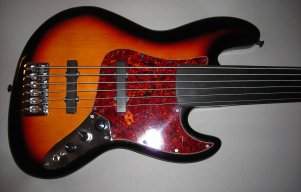
Perfect!
...and with the SX neck - really the only thing that gives SX that 'cheapness' to it. Sure the pickups could be better, maybe a little better workmanship here and there - but those damn cheap-ass necks...
I have/had 4 SX basses (all old headstock) and bought 5 necks from Rondo or from here on TB - seriously, all crap.
(to be fair - Fender MIM necks are not my cup of tea either)
A reinforced neck, in some form or fashion, FTW!
Thanks Chunger - keep rockin!
I"m sorry but I don't get this cheap-ass neck thing. OK, I know chunger likes an action down micro-inches off the top of the frets and I don't but still. I've got FIVE SX basses plus a spare neck from Rondo and I LOVE them. I love the feel (SO much better than Fender) and have had ZERO problems with stability. Note I live in Ohio...summer...winter...damp...dry. Adjustments have been few and minor. And now it seems that SX is shipping Ursa basses with leveled necks (but the frets are still flat on top and not crowned) which means that necks from the factory already have one step of "chungerizing" already done! In fact, (get this) the ONLY basses I own that were bad enough that I've had to pay to have a Plek job or luthier level-crown-polish to was my Conklin and my Ken Smith! Go figure. What can I say? Must be those cheap-ass Conklin and Ken Smith necks!
I must say, however, that I'm a HUGE fan of graphite necks (the non-adjustable solid ones) that never change and never go out, but while a graphite necked SX would be a totally cool instrument, it's obvious that would push the price for a modded $100 bass WAY over the top!

Not to start a blasting battle, but...
I should know better than to fight city hall, organized religion, or mass hysteria.
Awesome for you - sad for me, I guess.
I like the idea of a reinforced neck because I have had nothing but crap experience otherwise. My next bass will have a reinforced neck or another bass... I will not get.
I love the feel of the SX neck - the shape beats a Fender hands down in my opinion - and in many opinions. A newer American Fender neck though: far superior in every sense of the word.
Now - Chunger, back to the job of taking praise from us bass worshipers - awesome stuff you have going on, and extremely informative.
I should know better than to fight city hall, organized religion, or mass hysteria.
Awesome for you - sad for me, I guess.
I like the idea of a reinforced neck because I have had nothing but crap experience otherwise. My next bass will have a reinforced neck or another bass... I will not get.
I love the feel of the SX neck - the shape beats a Fender hands down in my opinion - and in many opinions. A newer American Fender neck though: far superior in every sense of the word.
Now - Chunger, back to the job of taking praise from us bass worshipers - awesome stuff you have going on, and extremely informative.
Not to start a blasting battle, but...
I should know better than to fight city hall, organized religion, or mass hysteria.
Awesome for you - sad for me, I guess.
I like the idea of a reinforced neck because I have had nothing but crap experience otherwise. My next bass will have a reinforced neck or another bass... I will not get.
I love the feel of the SX neck - the shape beats a Fender hands down in my opinion - and in many opinions. A newer American Fender neck though: far superior in every sense of the word.
Now - Chunger, back to the job of taking praise from us bass worshipers - awesome stuff you have going on, and extremely informative.
I wouldn't call it "mass hysteria" (whatever that is). I don't think I've seen any UFOs lately. We all do agree that graphite-re-enforced necks are better. I even said that all-graphite necks are best. But I just sort of objected to your characterization of an all-wood neck as crap. I guess you may be right that I've been lucky in that I've never had an all wood neck turn into a pretzel like some of the stories I've heard here. In fact, nearly all my necks are wood, and a good fraction of those not even laminated. And even you say you love the SX neck shape. (as do I)
So I think we are all in agreement here except that the level at which you call things crap seems to be set a bit higher than mine. Even Chunger did complain about some instability in some of his SX necks so I presume it DOES occur. But he did not say it was horrible, only that he thought it was not as adjustment-free as he'd like for beginning students. The only truly adjustment-free neck I've seen is my Modulus graphite neck. And that's hardly practical for beginner-affordable basses.
the sx neck is one of the things i like most about them. too bad about the new-ish headstock, however...
I have become a fan of the "Dixie Cup" mod. I have given ALL my SX Ursa headstocks that mod. Love it. Easy to do. Stick on some artist tape. Root around the basement for a poofcan lid or cup of the right diameter to trace the semi-circle on the end of the headstock. Remove neck (which you do to install threaded inserts anyway). Remove tuners. Take headstock to jigsaw. Cut end off nasty Ursa shape. Sand smooth. For light colored natural necks just rub on a few coats of clear gloss poly to match finish. For "nuclear orange" necks just rub on "colonial maple" stain to match color of rest of neck and THEN rub on a few coats of poly.
Done. LOVE IT! Not as cool as Chunger's headstock, but has the advantage of not needing any stripping, decals or other hassles beyond a simple saw, sand, and varnish job. Now if we can just get SX to do this "mod" BEFORE they leave the factory!
I have become a fan of the "Dixie Cup" mod. I have given ALL my SX Ursa headstocks that mod. Love it. Easy to do. Stick on some artist tape. Root around the basement for a poofcan lid or cup of the right diameter to trace the semi-circle on the end of the headstock. Remove neck (which you do to install threaded inserts anyway). Remove tuners. Take headstock to jigsaw. Cut end off nasty Ursa shape. Sand smooth. For light colored natural necks just rub on a few coats of clear gloss poly to match finish. For "nuclear orange" necks just rub on "colonial maple" stain to match color of rest of neck and THEN rub on a few coats of poly.
Done. LOVE IT! Not as cool as Chunger's headstock, but has the advantage of not needing any stripping, decals or other hassles beyond a simple saw, sand, and varnish job. Now if we can just get SX to do this "mod" BEFORE they leave the factory!
Pics?
Ya - no pics - no dixie cups!
GUYS! Go see post #713 THIS THREAD!
(Not mine but looks like mine. Pics of mine to follow once I get them all properly "Chungerized". Then I'll assemble them for a nice SX group photo!)
#7 is sold to Josh. . . he's a friend of mine who primarily plays guitar, but has been getting calls to play bass (weekly) more than guitar. The cool thing about it is, he'll have the bass paid for in 2 gigs.
I've been focusing my efforts on the amp side of things in the last few weeks. I've been able to assemble the preamp I hope to test first for my modular mini stack amp idea.

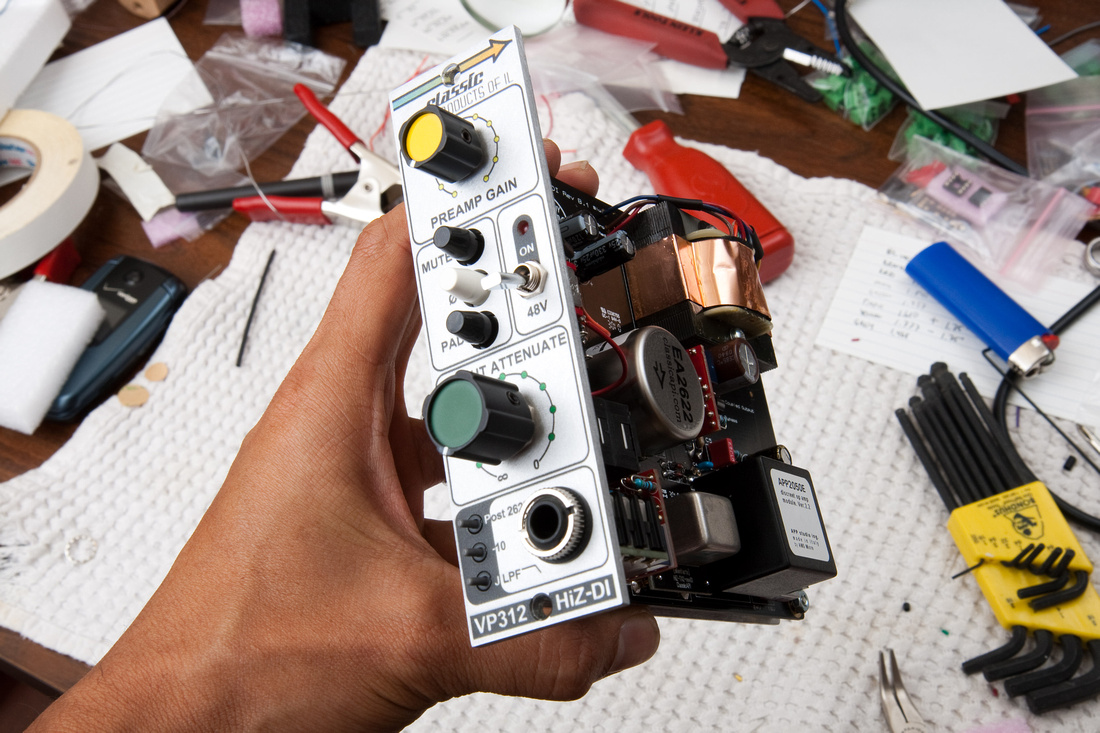
This is the VP312DI preamp kit (complete) available here: [Invalid or Expired Link Removed]
My build thread is here for preamps that I hope to test soon:
http://www.prodigy-pro.com/diy/index.php?topic=41741.0
If anyone is interested in that sort of thing.
I'm really excited about this preamp because it has a lot of build-in options for shaping the sound. There are 4 easily swappable and relatively inexpensive DI modules that are voiced differently:
1. FET active DI
2. IC active DI
3. Pikatron passive transformer DI
4. Jenson passive transformer DI
The preamp carries one of these DI modules onboard in a modular slot. There is also a front panel switch that bypasses the preamp's input transformer and directly injects the DI signal into the discrete op amp (2520 type).
Also, you're able to run this thing on 16 or 24 volt supply voltages (depending on the op amp that you use) which sound different.
The preamp is highly tweakable, inexpensive (in comparison to other top end studio preamps), and hopefully will yield a nice fat solid state tone for me as a front end to the power amp mini-module.
I've been focusing my efforts on the amp side of things in the last few weeks. I've been able to assemble the preamp I hope to test first for my modular mini stack amp idea.
This is the VP312DI preamp kit (complete) available here: [Invalid or Expired Link Removed]
My build thread is here for preamps that I hope to test soon:
http://www.prodigy-pro.com/diy/index.php?topic=41741.0
If anyone is interested in that sort of thing.
I'm really excited about this preamp because it has a lot of build-in options for shaping the sound. There are 4 easily swappable and relatively inexpensive DI modules that are voiced differently:
1. FET active DI
2. IC active DI
3. Pikatron passive transformer DI
4. Jenson passive transformer DI
The preamp carries one of these DI modules onboard in a modular slot. There is also a front panel switch that bypasses the preamp's input transformer and directly injects the DI signal into the discrete op amp (2520 type).
Also, you're able to run this thing on 16 or 24 volt supply voltages (depending on the op amp that you use) which sound different.
The preamp is highly tweakable, inexpensive (in comparison to other top end studio preamps), and hopefully will yield a nice fat solid state tone for me as a front end to the power amp mini-module.
I notice what looks like a low pass filter on there. Any chance there will be an option for a high pass filter? I find those to be quite useful#7 is sold to Josh. . . he's a friend of mine who primarily plays guitar, but has been getting calls to play bass (weekly) more than guitar. The cool thing about it is, he'll have the bass paid for in 2 gigs.
I've been focusing my efforts on the amp side of things in the last few weeks. I've been able to assemble the preamp I hope to test first for my modular mini stack amp idea.

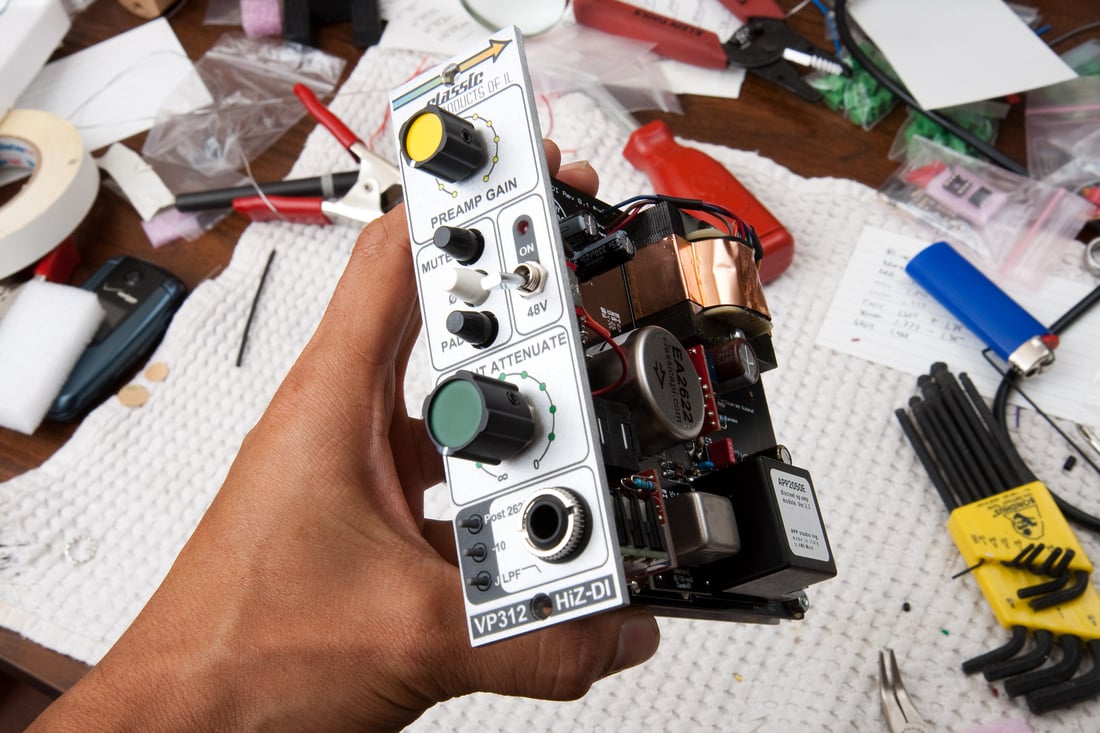
This is the VP312DI preamp kit (complete) available here: [Invalid or Expired Link Removed]
My build thread is here for preamps that I hope to test soon:
http://www.prodigy-pro.com/diy/index.php?topic=41741.0
If anyone is interested in that sort of thing.
I'm really excited about this preamp because it has a lot of build-in options for shaping the sound. There are 4 easily swappable and relatively inexpensive DI modules that are voiced differently:
1. FET active DI
2. IC active DI
3. Pikatron passive transformer DI
4. Jenson passive transformer DI
The preamp carries one of these DI modules onboard in a modular slot. There is also a front panel switch that bypasses the preamp's input transformer and directly injects the DI signal into the discrete op amp (2520 type).
Also, you're able to run this thing on 16 or 24 volt supply voltages (depending on the op amp that you use) which sound different.
The preamp is highly tweakable, inexpensive (in comparison to other top end studio preamps), and hopefully will yield a nice fat solid state tone for me as a front end to the power amp mini-module.

This part might be best located in the Amps section of the forum. I know next to nothing about amps, and the first thing I'm wondering is why you would buy kits like this at that price when you can buy a preamp off the shelf for that or less. What am I missing? Did you get a special deal?
- Status
- Not open for further replies.


