• TalkBass has been independent since 1998. Add your voice.
    Create a free account to reply to discussions, view embedded media, and browse with fewer display ads.
    Join freeLog in
    Want zero display ads or expanded classifieds tools? Compare plans.
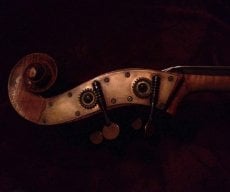
Double Bass Bent fingerboard

If it is only a millimeter and a half or so, and the fingerboard, not the neck, I would call it camber-- and it is necessary.

The neck looks very nice and straight and the fingerboard appears to be straight up until where it meets the neck joint then curves up slightly over the body. I did put a ruler on top of the fingerboard and there is a gap of several mm. When I get home (at work now) I'll take a picture and show you the gap.

If it is camber, do you then sand it down so that it is flat? or use another method?

Jason

Ps: I am always humbled and thankfull for all of your responses btw. Thank you.
 
Here are a few pics of the cello.
 

Attachments

  • uploadfromtaptalk1366127127517.jpg
    uploadfromtaptalk1366127127517.jpg
    24.9 KB · Views: 150
  • uploadfromtaptalk1366127140660.jpg
    uploadfromtaptalk1366127140660.jpg
    36.9 KB · Views: 146
That looks like a fairly appropriate camber, from the little I can see in the photos...perhaps a bit high...but you do NOT want the fingerboard flat-- a camber in the board, similar to what you have, is necessary for most players.

So this camber is a good thing? Interesting. Once I get the repair done and get strings on I'll be able to more clearly see what is going on.

I need to get me a good repair/setup book. :)

Thanks very much for your reply.
 
Yep...camber is a good thing...but just the right amount-- no more.
The cello I am currently building is nearly complete, but I still have to dress the fingerboard, as it had a bit of a reverse camber, so I have a lot of planing to do. (Planing, then rasping, then scraping laterally, and finally sanding with a hard block.) Done correctly, so that there is a gentle curve, and no humps or hollows to cause buzzes or bad notes.
 
Guitars have camber too, but it is achieved with a balance of tension between the strings and the truss rod, not carved into the fingerboard like bowed strings.

Chet, the method you describe for shooting a fingerboard is very different from what I do. Why do you use a rasp?
 
Well, because I was taught to:
1. Use the plane first, to get the general shape, camber, etc.
2. Then a Swiss Rasp, laid flat on the ebony, to get rid of any high-spots left by the plane,
3. Then a scraper, parallel to the board, but moving diagonally, to get rid of marks left by the rasp, and
4. Finally very fine sandpaper, with a smooth, hard block, progressing to 600 grit or finer (1200, 1500--your choice...).

I try for a mirror-finish, but sometimes run out of time or energy (or interest) and just decide it is good enough.

The rasp, by the way, has a slight "rocker". or taper, or something, to it, which aids in maintaining the camber.
 
Ahhh..Interesting. Does the hand scraper take off more wood at one time? Sharper? Do you have a suggested craper that I can get from Home Depot or Rona?

A scraper won't catch the grain as a plane might, and will let you feel the surface you're dealing with. It does not take a great deal off at a stroke, and you can easily control just how much it takes off. You should be able to get one at home depot. Stanley makes 'em. Just get one that is a simple rectangle of high quality steel about 3" by 5", and learn to sharpen it as necessary. It will be sharp out of the package. And... by sharp, it is merely a 90 degree edge.

Steven
 
I don't think I would go messing with a Stradivarius made in 1699! ;)

I think my favorite label read "Antonius Stradivarius Cremonensis Faciebat Anno (some date), Made in West Germany"

Seen any other good labels out there?