• TalkBass has been independent since 1998. Add your voice.
    Create a free account to reply to discussions, view embedded media, and browse with fewer display ads.
    Join freeLog in
    Want zero display ads or expanded classifieds tools? Compare plans.

Berg IP153 review

The IP153 is a cab the exact dimensions as the IP212 and IP310. Same weight.
It has 1x15", 2x6"s, and a tweeter.
It has two amps within. One 500w into 4 ohms does the highs. The other is 500w into 8 ohms and does the lows. When the EX115 is added, a 1x15 cab, that amp does 1000w into 4 ohms.
Like the IP112 the DSP has two settings one for a single cab and the other for the additional 1x15.

Without gushing I will say that it sounds outstanding. Tom called it effortlessly articulate. That's it.

I called Jim and asked how could the second cab sound good? Wouldn't that be too much low end as the 153 is so ideally balanced.

Jim said, "The EX115 is just to add
more output capabilities to the system for larger venues without
changing the overall character of the system. The second program in
the IP153 adjusts the mid-tweeter level to accommodate the added
output of the extension 115.*The DSP is programmed not
only for Eq'ing and Compression/Limiting as in the other IP models,
but it also has all the filtering for the crossover between the 15
and mid-tweets as well as time alignment. The DSP along with the second channel of amplification has really allowed me to take the IP concept to another level."

I asked Tom before I heard them was the 15 slow. He said you won't believe it. Jim said that traditionally we have associated 15s with boominess or muddiness. This is neither.
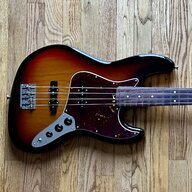
I tested the system with a Roscoe and several Fender RIs through a Kern IP777 and Demeter HPB-1.

When these were first announced Tom posted a pic of the two stacked. The IP153 now has a dome tweeter like the IP112. It is, I know, no pics, in the far upper right hand corner. The wonderful horn in the IP212 and IP310 is tuned to go down to those woofers. It was not necessary in the IP153 as the two 6"s do so much.

The lows are all there tight and controlled. The mids and highs speak all in concert. It's as fast as tens. Again effortlessly articulate. I added the EX115 and it's a true stadium rig. I can see using the IP153 in a club and taking the EX115 for those outside gigs. Knowing some of you you'd use them both all the time. I have an outside gig in June w/o PA support so I'll report back. In my studio it's ridiculous. The same sound of the IP153 that's just more. Plus the IP153 is up by your ear.

Jim is an audio chef. You can go to his "kitchen" and get what you want whether it's an NV610 or an IP112. Each is going to have his signature design and awesome quality and finish. He tops it off with supreme customer service.

Okay I gushed some. I do not work for Bergantino. I only play one on TV.
My guitarist wants to know why I keep hanging out with Burke and Tina. I said oh no! I'm hanging with Brooke and Tina!:)
 
Sounds interesting. One of the things I dislike about the larger Berg cabs is all the upper mids coming from that big horn due to the two way design and the high xmax speakers. I would guess this might be an improvement, with the paper cone mid drivers providing a more natural and less 'metalic' upper mid response.

A few of us had talked to Jim about this in the past, and it looks like he's giving a three way design a try. Cool!

I really like that NV215, and felt that cab with a tweeter would be quite amazing. It looks like this model is close to that.
 
Other than the plate amp, I've been working on a very similar design, with the same approach of "add a 15 cab and switch the padding for the mids and highs when you want more output with the same basic tone". With some of the neo 15 drivers available today a augmentable 3-way like this is a far better route to high SPL, smoother, more extended response on axis and off, and portability.

But I really don't cotton much to all this "fast" talk that's always making the rounds ; } - it still seems like balanced frequency response with its better rendition of all overtones gets confused with the ability to process transients effectively. If a cab or head/amp/preamp isn't especially capable of making a smooth balanced midrange transition from bass to treble (because of voicing by accident or design), nothing's really different in the SPEED - only the presentation of overtones that really ought to be there.

Rant aside, hats off to Bergantino for taking bass rigs farther and er, ah, faster ; }
 
Other than the plate amp, I've been working on a very similar design, with the same approach of "add a 15 cab and switch the padding for the mids and highs when you want more output with the same basic tone". With some of the neo 15 drivers available today a augmentable 3-way like this is a far better route to high SPL, smoother, moe etended response on axis and off, and portability.

But I really don't cotton much to all this "fast" talk that's always making the rounds ; } - it still seems like balanced frequency response with its better rendition of all overtones gets confused with the ability to process transients effectively. If a cab or head/amp/preamp isn't especially capable of making a smooth balanced midrange transition from bass to treble (because of voicing by accident or design), nothing's really different in the SPEED - only the presentation of overtones that really ought to be there.

Rant aside, hats off to Bergantino for taking bass rigs farther and er, ah, faster ; }

I agree with the 'fast' terminology. I am guilty of using it also, and many times it's not very helpful. I think your comment about the smooth balanced midrange transition is key, and why I find the larger Berg cabs 'slow' versus, for example, some of the EpiUL's, that are so fast it scares you! However, that's my definition of 'fast' or 'quick', and like 'transparant', it means different things to different people.

That being said, I think the larger Berg designs can be GREATLY improved with a three way design, and I hope Jim puts some moderate size passive cabs forward with both his wonderful long throw speakers, paper cone mids, and nice tweeter!
 
I agree with the 'fast' terminology. I am guilty of using it also, and many times it's not very helpful. I think your comment about the smooth balanced midrange transition is key, and why I find the larger Berg cabs 'slow' versus, for example, some of the EpiUL's, that are so fast it scares you! However, that's my definition of 'fast' or 'quick', and like 'transparant', it means different things to different people.

I recognize the shorthand as basically being used for anything with a lot of upper mids and treble emphasis, or a relative dearth of sub-100 Hz information which in turn makes what is available above that stand out. But still, a lot of people are abusing the term for say comparing SS preamp/power amps/heads which all react JUST as fast to incoming signals - really no difference at all in their ability to present transients as quickly as they come in, other than the default voicing of the things before any EQ is used... it's all in the frequency spectrum's presentation, and not in any intrinsic ability or disability in acting as fast as electrons can travel over the short distances the circuitry presents. You'd think these things had delay lines built into them the way some people talk ; }

That being said, I think the larger Berg designs can be GREATLY improved with a three way design, and I hope Jim puts some moderate size passive cabs forward with both his wonderful long throw speakers, paper cone mids, and nice tweeter!

I think just about any design can greatly be improved by using three drivers properly chosen for their bandpass abilities, and melded together with good crossover design. I don't see horns themselves as being the problem - but only the gap in frequency response or smooth transition or crossover compromises made because of only using two components often making the horns appear as convenient scapegoats.
 
Ah, Chad, is that you?! Great to hear you've gotten into what I think may be a superlative rig - certainly one that promises to do what I consider ideal!

Anyway, regarding "blooming", there's where that presentation of a more balanced frequency response rears its head again. If there are frequency gaps or scoops in regions where the overtones most prevalent during a bass's attack exist, they then are under-represented. And if there are frequency bumps/hills where the bass's overtones that become prevalent during the sustain/decay are, then that sense of blooming without initial "punch" is the result.

If the cab's curve is relatively smooth then the transitions as different overtones become predominant are therfore also smoother. Same with pre-voicing on preamps/head, natch.
 
I recognize the shorthand as basically being used for anything with a lot of upper mids and treble emphasis, or a relative dearth of sub-100 Hz information which in turn makes what is available above that stand out.

So true!

I always felt that the IP concept was better suited to a biamped 2- or 3-way design such as this, rather than the original 2-way with passive crossover designs. However, Jim already had a lot of expertise with passive crossovers and with the help of some DSP you can get round some of their limitations and produce an active cab with less cost than an active biamped one.

I'd really like to hear one of these, I'm sure it sounds awesome!

So is this 15" woofer a neo one, seeing as Eminence finally have a high Xmax design available? I'm sure the lack of high Xmax neo 10"s and 12" from the Eminence catalogue explains the current ceramic magnet drivers in the IP cabs.

After spending ages kicking around 3-way designs, I'm leaning towards a 2-way biamped design with DSP with a BIG HF horn like you see on high end PA cabs, so the crossover can be down in the midrange, and a 15" to cover the lows up to mid-midrange. And then a 15" extension cab for louder venues. And composite panels (phenolic/foamcore/ply or similar) for minimal weight and maximum strength.

Alex
 
I'm just waiting for Jim to do this with a 112 instead of the 115.....this sounds outstanding though.

Hey emjazz,

Just curious why. Better 15 drivers seem to be available to do this particular three-way-wtih augmentarion concept. There are a couple twelves that would do it well in a smaller cab size, but (1) the ones with good xmax and other characteristics that fit this concept cost quite a bit more (2) don't develop as much SPL - though with two 12" some will find it quite enough.
 
I do not want to sound self serving or bragging...but i have to make a statement about the FAST remarks... i think it is valid..
In my years or gigging and recording I have spoken with and worked with people that have far greater on hand knowledge and sound experience than myself .... and for that matter more experience than many other people that have their own opinions...
One being Roger Nichols of steely dan fame... he used the term "fast" when talking about different consoles and channel strips all the time..

Talking of how fast they sound or how they react to the input signal and the way that you hear it or feel it..
Many biggies speak of how much FASTER the ssl is over a neve... and it is used all the time.. I know what they are talking about...it is just a term.... Who here has more sound engineering experience than roger nichols?.. not me ....
He invented wendell for gods sake.. the guy is a genius.. bob rock and jimmy iovine are others that use that term... those guys are at the top of the recording food chain....
IMO..
 
Hey emjazz,

Just curious why. Better 15 drivers seem to be available to do this particular three-way-wtih augmentarion concept. There are a couple twelves that would do it well in a smaller cab size, but (1) the ones with good xmax and other characteristics that fit this concept cost quite a bit more (2) don't develop as much SPL - though with two 12" some will find it quite enough.

I know this is a very different animal that Jim has here but I've just always loved the sound of 12" drivers. Also, for me and what I do, a 3 way cab with a 115 speaker in it would be too big for most gigs. I just don't need the volume and I prefer the size of smaller cabs. I would freak out for a 3 way 112 cab in this vain. I've been asking Jim to do a 3 way 112 for years. He's been against it for years and now I see hope with this new development.
 
As for the fast remark, I get it for sure. The first thing I noticed when I played through an IP was how quickly my notes were reproduced when I played them. It was uncanny. It's what got me hooked from the get go. I'd imagine with this technology through a really good 115 speaker as well as the DSP controlling the crossovers, it would seem very fast. It's not what one would expect from a cabinet loaded with a 115....not at all.
 
Well, emjazz,

Pray that some speaker manufacturers either gets their pricing lower, or that Eminence develop a 12 that acts a lot more like the Kappalite fifteens. And anyway, in a three-way design the 12 or 15 functions mainly as a woofer and not so much as the midrange provider, so the "sound" of a 12 designed for that job really needn't or shouldn't be any different than a 15 doing that same job. It would be nice if a 12 that functioned that way in a small box became practical financially because there is no physical reason it can't do it just as well, SPL notwithstanding.
 
Just trying to attribute the shorthand of "fast" to what is actually producing those observations. Almost without exception it has to do with frequency plot and phase linearity (with maybe a dollop of group delay thrown in for some ported cabs) - and NOT the speed a speaker jumps to the job (the tired old 18/15/12/10 misconception) - and NOT how fast certain frequencies make it through the circuitry in a preamp or power amp.
 

143_4319.jpg


dang, tommyb gets all the cool toys...