• TalkBass has been independent since 1998. Add your voice.
    Create a free account to reply to discussions, view embedded media, and browse with fewer display ads.
    Join freeLog in
    Want zero display ads or expanded classifieds tools? Compare plans.

Best bridge/ material

Don't kill me if there are topics on this already, and I'm sure there are, the search function isn't working properly.


In your opinion, what is the best material to use for a bridge, and what is the best brand? And please, bring up all the ridiculously minute points involving science if you can.
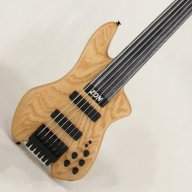
 
i like the tone block idea. Doesnt matter what material the bridge is made of, as long as its stiff enough to hold the strings, but a big chunk of metal in the bridge below the wood (a la alembic) sounds to me like a great way to get a good sustain.

Aesthetically i like wood most.
 
Interesting topic...

I've been wondering about bridges....
I always thought the vintage fender type was supposed to let more of the acoustic vibration through, whereas the heavier bridges give more sustain, and more of a pianoish ring? Is this accurate? Or b.s.?

I don't know about best, but I'm pretty happy with my Hipshot products (tuners, bridges)...


shawn
 
Don't kill me if there are topics on this already, and I'm sure there are, the search function isn't working properly.


In your opinion, what is the best material to use for a bridge, and what is the best brand? And please, bring up all the ridiculously minute points involving science if you can.


AAAARRRG!! Sorry, but I just find this mind set of "What's the best, Who's the best etc." so damn frustrating. Music is an art form, not a competition.(please excuse the rant)

I've pointed out many times that any thing you do to your instrument will make a difference in the way it sounds. Whether the difference is noticeable to your ear is a matter of degree, some ears being more acute than others. Brass will sound different than steel, steel will sound different than aluminum etc. What sounds best is a matter of taste. Take a Boogie Woogie piano tune played on a grand piano. Is that "the sound" your really looking for in that type of music? Maybe not.

My aluminum bridges sound different than anything out there not only because they're aluminum but also because the design is different than what is currently available. I plan on trying this design in wood as well as carbon fiber if possible. When, and if, that happens I'll be posting sound clips to try and demonstrate, audibly, some of these differences.

I apologize for not really answering your questions, but you can probably guess which bridge design I consider the best.

By the way, I've also noticed that the search function doesn't seem to work the way I expect it to. :confused:
 
a "best bridge material"? there is no such thing, as all answers would be subjective opinions where we may agree or disagree. you also need to consider the total bridge design and not just the material it's made from.

and then, right when you think you really know what you're talking about ... someone will change the pickups (or pot value, or fret wire material, or finish material, or strings, or ...) and everything you just pontificated as absolute truth suddenly changes


all the best,

R
 
+1 for aluminium bridges.
I have an early Lakland that has the exact same style of bridge but made from aluminium instead of steel or brass like others from the same company. It just sounds different, and to my ear changes the focus of the mids.
If you asked me to explain why, I could make up something about Aluminium being stiffer and lighter than steel or brass and therefore more resonant, but I don't really know. Someone else who's taken an acoustics/physics course more recently than I will have to weigh in on that.
I can't say that it's the best material for a bridge, just that in the lakland design it makes a noticable difference and works for me.
 
a "best bridge material"? there is no such thing, as all answers would be subjective opinions where we may agree or disagree. you also need to consider the total bridge design and not just the material it's made from.

and then, right when you think you really know what you're talking about ... someone will change the pickups (or pot value, or fret wire material, or finish material, or strings, or ...) and everything you just pontificated as absolute truth suddenly changes


all the best,

R

Much wisdom here.

Everything and every material that is part of the design will affect the basic voice of the instrument. Some materials and parts will have a greater or lesser influence depending on the other choices. It is an equation with many variables and few constants. Since the guitar itself is only one half of the total instrument each change becomes less important to the overall tone produced on stage. Bridge material is an important choice but must be made in consideration of every thing else on a particular instrument. It cannot be made in a vacuum. When a builder expresses an opinion on their favorite, the advice must be tempered with the knowledge that their choice is made because their particular design.
 
AAAARRRG!! Sorry, but I just find this mind set of "What's the best, Who's the best etc." so damn frustrating. Music is an art form, not a competition.(please excuse the rant)

Oh, I agree, but this is a little different. I'm curious as to which materials people think hold up strings better...I'm sure that there can be at least a little bit of credibility to a better/ best competition.
 
Oh, I agree, but this is a little different.
How is this any different?
I'm curious as to which materials people think hold up strings better..
:confused:
..I'm sure that there can be at least a little bit of credibility to a better/ best competition.
What makes you so sure?
Credibility is not a matter of degree. A thing is either credible or it's not.
You seem to have ignored the posts by 202dy and Rodent. You might consider reading them in an effort to find the answer you're looking for. :rollno:
 
I've used wood, aluminum, brass and steel bridges. When properly executed, they all work equally well, in my opinion, but they are not identical, either in sound or "feel".

My most recent bass (a short scale) has a wood bridge, because after getting the body done, it looked so organit, that I couldn't stand the idea of mounting a metal bridge on it. Instead, I attacked a chunk of striped ebony with a post sander, and a lovely bridge took shape. It kinda resembles an old archtop bridge, in that it is just a piece of wood that tapers on the ends, and is contoured not only for intonation, but for aesthetic.
 
How is this any different?

:confused:

What makes you so sure?
Credibility is not a matter of degree. A thing is either credible or it's not.
You seem to have ignored the posts by 202dy and Rodent. You might consider reading them in an effort to find the answer you're looking for. :rollno:
I did read them, but I still believe that there can be slight differences in bridge stability depending on the material. Ok, the design could make a huge difference as well, so we can bring that into the discussion. Of course luthiers won't agree what the best bridge material/ design is, but that is what I want to see. I am just curious as to what material (and now, design) luthiers find to be the most reliable. It's not a stupid question.
 
The bottom line is that of the available materials (aluminum, brass, steel, wood, bone, etc.) none are really *better* than another... rather, they each have different tonal properties, and you should select whichever one suits your needs tonally. Wood, in my experience, tends to provide a warmer sound with slightly less attack definition and sustain, but with a more organic tonality. Aluminum is very transparent, and seems to "color" the sound very little. My (limited) experience with brass is that it seems to mellow low end and brighten high end. Steel wears very well and seems to work just fine as a bridge, but I've never been fond of the bent sheet-metal bridge (a la Fender).
 
I replaced the saddles on my jazz bass with TUSQ saddles (from Graph Tech) they really improved the reponse of all of the frequencies very evenly... metal saddles have a transient peak around 2k that seems to amplify fret noise (to my ears). the Tusq saddles give me more punch in the mids and warm up the low-end nicely...replaced my nut with the same stuff..haven't broken a string yet with this set-up.....I'm sold on it!