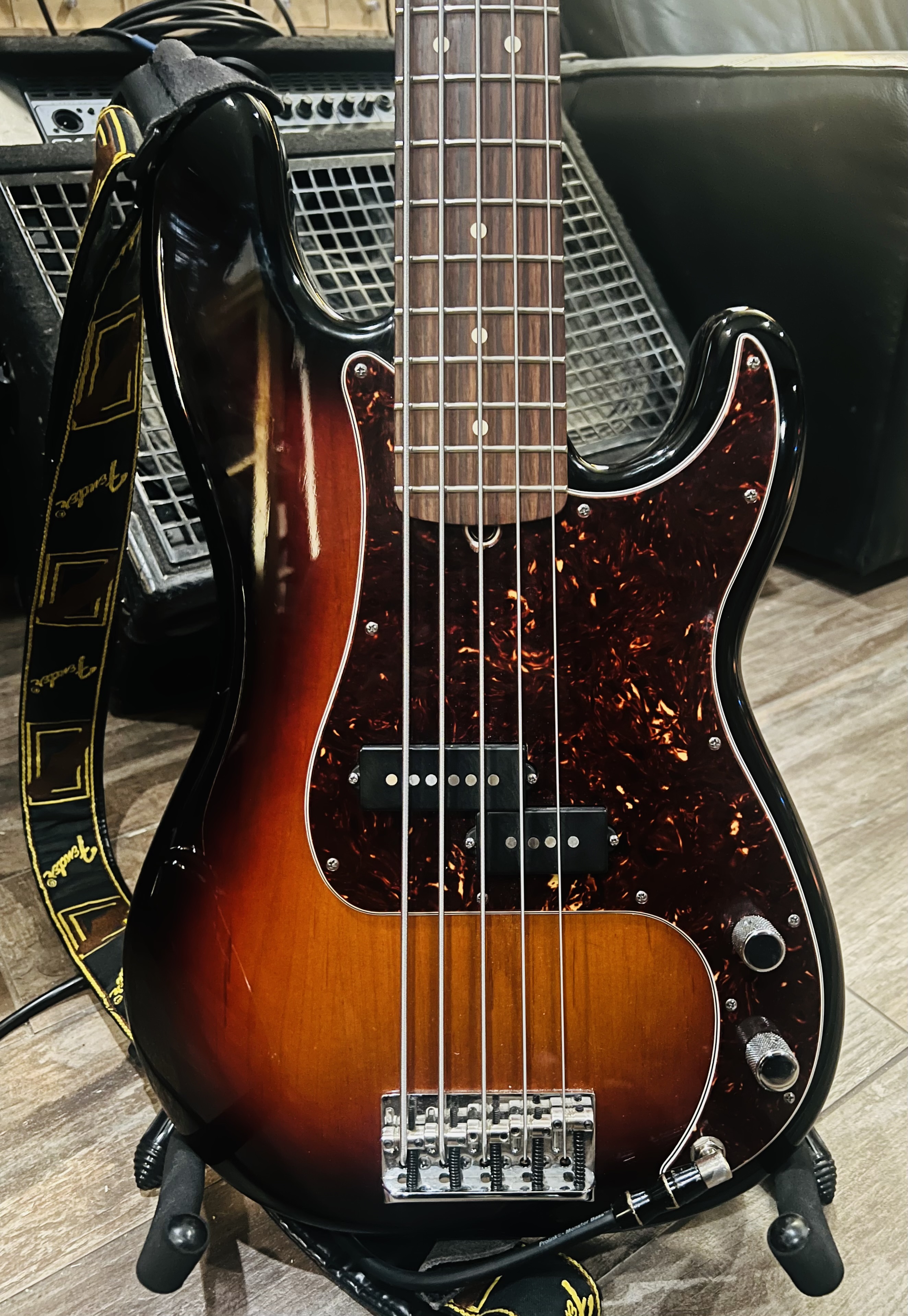
Whatever PU you choose for the J, make sure it's humbucking eg a stack PU.
i personally would consider repositioning the P PU since the bass is in for alteration anyway. The 'reverse P' orientation will still give the typical Precision sound but with a flatter low end. Leo F acknowledged that, but some don't like the look. I don't listen with my eyes. Lee Sklar's famous double reversed P, with EMGs, did 80% of his recording work so we've all heard it. You will need another pickguard, and some more routing.
I have a reverse PJ 4 string and benefit enormously from the different geometry. The neck soapbar on my 5 string is not as good.
Just as impotant (also IMHO):
The B & E strings are the most difficult to EQ, and it would make more sense to site the 2 pole PU under them, and use the 3 pole PU for the A, D & G strings which are more similar. Guitar designers need to drop tradition and use more geometry and physics.
While I'm angrily arguing against mindless tradition, let me suggest a stereo wiring (with a mono option naturally). This is NOT for spacial stereo, or biamping. It allows you to mix each PU individually using a 2 channel amp/preamp. This improves the your ability to focus on lows, mids, highs, and gives you combinations onboard at your fingertips. Needs another tone control, and a stereo/mono switch.
And then there's the coiltap option of series/paralell for the neck PU, giving you a useful bass boost for reggae, plectrum etc. A push/push vol pot does the trick.
Passive basses all seem to have rubbish shielding. I won't bore you further but extensive shielding (with your more even fundamental) will allow you to use higher gains for better presence, and cleaner recording/FOH.
Yes I'm a geek, but my sound got me work beyond my ability.
If you want excellence then the Law of Dimishing Returns doesn't apply. Think outside the box.