
• TalkBass has been independent since 1998. Add your voice.
    Create a free account to reply to discussions, view embedded media, and browse with fewer display ads.
    Join freeLog in
    Want zero display ads or expanded classifieds tools? Compare plans.

Best Studio Monitors

Ever seen anyone pictured in a studio at a console, or perhapse maybe some video footage of them? Have you ever noticed that regardless of how many other, or how large of speakers you may see pictured there's ALWAYS a 2 way black speaker cab with a white cone in it there as well? Almost without exception. Wonder what that is in nearly every recording studio in the world?

HS50 M

Sometimes it might be the 40 or the 80. But pretty much it's always the HS50 M.

World standard. Think it over.

:eyebrow: ummm...no...
what you're actually referring to is the mighty Yamaha NS-10
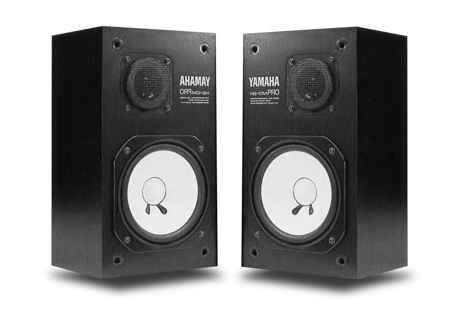
yamaha-ns-10m.jpg

used for its very revealing (and unforgiving) mid range

these are no longer sold and only available used
 
:eyebrow: ummm...no...
what you're actually referring to is the mighty Yamaha NS-10
yamaha-ns-10m.jpg

used for its very revealing (and unforgiving) mid range

these are no longer sold and only available used

Since they are no longer available and sold only new, then, no, they wouldn't be the thing I'm referring to.

Was a designer for 11 years, wrote for Photoshop User Magazine, and published a couple other times and taught a semester of for credit college class.

Now, undoubtedly some of the ones I saw are what you describe, but I can promise, I've seen MANY of the others pictured. I know design a lot better than I know music (unfortunately), and having said that I'm pretty adept with identifying visual things. :)

The Yamaha NS-10 was "unforgiving", more than our little inexpensive guys? That's scarry. Those little and comparitively cheap guys are so flat it's almost painfull, and they fogive nothing and hold grudges against every minor transgression! Silly little things are almost downright hateful... But if you can make your mix pass their muster, it's likely sound wonderful on anything.

 
Since they are no longer available and sold only new, then, no, they wouldn't be the thing I'm referring to.

Was a designer for 11 years, wrote for Photoshop User Magazine, and published a couple other times and taught a semester of for credit college class.

Now, undoubtedly some of the ones I saw are what you describe, but I can promise, I've seen MANY of the others pictured. I know design a lot better than I know music (unfortunately), and having said that I'm pretty adept with identifying visual things. :)

The Yamaha NS-10 was "unforgiving", more than our little inexpensive guys? That's scarry. Those little and comparitively cheap guys are so flat it's almost painfull, and they fogive nothing and hold grudges against every minor transgression! Silly little things are almost downright hateful... But if you can make your mix pass their muster, it's likely sound wonderful on anything.


Well like it or not Yamahe NS-10s were for the longest time the defacto standard hard to mix for monitor, and as such have definitely appeared in the background in more studio shots than any other monitor that I am aware of. I know other people copied the white on black thing, but believe you me when you've spent ten years staring at a pair of them in several differnt studios, you can recognise them in a piccy instantly :)

Having said that I agree about the used Dynaudios myself, largely cos the NS10s arent much good down deep IME, Dynaudios definitely go lower more successfully. If I'm mixing vocal orientated stuff I like my Rogers though, and as a final listen to speaker my pair of TDL Studio 0.75m may be 'hifi' speakers, but they are as accurate as any monitors I've ever heard in a studio. Occasionally they turn up (the Studio 1.0 are even more impressive) on the bay, I would recommend them in an instant as a midfield/room monitor/mix checking speaker. The bass response is ungodly, not loud, just very very deep an yet super natural.
 
I used a pair of old school powered Mackie HR824s (not the current production HR824mk2, I don't care for those) a ton when I was DJ'ing at a college radio station, I love those, I bet you could find a pair used. and the two sets I used recently when my band was in the studio were the Yamaha NS-10s and some really nice Dynaudio monitors with 8 inch woofers. Dynaudio makes some damn fine monitors.
 
I have a pair of Yamaha HS50M's and can vouch that they sound absolutely fantastic. I don't let a mix leave my studio without hearing it on them first and making final adjustments. They also have a surprising amount of bass output from such small woofers. To me they are the most revealing and transparent sounding with vocals. You can spot an issue with a vocal in a mix in an instant with these.

That being said, I also own the cheaper Behringer Truth B2031A monitors that sound closer to my Mackie HR824's and cost only about $350 for the pair. And worth every cheap penny.

If I were buying studio monitors all over again and was on a $600 budget, I would honestly never purchase my Mackie HR824s and accompanying Mackie HRS120 subwoofer, nor would I purchase my Yamaha HS50M pair. For a strict $600, I would buy the Behringer B2031A's for $350 for the pair, and then add the Behringer B2092A subwoofer (which I also own) for $200. Price wise, I think this combo can't be beat. I bought all mentioned monitors by the way from Full Compass, I've got a sales guy there that really works on the price whenever I order anything.

But then again, I wasn't constrained to such a budget and I've found the best way to mix is to listen to your mix on as many monitors as possible (I listen on all three pairs of my monitors with a Mackie Big Knob) and then I burn on a CD and listen on as many home speakers (I have two pairs of Cerwin Vega home speaker stacks and a Realistic/Radio Shack stack) as possible. Then I listen in the car or multiple cars. The key seems to be for me to make a mental note of any overall adjustment; ie. the vocal sounds too loud on _all_ my listening stations, so therefore I adjust the vocal a bit. And so on and so forth.

A good pair of cheap monitors is a start though and the Behringer's would be a good choice in both my opinion and my experience.
 
Since they are no longer available and sold only new, then, no, they wouldn't be the thing I'm referring to.

Was a designer for 11 years, wrote for Photoshop User Magazine, and published a couple other times and taught a semester of for credit college class.

Now, undoubtedly some of the ones I saw are what you describe, but I can promise, I've seen MANY of the others pictured. I know design a lot better than I know music (unfortunately), and having said that I'm pretty adept with identifying visual things. :)

Actually, you likely did see the Yamaha NS10's in all those ads and pictures.

Yamaha's HS series of monitors have only been available since October 2005. I bought mine in 2006:

http://news.harmony-central.com/Newp/2005/HS50M-HS80M-HS10W.html

September 2, 2005
The HS Series is a two-way, internally powered speaker system designed to provide reference monitoring for all types of recording and multimedia applications--home studios, computer-based music production, gaming systems, keyboards rigs and personal computer systems. Three cabinet models, the HS50M (MSRP $249.95), HS80M (MSRP $449.95) and HS10W (MSRP $599) subwoofer will be available in October 2005. All products are sold and packaged individually, making it easy to build flexible monitor setups and 5.1 systems.

The 70-watt HS50M (5-in. cone and 3/4-in. dome tweeter) and 120-watt HS80M (8-in. cone and 1-in. dome tweeter) are housed in bass reflex-type cabinets, and reproduce surprisingly tight low end and smooth, high frequency response to beyond 20 kHz. Inputs include a balanced XLR and 1/4-in. phone jack. In addition to master level controls, each speaker has trim switches that allow you to custom-tailor low, mid and high frequency response for different applications.

 
The NS-10 is as much a studio staple as the Shure SM-57 and rigid fiberglass sound panels. I think you'd be hard pressed to find someone with professional studio experience who hadn't used a pair in some capacity.

Back on topic: I vote for saving up a few hundred bucks and spending the extra money on good monitors. It has been said, in many places and by many people who have experience putting food on the table with studio work, that a good monitor setup in a well treated room is worth a whole lot more than the equivalent investment in mics, preamps, etc. Not to say that the latest Neve clone isn't going to be a great addition, but it is important to have an accurate idea of what you're doing.

I bought a pair of Adam A7s unheard a few months back from Mercenary, who have a generous return policy and sent a box of Girl Scout cookies with my order. I dig them quite a bit.

You are lucky in that there are a lot of great options out there both in your ideal price range and in the $1000 range. Make sure you do the research on sound treating for your mixing room just like you're doing with monitors.
 
I use Yammy HS80Ms as my monitors proper, but with a home studio, there is something you have to remember: you're never going to find good, flat monitors on the cheap. You buy a pair that has good reviews for clarity, and then you get used to the idiosyncrasies in the sound. The Yammies have this funky little bump around 450Hz and a presence boost around 2.5kHz (just over the crossover point, I think?). You get used to those and realize that your mix is always going to sound hot in those regions, and cold in others.

After that, though, you have to take your mix to a bunch of other listening environments. On iPod headphones in a noisy train, on a car stereo, through your home theatre system. Then you'll really notice the problems with the mix, and will be much more able to fix them.

And trust me when I say, you will want to kill yourself after spending hours on an awesome mix on your monitors, then taking it out to your car and hearing nothing but a boomy 60Hz trainwreck. Don't just use your monitors for playing back your mixes - listen to music on them! Get to know them, you're going to be spending a lot of time with them.