• TalkBass has been independent since 1998. Add your voice.
    Create a free account to reply to discussions, view embedded media, and browse with fewer display ads.
    Join freeLog in
    Want zero display ads or expanded classifieds tools? Compare plans.

Breaking in La Bella?

It also depends on how you define 'broken in'
I've played a set of DTFs on my main bass and I recon that there was no further change of the timbre
when I've had them on for about 9 months. I did not play overly much in that period (maybe 10 gigs plus weekly rehearsals, but due to a busy schedule something like 5-10 minutes of daily practice at home), but my hands get sweaty and I tend to go through regular roundwounds quite fast.
 
Hi there.

I have decided to start my journey in the flatwounds world buying a set of La Bella's (Low Tension LTF-5A).


Any ideas if they need breaking in and what long could it take? I reckon it will depend on how long you play and your playing style?

Thanks,

Ribalta

I have a set installed on my Wilkins 5 string P since 4 Years now. 1 year to break in (for me at least) and love the Tone.
 
  • Like
Reactions: FunkHead
So I thought that during a period of time the timbre and tone would change until the strings settle and keep the same tone for a long time?
It also depends on how you define 'broken in'
I've played a set of DTFs on my main bass and I recon that there was no further change of the timbre
when I've had them on for about 9 months. I did not play overly much in that period (maybe 10 gigs plus weekly rehearsals, but due to a busy schedule something like 5-10 minutes of daily practice at home), but my hands get sweaty and I tend to go through regular roundwounds quite fast.
 
So I thought that during a period of time the timbre and tone would change until the strings settle and keep the same tone for a long time?

Well, yes. They loose their fresh zing sound after about two weeks and some consider them done by then and they play them until they are dead, about a year later.
Others will claim that they are properly matured by this point and will keep them forever.
Steve Harris will tell you that only fresh flats are good flats.
 
So I thought that during a period of time the timbre and tone would change until the strings settle and keep the same tone for a long time?
As @el murdoque mentioned, it's about 2 weeks in my case.

When I was playing and using them (until I quit because of virus safety concerns), that would be two 4 hours gigs a weekend and maybe 2 to 5 hours of noodling between weekend gigs. So, during a two week period, maybe 20 to 25 hours.

But really, I only noticed the newness at home. Once the band kicked in, even after new ones were installed within days of the gig, it drowned out any newness factor. Considering a break-in period was never an issue with me.

And they'd last close to a year before I'd change. Only used the La Bella LTF-5A's. Short period of D'Addario Chromes, but changed 'em back to La Bella after a few months.

If your bass is 34inch scale, like mine, you'll probably get in-tune, distinct notes beyond the octave B with the .118 B string when properly intonated. Opened up a whole new playing area on my bass when I got away from .125's and larger for B strings. The roundwound set I use has a .115 B string.

No loss of bass goodness and increased in-tune range up the neck in those thinner B's.

The LTF-5A's are a good starting point for you, in my opinion. Hope you enjoy.
 
  • Like
Reactions: ribalta
Traditionally, a better set to start the foray into flats has been the regular La Bella flats in the "light" gauge, 760-FL, 43-104 on the G-E strings, I forget the gauge of the B string. These have enough tension that they are stable, break in relatively quickly, have the signature tone, but are not so thick that they go thumpy too soon.
 
Traditionally, a better set to start the foray into flats has been the regular La Bella flats in the "light" gauge, 760-FL, 43-104 on the G-E strings, I forget the gauge of the B string.
Those are the 760FL-B Deep Talkin' Flats light, probably an excellent choice. I thought the OP had ordered the LTF's already, but I may be wrong about that. But that's why I addressed those specifically.

The 760FL-B's would sure be worth a try.

[Invalid or Expired Link Removed]

I looked at the 760FL-B's long ago, but avoided them for two reasons (which may not apply to the OP).

My bass doesn't like tapered B's. Tried two types in the past, just won't work for me, which from my understanding, happens on some basses. Mine being one, it seems LOL.

Plus the .128 gauge B was a size I was avoiding. Anything at .125 or over on my 34inch bass gets funky unusable above about the 7th or 8th fret, no matter how well intonated I could get the B string. .118 or less gets me in-tune notes past the octave. I learned about thinner B's working great on 34inchers in this forum. Worked much better than I'd hoped.
 
Thanks for your answers guys.

Yes I already bought he LTF's, they should arrive in a couple of days.

I think I like the idea of that "dead" sound, that was my intention when buying the flats in any case. I will have to see if the sound is in line with my expectations once I get that far :rolleyes:

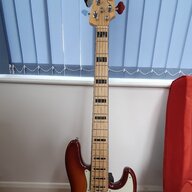
What adjustments or set-up do you guys think I need to do after putting the new strings on? My bass is a Fender JB Elite and I have some old roundwounds on at the minute.

Cheers!
 
  • Like
Reactions: fig
What adjustments or set-up do you guys think I need to do after putting the new strings on? My bass is a Fender JB Elite and I have some old roundwounds on at the minute.

La Bella Low Tension Flats are in fact lower in tension (as in pulling weight) than most light-gauge rounds, so keep your eyes on the amount of the neck relief. You may or may not have to loosen the truss rod a bit. And of course, going from rounds to flats, some intonation adjustments may also be necessary. But those are pretty basic stuff.
 
  • Like
Reactions: ribalta and fig
Thanks Michael, will do!
La Bella Low Tension Flats are in fact lower in tension (as in pulling weight) than most light-gauge rounds, so keep your eyes on the amount of the neck relief. You may or may not have to loosen the truss rod a bit. And of course, going from rounds to flats, some intonation adjustments may also be necessary. But those are pretty basic stuff.