Hi, I'm new to the forum and currently studying as an Industrial Design engineer. I would like to design and build my own electric upright bass. What kind of dimensions are standard? What else would you recommend?

Enjoy the benefits of a premium membership!
Upgrade Account
-
TalkBass has been independent since 1998. Add your voice.
Create a free account to reply to discussions, view embedded media, and browse with fewer display ads.
Join free Log in
Want zero display ads or expanded classifieds tools? Compare plans.
You are using an out of date browser. It may not display this or other websites correctly.
You should upgrade or use an alternative browser.
You should upgrade or use an alternative browser.
Building my own electric upright bass
- Thread starter NopeMan007
- Start date
More options
Who Replied?
Here's an older topic I posted on designing and constructing an EUB:
https://www.talkbass.com/threads/my-ultimate-eub-imho.887703/
https://www.talkbass.com/threads/my-ultimate-eub-imho.887703/

Hi, I'm new to the forum and currently studying as an Industrial Design engineer. I would like to design and build my own electric upright bass. What kind of dimensions are standard? What else would you recommend?
Welcome NopeMan!
Definitely look through Rudy's thread on his EUB project. Lots of good design details in there.
Overall, there isn't really any Standard for Electric Upright Basses. They are all over in design and dimensions. But there are two general directions of design:
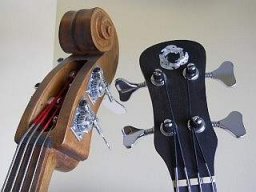
The Old Style are based on the Ampeg Baby Bass ('59-'70). That general design was later followed by Azola, Ramirez, K & K, and a few others, including variants which have skinnier bodies. The Baby Bass visually looks like a slightly smaller upright bass. Most of them are 40" scale length (vs 42" on a 3/4 upright), 4-string, with an upright-style rounded fingerboard. The headstock is scroll style, a smaller version of an upright, the bridge is a simple vertical blade, and the strings extend back to a tailpiece at the bottom. The body is mostly there for decoration, with no real function in the sound of the bass. On the Ampegs, the body was made from molded plastic filled with foam. On others, they are fiberglas or wood, but they are not functioning as acoustic chambers.
A unique feature of the Baby Bass is the pickup. It's a mechanical-percussive style pickup, located under the feet of the bridge. It detects the movement of the bridge, not the strings themselves. It gives the Baby Bass a distinctive sound, a complex attack curve with Pop, Warble, Decay and Bloom. Similar to the sound of an upright bass recorded through a microphone.
Baby Basses were designed specifically to appeal to bassists who normally play upright bass. It was smaller, easier to transport, and able to be plugged into an amplifier. But it was made to feel like, and be played like, an upright bass. These days, Baby Bass-style EUBs are still popular in Salsa music and some in Bluegrass. They've faded out in Rock, Jazz, Pop, Country.
Modern Style EUB's are different. They are generally built like an electric bass, turned vertical. Usually around 34" scale length, flatter fingerboards, standard magnetic pickups, simple slab construction, minimal body, low action. They are designed to appeal to electric bass players, and be played in electric bass style.
Those are the two general approaches to the design of an EUB. Are you trying to design an upright bass that can be played through an amp? Or an electric bass that can be played vertically? Your choice.

A couple more builds you might find interesting:
https://www.talkbass.com/threads/homebuilt-eub-build-thread.1498608/
https://www.talkbass.com/threads/winter-build-off-2022-bamboo-eub.1543730/
https://www.talkbass.com/threads/homebuilt-eub-build-thread.1498608/
https://www.talkbass.com/threads/winter-build-off-2022-bamboo-eub.1543730/

The reason you've not gotten many answers to your question is that -- and I'm conscious that you may not be aware of this -- it's essentially tantamount to the old saw of 'how long is a piece of string?'.
The real question is "Why do you want an electric upright bass?" or, put differently, "What do you want it for?".
The answer to that question is going to dictate which part of the answer space your numbers come from.
Some people (usually double bass players) want EUBs to essentially be convenient touring and practicing instruments that are as close an analog as possible to their usual double bass. Those types of EUBs can be difficult to make, as they partly require synthesizing the heft and ergonomics of a double bass and usually involve building wings and appendages, sometimes with additional weights, to make it feel and have the inertia of the 'real' thing.
If that's what you're after, you're better off looking at double bass resources, as the dimensions, angles and feel you're trying to emulate come from there. Roger Hargrave's Making a Double Bass is a useful starting point (PDF here). It's the blog of someone trying to create a copy of a 3/4 size Amati. Atelier Puglisi had a good video series on building a copy of a Meyer; it's pretty light on details, but will tell you what you're trying to emulate. There are many books available too.
Bear in mind that, even in that realm, there are few set numbers. Numbers are available if you look around, but they vary between makers and even instruments. Bear in mind also that double basses come in different sizes as well (1/2, 3/4, 4/4 etc.). 3/4 is the most common for Jazz and live playing; they typically use a 41" scale length, which often means they use actual steel double bass strings, which often means the chassis has to be stronger to accommodate the tension. There's some general sizing information here.
Other EUBs take completely the opposite approach. They throw historical parallelism out of the window and do their own thing. People who play them may hate me for saying this, but a great many (not all) of those are essentially fretless bass guitars mounted vertically. Doesn't mean they're not fun. They often have 34-36" scale lengths and frequently use bass guitar hardware and strings, but they sometimes reorient the fingerboard to be more tilted and emulate a double.
One of the chief differences between bass guitars and uprights is the fingerboard. Bass guitar fingerboards are usually cylindrical sections (or very slight conic sections) that have a radius between 10" and infinite (flat). Double basses have fairly extreme conic section fingerboards that can go as low as a 1.75" radius at the nut. Oftentimes a modern EUB is a vertical fretless bass with something more like a classical fingerboard.
The place to start might be to decide what scale length you're using and why -- and that will dictate what strings are available to use with it and how the structure needs to accommodate them. The next thing to bear in mind is probably pickups -- exactly how are you going to electrify it, and where on the scale length? The strings, their layout, their tension and orientation will then dictate the available sizing and structure. Do you want it to resonate acoustically or not? That'll dictate whether you need a resonance chamber etc.
There are no set answers. The question determines the answers.
The real question is "Why do you want an electric upright bass?" or, put differently, "What do you want it for?".
The answer to that question is going to dictate which part of the answer space your numbers come from.
Some people (usually double bass players) want EUBs to essentially be convenient touring and practicing instruments that are as close an analog as possible to their usual double bass. Those types of EUBs can be difficult to make, as they partly require synthesizing the heft and ergonomics of a double bass and usually involve building wings and appendages, sometimes with additional weights, to make it feel and have the inertia of the 'real' thing.
If that's what you're after, you're better off looking at double bass resources, as the dimensions, angles and feel you're trying to emulate come from there. Roger Hargrave's Making a Double Bass is a useful starting point (PDF here). It's the blog of someone trying to create a copy of a 3/4 size Amati. Atelier Puglisi had a good video series on building a copy of a Meyer; it's pretty light on details, but will tell you what you're trying to emulate. There are many books available too.
Bear in mind that, even in that realm, there are few set numbers. Numbers are available if you look around, but they vary between makers and even instruments. Bear in mind also that double basses come in different sizes as well (1/2, 3/4, 4/4 etc.). 3/4 is the most common for Jazz and live playing; they typically use a 41" scale length, which often means they use actual steel double bass strings, which often means the chassis has to be stronger to accommodate the tension. There's some general sizing information here.
Other EUBs take completely the opposite approach. They throw historical parallelism out of the window and do their own thing. People who play them may hate me for saying this, but a great many (not all) of those are essentially fretless bass guitars mounted vertically. Doesn't mean they're not fun. They often have 34-36" scale lengths and frequently use bass guitar hardware and strings, but they sometimes reorient the fingerboard to be more tilted and emulate a double.
One of the chief differences between bass guitars and uprights is the fingerboard. Bass guitar fingerboards are usually cylindrical sections (or very slight conic sections) that have a radius between 10" and infinite (flat). Double basses have fairly extreme conic section fingerboards that can go as low as a 1.75" radius at the nut. Oftentimes a modern EUB is a vertical fretless bass with something more like a classical fingerboard.
The place to start might be to decide what scale length you're using and why -- and that will dictate what strings are available to use with it and how the structure needs to accommodate them. The next thing to bear in mind is probably pickups -- exactly how are you going to electrify it, and where on the scale length? The strings, their layout, their tension and orientation will then dictate the available sizing and structure. Do you want it to resonate acoustically or not? That'll dictate whether you need a resonance chamber etc.
There are no set answers. The question determines the answers.
Last edited:
One of the chief differences between bass guitars and uprights is the fingerboard. Bass guitar fingerboards are usually cylindrical sections (or very slight conic sections) that have a radius between 10" and infinite (flat). Double basses have fairly extreme conic section fingerboards that can go as low as a 1.75" radius at the nut. Oftentimes a modern EUB is a vertical fretless bass with something more like a classical fingerboard.
The main reason for this is whether you will be playing with a bow. A double bass fingerboard allows for bowing; an electric bass guitar-style fingerboard doesn't. It's the single most important design issue, IMO.
This will be my first instument I'll build and learn to play on it.
The genre of music would be classical and modern, but mostly modern. It feels like quite a big engineering challenge to keep myself busy for a year or two. Based on the different design approaches, as you've mentioned, the other type where the instrument design doesn't follow the classical shape and function of the body would be the perfect one for me.
The main reasons are: it's less louder, easier to transport, and easier to design. Also, I might want to play songs that were originally written for bass guitars. Considering all the information above, I might go for 3/4 or 4/4, and I definitely don't want the body to resonate.
In the meantime, I've also found a subject and its published lectures about the physics of instruments. As I slowly progress with my design, I'll be more than happy to share my documentation and blueprints here.
Edit: I definetly want to play with a bow
The genre of music would be classical and modern, but mostly modern. It feels like quite a big engineering challenge to keep myself busy for a year or two. Based on the different design approaches, as you've mentioned, the other type where the instrument design doesn't follow the classical shape and function of the body would be the perfect one for me.
The main reasons are: it's less louder, easier to transport, and easier to design. Also, I might want to play songs that were originally written for bass guitars. Considering all the information above, I might go for 3/4 or 4/4, and I definitely don't want the body to resonate.
In the meantime, I've also found a subject and its published lectures about the physics of instruments. As I slowly progress with my design, I'll be more than happy to share my documentation and blueprints here.
Edit: I definetly want to play with a bow
This will be my first instument I'll build and learn to play on it.
The genre of music would be classical and modern, but mostly modern. It feels like quite a big engineering challenge to keep myself busy for a year or two. Based on the different design approaches, as you've mentioned, the other type where the instrument design doesn't follow the classical shape and function of the body would be the perfect one for me.
The main reasons are: it's less louder, easier to transport, and easier to design. Also, I might want to play songs that were originally written for bass guitars. Considering all the information above, I might go for 3/4 or 4/4, and I definitely don't want the body to resonate.
In the meantime, I've also found a subject and its published lectures about the physics of instruments. As I slowly progress with my design, I'll be more than happy to share my documentation and blueprints here.
Edit: I definetly want to play with a bow
I suggest starting your design process by looking closely at an Azola BugBass:
Link Removed
This is modernized variant of the Baby Bass idea. It's 40" scale length (I think?), fairly simple headstock, rounded fingerboard, simple minimal solid body, no acoustics, adjustable peg. The bridge is a maple blade, like an upright bass, with a compression piezo pickup (an Underwood, I believe) in the bass side leg. Simple passive electronics.
This is a basic form of a full-size EUB. Made to be played like an upright, plucking or with a bow. Functional, easy to transport, no frills, not too difficult or expensive to build.
I'd start with this for your design project, and think about how you'd like to improve it. Make it better. But avoid the temptation of piling every cool feature you've ever seen into it. Universal All-Purpose, Do-Everything basses usually don't work very well. Keep it simple and focused on the specific job you are designing it for.
Last edited:

You might want to find a bass shop (or a violin shop that sells electric instruments) and try a few out. Musical instruments are like clothes in that they can't just look good, they have to fit you personally. When something clicks for you, rent it for a couple weeks or a month to see if it still feels good in the longer term. Basses are expensive, even home-made ones (equipment, parts, and your time -- the strings alone will easily cost over $100), and you don't want to commit yourself to a long-term project that you realize before you're finished isn't going to work for you. The world is full of custom instruments that have been abandoned unloved because they were designed without understanding what the player actually needed.This will be my first instument I'll build and learn to play on it.
As far as designs go, Ned Steinberger's are some of the ultimate in functional minimalism, but when you study the working bits they are also good examples of the range of conventions in EUB design. He has both upright basses that are 41.75" scale (roughly 3/4 scale, in classical terms) and have traditional upright bass fingerboards -- and the Omni Bass which are 34" scale (same as a Fender bass guitar) and are designed to be playable both upright and on a strap. Omni basses have an unusual conic section fingerboard: 9.25" radius at the nut, 2" radius at the bridge -- which allows fingering like on a bass guitar while still being playable with a bow.
You should also read this FAQ about upright bass scale on the Gollihur website. It has some good reasons for how basses ended up the way they did, why you can consider 3/4 scale to be effectively full-scale, and why you don't necessarily want to go any larger.

Also, this website has a section on the electric upright:
https://www.talkbass.com/forums/electric-upright-basses-eubs-db.101/
https://www.talkbass.com/forums/electric-upright-basses-eubs-db.101/

@Max Bogosity has already linked my EUB build, so I won't duplicate it. However the first several pages of the thread are some great discussions about the why's, how's, and what's of EUB design. Your choices will lead you down a different path than my designs, but the theoretical discussions may be helpful.
One thing that I didn't really appreciate prior to building mine is the back of the neck is shaped very different than a normal bass. More Gothic arch, than barrel arch. At some point I will wind up doing some major reshaping of the neck.
Think about what you plan to play, and how you want to do that.
I will also tell you that a used EUB will be much easier and less expensive than I wound up spending on my build (despite efforts to curb costs).
That said, playing your own instrument is a joy in its own right! And every time I pull it out to play someone asks "what is that? It's so cool!"
One thing that I didn't really appreciate prior to building mine is the back of the neck is shaped very different than a normal bass. More Gothic arch, than barrel arch. At some point I will wind up doing some major reshaping of the neck.
Think about what you plan to play, and how you want to do that.
I will also tell you that a used EUB will be much easier and less expensive than I wound up spending on my build (despite efforts to curb costs).
That said, playing your own instrument is a joy in its own right! And every time I pull it out to play someone asks "what is that? It's so cool!"
Attachments

Last edited:
This will be my first instument I'll build and learn to play on it.
The genre of music would be classical and modern, but mostly modern. It feels like quite a big engineering challenge to keep myself busy for a year or two. Based on the different design approaches, as you've mentioned, the other type where the instrument design doesn't follow the classical shape and function of the body would be the perfect one for me.
The main reasons are: it's less louder, easier to transport, and easier to design. Also, I might want to play songs that were originally written for bass guitars. Considering all the information above, I might go for 3/4 or 4/4, and I definitely don't want the body to resonate.
In the meantime, I've also found a subject and its published lectures about the physics of instruments. As I slowly progress with my design, I'll be more than happy to share my documentation and blueprints here.
Edit: I definetly want to play with a bow
It's good to define your intended use before ever lifting a pencil. Do be aware that ANY string that allows you to play arco is going to start close to $200, and many arco capable strings go much higher. A bow is going to be some serious jack, too.
Basses are expensive, even home-made ones (equipment, parts, and your time -- the strings alone will easily cost over $100),
You're off by at least an order of magnitude... good quality 3/4 scale bass strings are eye-wateringly expensive. Often costing more than an EB... each. It was one of many deciding factors that drove me to making mine a 34" scale.
A bow is going to be some serious jack, too.
A cheap carbon fiber bow is a good starting point for a couple of $100, but a good pernambuco bow can cost more than a car... a pretty nice one... new... when I took a lesson to learn a few things, the bass player let me play with his bass and bow. The bass would buy a nice starter home (it was his 'cheap one', and only a century old...) The bow was in the $10s of thousands. It was also over hundred years old made in Germany before the Civil War.
I'm not trying to dissuade you from building your dreams, but to help you set some realistic budgets for your build, and to understand some fundamental things that I didn't know before I started. For reference, my EUB build cost something in the neighborhood of $12 - $1500 all in. The wood was the cheapest part of the build. The electronics and several tools that I needed to make the build happen added up quickly.
Last edited:
Playing Devil's Advocate, the fairly cheap Superior Bassworks 'Deluxe' strings are bow-able, and used strings of all kinds and used bows are available all the time in the double bass classified section here. They might not set the world on fire, but they'll let you get started and see if that's something you really want to invest the time and money in.

String economics reality check:
Looking at Gollihur, the Pirasto Flexocores on my 3/4 upright go for ~$274-359 for a EABG set (I suppose they are probably "original" given their age, though I don't know for sure so that would be the higher end) for a set of 4. $160 for a B string alone (only offered by Gollihur in "deluxe") if I wanted one to go BEAD.
Gut strings get to crazy price levels, but opting to choose guts involves a whole other level of crazy, period. A valid choice if your sound takes you there, but hardly the place to start learning.
Going down to electric-guitar-scale, Thomastik-Infeld Jazz Flats are higher-end in guitar flat wounds with some construction similar to upright flatwound, and around $100 for a 4 string set.
If you want to bow, the strings need to be flatwounds.
Whole-project economics-wise, a used EUB is almost certainly going to be less out of pocket than building one, but that wouldn't be building one, and we're prone to support building here in the LC. But do it eyes wide open (and consider the possibility that buying one for parts, playing it while you build the new body/neck/fingerboard, and then moving the parts when you have it built might be a way to go.)
I've been happily using a $51 CF bass bow from a certain auction site, after retiring a fiberglass cello bow that came with the bass. I rate the stick pretty good and the workmanship so-so - I've repaired the tip mortise being the wrong shape and cut a new wedge for it, and it's unconcerning to work on myself because it cost so little. Better made ones can be had for $200 or so, or you can spend pretty much any figure you'd care to pick in the higher direction.
Looking at Gollihur, the Pirasto Flexocores on my 3/4 upright go for ~$274-359 for a EABG set (I suppose they are probably "original" given their age, though I don't know for sure so that would be the higher end) for a set of 4. $160 for a B string alone (only offered by Gollihur in "deluxe") if I wanted one to go BEAD.
Gut strings get to crazy price levels, but opting to choose guts involves a whole other level of crazy, period. A valid choice if your sound takes you there, but hardly the place to start learning.
Going down to electric-guitar-scale, Thomastik-Infeld Jazz Flats are higher-end in guitar flat wounds with some construction similar to upright flatwound, and around $100 for a 4 string set.
If you want to bow, the strings need to be flatwounds.
Whole-project economics-wise, a used EUB is almost certainly going to be less out of pocket than building one, but that wouldn't be building one, and we're prone to support building here in the LC. But do it eyes wide open (and consider the possibility that buying one for parts, playing it while you build the new body/neck/fingerboard, and then moving the parts when you have it built might be a way to go.)
I've been happily using a $51 CF bass bow from a certain auction site, after retiring a fiberglass cello bow that came with the bass. I rate the stick pretty good and the workmanship so-so - I've repaired the tip mortise being the wrong shape and cut a new wedge for it, and it's unconcerning to work on myself because it cost so little. Better made ones can be had for $200 or so, or you can spend pretty much any figure you'd care to pick in the higher direction.
Last edited:
String economics reality check:
Looking at Gollihur, the Pirasto Flexocores on my 3/4 upright go for ~$274-359 for a EABG set (I suppose they are probably "original" given their age, though I don't know for sure so that would be the higher end) for a set of 4. $160 for a B string alone (only offered by Gollihur in "deluxe") if I wanted one to go BEAD.
Gut strings get to crazy price levels, but opting to choose guts involves a whole other level of crazy, period. A valid choice if your sound takes you there, but hardly the place to start learning.
Going down to electric-guitar-scale, Thomastik-Infeld Jazz Flats are higher-end in guitar flat wounds with some construction similar to upright flatwound, and around $100 for a 4 string set.
If you want to bow, the strings need to be flatwounds.
Whole-project economics-wise, a used EUB is almost certainly going to be less out of pocket than building one, but that wouldn't be building one, and we're prone to support building here in the LC. But do it eyes wide open (and consider the possibility that buying one for parts, playing it while you build the new body/neck/fingerboard, and then moving the parts when you have it built might be a way to go.)
I've been happily using a $51 CF bass bow from a certain auction site, after retiring a fiberglass cello bow that came with the bass. I rate the stick pretty good and the workmanship so-so - I've repaired the tip mortise being the wrong shape and cut a new wedge for it, and it's unconcerning to work on myself because it cost so little. Better made ones can be had for $200 or so, or you can spend pretty much any figure you'd care to pick in the higher direction.
I think I was looking at 5 string sets, which when compared to EB strings I just remembered being astounded by the prices, as I was used to $40-50 for EB strings, and the 5 string sets were $300+ with a single string (B) being almost $200! thanks for the reality check.
Yeah, it's notable that my entire Amp, EB, and new strings on the EB side (used, used, and new) cost less than it would cost to replace the strings on the UB. So I haven't replaced the strings on the UB, and while I've looked at possibly restringing BEAD since I hardly use the G, the price of that one string by itself is more than any two of the three parts of the EB setup.
There are cheaper UB strings, but at some point they fall off a bit of a usability cliff, AFAICT (not sure what makes cheap strings that apparently sound bad and are harder to play "student" strings, other than the cheap part.) IIRC the family member who I have the bass on long-term-loan from tried a bunch before ending up with these, and they do seem to work pretty well, for all that the bass itself is kinda low-end as UBs go (but an order of magnitude more expensive than the EB, for all that.)
There are cheaper UB strings, but at some point they fall off a bit of a usability cliff, AFAICT (not sure what makes cheap strings that apparently sound bad and are harder to play "student" strings, other than the cheap part.) IIRC the family member who I have the bass on long-term-loan from tried a bunch before ending up with these, and they do seem to work pretty well, for all that the bass itself is kinda low-end as UBs go (but an order of magnitude more expensive than the EB, for all that.)


