
Enjoy the benefits of a premium membership!
Upgrade Account
-
TalkBass has been independent since 1998. Add your voice.
Create a free account to reply to discussions, view embedded media, and browse with fewer display ads.
Join free Log in
Want zero display ads or expanded classifieds tools? Compare plans.
You are using an out of date browser. It may not display this or other websites correctly.
You should upgrade or use an alternative browser.
You should upgrade or use an alternative browser.
Double Bass C-Extentions
- Thread starter Jake
- Start date
More options
Who Replied?Jake,
If this is your main bass, which you intend to use for years (perhaps for orchestral auditions or jazz gigs), then Ken has it right. We all know that our instruments are investments in ourselves, etc., etc. Why spend less on something that won't be of the best quality? If you can't yet buy a Robertson's or Schnitzer extension, then it may be best to wait (this is your main bass, of course).
If you plan to buy a new bass in the future or have a student bass, but need an extension for the bass you have now, you may want to go with a KC Strings extension. They cost between 400 and 500 dollars (not including set-up). There has been plenty of mostly-positive talk about those. The debate revolves around the weight of the brass extension (for the sliding extension) and whether that helps the bass or whether the bass sounds good despite the weight (to quote Mr. Schnitzer).
I intend to get an (inexpensive) extension in the near future, so I am in the same boat as you.
Alex
If this is your main bass, which you intend to use for years (perhaps for orchestral auditions or jazz gigs), then Ken has it right. We all know that our instruments are investments in ourselves, etc., etc. Why spend less on something that won't be of the best quality? If you can't yet buy a Robertson's or Schnitzer extension, then it may be best to wait (this is your main bass, of course).
If you plan to buy a new bass in the future or have a student bass, but need an extension for the bass you have now, you may want to go with a KC Strings extension. They cost between 400 and 500 dollars (not including set-up). There has been plenty of mostly-positive talk about those. The debate revolves around the weight of the brass extension (for the sliding extension) and whether that helps the bass or whether the bass sounds good despite the weight (to quote Mr. Schnitzer).
I intend to get an (inexpensive) extension in the near future, so I am in the same boat as you.
Alex
I got an extension put on by Mike Shank this past year and have been very happy with it. I didn't get any of the chromatic stops put on though. It cost me a little over $800. It's $250 for each stop. I'm thinking of getting a D stop put on but I'm a broke student so I'm not sure if I'll do it anytime soon.
Usualy if you go to a local luthier you could get the whole thing for about $300. This without a machine just capos.
mcnaire2004 said:Usualy if you go to a local luthier you could get the whole thing for about $300. This without a machine just capos.
This is profoundly untrue.
P
p.nemeth
Guest
Chris Threlkeld-Wiegand, who runs the Heartland String Bass Shop made my extention and it is by far the best work I have ever seen. His website is http://www.heartlandsbs.com/
mcnaire, I would love to know who makes $300 extensions.
mcnaire, I would love to know who makes $300 extensions.
P
p.nemeth
Guest
My extention cost a little under 2k. I have four stops on it and the whole thing is made of ebony. Chris's prices will vary depending on what you want to do. I find that it's easiest to have four stops because most of the time you'll only be playing one note below E in a passage. If the lowest note is D you can just set the stop to D and not have to worry about fingering it. Plus if you do have a passage that requires fingering multiple notes below E, you can take all the stops off. Chris's extentions are also great because he carves in a place for your thumb to rest behind the extention for when you have to finger notes. A lot of extentions I've seen are just straight slabs which adds to the difficulty of fingering passages down there since you have to play off to the side.

Bill Merchant is the way to go. I researched this a lot before getting mine and I think his design and work are great. Check out merchantbass.com. One difference is that he secures it to the scroll with a screws. That may sound bad but there are reasons. Bottom line is mine not only works but the bass sounded better after it was installed. Speak to him.
I also have a Merchant extension. Mine, however, does not have a screw into the scroll, as I told Bill that I wanted the least alteration to the scroll possible. This ended with him only taking a chunk of the nut out and nothing else.
My only problem with the Merchant design is that the extension cannot be tuned. As a result the C is ever so slightly sharp. This means that I have to decide with each piece in the orchestra whether to tune to C or to E, which kind of sucks. The difference is not terribly significant, but its just enough to give me a little twitch.
My only problem with the Merchant design is that the extension cannot be tuned. As a result the C is ever so slightly sharp. This means that I have to decide with each piece in the orchestra whether to tune to C or to E, which kind of sucks. The difference is not terribly significant, but its just enough to give me a little twitch.
Im thinking of getting an extension on my bass, but I was curious, to you guys with them, as to the stability tuning wise of the low C? By this I mean does it hold its tuning well with things like Bartok pizz or does the extra length cause problems?
EFischer said:
"My only problem with the Merchant design is that the extension cannot be tuned. As a result the C is ever so slightly sharp. This means that I have to decide with each piece in the orchestra whether to tune to C or to E, which kind of sucks. The difference is not terribly significant, but its just enough to give me a little twitch."
Thanks again, everybody, for the input. Rumano Solano is now building a fingered extension for my bass with just the E stopper. I read EFischer1's post and asked Rumano about the intonation. He told me it will be adjustable.
"My only problem with the Merchant design is that the extension cannot be tuned. As a result the C is ever so slightly sharp. This means that I have to decide with each piece in the orchestra whether to tune to C or to E, which kind of sucks. The difference is not terribly significant, but its just enough to give me a little twitch."
Thanks again, everybody, for the input. Rumano Solano is now building a fingered extension for my bass with just the E stopper. I read EFischer1's post and asked Rumano about the intonation. He told me it will be adjustable.
- Aug 1, 2005
- 3,546
- 1,421
- Disclosures
- Private Inventor - Bass Capos
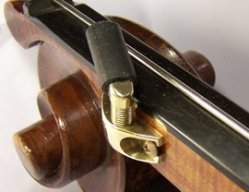
"My only problem with the Merchant design is that the extension cannot be tuned."
I have a Merchant extension and it is also not tunable. I have seen some very cool tunable nuts, but in my opinion that adds a lot of work for something you don't really need. Bill's original design had the string sit in a groove at the end of the extension fingerboard. I simply added a small nut there, and this added just enough length to get the thing in tune.
It is a simple fix, and I'm sure Bill would be happy do do it for you, and probably ask for no money. If you can't get it to him, it is a very quick fix, and any luthier should be able to do it cheaply.
You don't want to be going around with an out of tune C-string. Get it fixed.
Also, if anyone is holding off on chromatic locks because of the price, have you checked out www.basscapos.com? (Shameless Plug!)
Robobass
I have a Merchant extension and it is also not tunable. I have seen some very cool tunable nuts, but in my opinion that adds a lot of work for something you don't really need. Bill's original design had the string sit in a groove at the end of the extension fingerboard. I simply added a small nut there, and this added just enough length to get the thing in tune.
It is a simple fix, and I'm sure Bill would be happy do do it for you, and probably ask for no money. If you can't get it to him, it is a very quick fix, and any luthier should be able to do it cheaply.
You don't want to be going around with an out of tune C-string. Get it fixed.
Also, if anyone is holding off on chromatic locks because of the price, have you checked out www.basscapos.com? (Shameless Plug!)
Robobass
- Aug 1, 2005
- 3,546
- 1,421
- Disclosures
- Private Inventor - Bass Capos
Hey, Is Gino Biondo still working? When I was studying at Mannes in 1990 he was doing alot of extensions for Manhattan School students and he did a very nice one for me. I haven't heard his name for years.
Robobass
Robobass


