Band in a box spat out this chord: C2.
I have never seen this before, can someone please explain this to me?
I have never seen this before, can someone please explain this to me?

TalkBass has been independent since 1998. Add your voice.
Create a free account to reply to discussions, view embedded media, and browse with fewer display ads.
Join free Log in
Want zero display ads or expanded classifieds tools? Compare plans.
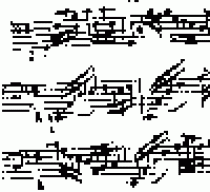


http://www.looknohands.com/chordhouse/guitar/index_rb.htmlC 2
a.k.a.: on guitar equivalent to: Cadd9
intervals: 1,2,3,5
half-steps: 2-2-3
notes: C,D,E,G
 . It's a cool sound.
no, it's not a C add9.
a C add9 has the note "E" in it.
A C2 does not have the note "E" in it.
as stated above, a C2 has the notes C, D, G. only

Csus2 would not be the same because it would have the fourth (F) in it, that's what makes it a suspended chord.
I don't think that's necessarily true. I think things are more flexible than that. For instance, a common way of voicing C2 on guitar (which I mention because i know it better than piano) is, from low to high, C C D G. You could also do it C G D.A C9 chord, typically, has the note D voiced outside of the octave whilst the Csus2 or C2 chord is voiced within the octave and omits the third.
IME this is not exactly the case. Not all sus chords have the 4th. That's not what makes it a suspended chord. What distinguishes a sus chord is simply that the 3rd is replaced. The key pioint, however, is that it may be replaced EITHER by the 4th (sus4) or the 2nd (sus2); that's why we have those two terms. It's common to use sus in place of sus4, because that's probably the more common type, but it's not exactly correct. The correct term would be sus4. A sus2 would not have the 4th, it would have only root, 2nd, 5th.
I don't think that's necessarily true. I think things are more flexible than that. For instance, a common way of voicing C2 on guitar (which I mention because i know it better than piano) is, from low to high, C C D G. You could also do it C G D.
A problem you get into when you think about voicing within or outside the octave is, whose octave(s) are we talking about? Think about a band with two guitars, a keyboard, and a bass. How many octaves are we talking about here, and where exactly would the D have to be to be considered "within" or "outside" the octave?
C2 fingering - not sounding the 1st...ence and I for one would hear the difference.
+1A C9 chord, typically, has the note D voiced outside of the octave whilst the Csus2 or C2 chord is voiced within the octave and omits the third.
Voicings matter, whether you like it or not. "Cadd9" and "Cadd2" can mean two different things. Cadd2 has a different history as a voicing than Cadd9 - it was first adopted as a way to explain how a lap steel player articulates the major third in a chord in country/country rock music - usually by playing the major second as an appogiatura. This sound can be approximated on piano, and the chord symbol Cadd2 is used to reflect that. The 2 HAS to be next the third for the lapsteel effect. Cadd9 doesn't have any of these connotations, and so the 9 is placed in a different octave to the third.