• TalkBass has been independent since 1998. Add your voice.
    Create a free account to reply to discussions, view embedded media, and browse with fewer display ads.
    Join freeLog in
    Want zero display ads or expanded classifieds tools? Compare plans.

Can a headless adaptor be installed on a Jazz neck?

Hi. Well in regards to my question, I'm sure nearly anything can be done if one throws enough money at it.

But what I am wanting to know is if there is enough material on a "pretty much standard" Jazz type neck to deal with installing something like this ....

http://bgstainless.com/index.php?main_page=product_info&cPath=2&products_id=1

Installation instructions PDF (so you can get a better idea what the mounting shelf looks like, there's several multi-angle pictures in this PDF file)...
http://www.bgstainless.com/download/installation_pdf/Headpiece_Single ball.pdf

BGStainlessHeadless4stringbasshead-1_zpsdefe5388.jpg


If not one of those, then perhaps one of these ....

[Invalid or Expired Link Removed]

HeadlessUSAstainlessheadpiece-1_zps63d50ed0.png


BGStainlessHeadless4stringadaptor-2_zps97ee1aba.jpg


Or perhaps the Hipshot kit .....

http://store.hipshotproducts.com/cart.php?m=product_detail&p=353
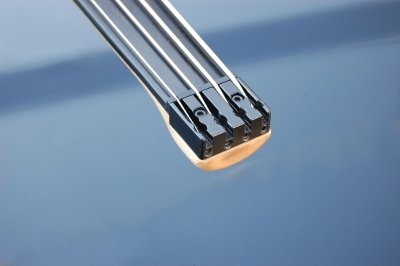
HipshotHeadlessBassadaptor-1_zps1bc6b5e2.jpg


I see that some of these use a zero fret, but why couldn't something be installed that uses the stock nut? I mean, it just has to clamp the ends of the strings, so couldn't one be installed that uses the stock nut? It seems like a WHOLE lot less monkey business would be required if the zero fret thing wouldn't have to be addressed, that way I could use ~stock~ Jazz necks for this without doing too much modding ot the head area other that what it would take to accept the string adaptor.

But then again if I knew that for sure I wouldn't have to put the question to you folks, now would I!

If a standard Jazz style neck will accept one of those headpiece/string adaptors, then it wouldn't take a whole lot to retrofit a headless bridge system to the body. I would guess it would just be a matter of alignment and positioning (of course, removing some of the rear end of the body would be required to allow access to the tuning knobs, that's a given).

I've always wanted to build up a headless bass, but I've not been willing to have a neck ~made~ for it (cost issues). If I can simply order a Jazz neck from Warmoth with the frets and fretboard I prefer, and then have someone (or myself) retrofit the string adaptor to it, then it seems like it would cost a lot less to go that route. Then I'd have a headless bass that would accept any type of Jazz neck (fitted with the string adaptor of course) in the event I want to go with a different wood or whatever at some point later on.

I presently have a Squier VMJ that would make a fine headless, and since I only have $300 in the entire instrument it would be GREAT if one of those string adaptors could be fitted to the stock Squier neck without reinventing the internal combustion engine to do so.

Any thoughts or experiences?

 
I live in the desert southwest. There is no ~locally~ here other than lizards and sand dunes.

I can get into a Warmoth neck for around $250. Less if I don't go with exotic niceties. Look here .....

Invalid Link Removed

Everything but the nut for $180, that includes the frets installed. Add the nut and we're still at $205.

Can a luthier make a neck for that? Of course the cost of fitting a headless string adaptor would be added to that. I'm not being a sarcastic ass, I'm actually asking.

And then the question of "who/where do I go to for this work?" comes up as well.

I'm not a woodworker or luthier, but I do have a mill, a lathe, TIG, MIG, and I've been a metal fabricator since 1973. So I'm not totally clueless when working with my hands ... HOWEVER my wood working skills are not as well developed as my metalworking skills and experience.

And I got a router for x-mas! So that means I'm already a pro, right? (wink wink, rolling eyes, and all of the other "yea right" body language).

Point being if I had some instruction .... I MAY ... stress MAY .... be able to DIY it ... depending on the complexity of the task.
 
Your drama will be sorting out where the truss rod comes through. Aside of that, I really can't see why you couldn't do it. I've been thinking about a similar conversion for my P bass, but haven't got around to doing it.

I'd considered that ... it looks to me like Warmoth's J necks have the truss rod adjuster at the body-end of the neck.


Invalid Link Removed

And if you look around on their site it sure does look like that is how their J necks are set up. :)
 
I'm not a woodworker or luthier, but I do have a mill, a lathe, TIG, MIG, and I've been a metal fabricator since 1973. So I'm not totally clueless when working with my hands ... HOWEVER my wood working skills are not as well developed as my metalworking skills and experience.

And I got a router for x-mas! So that means I'm already a pro, right? (wink wink, rolling eyes, and all of the other "yea right" body language).

Point being if I had some instruction .... I MAY ... stress MAY .... be able to DIY it ... depending on the complexity of the task.

Dude, that was me 18 months ago! Werl, not since '73, but I used to work with metal. Seriously, you can do it. Get some cheap pine and use your mill for the trussrod slot. Make a practice copy from pine first then get some maple and go to work. It's really not that hard. And shaping is hell fun! You can do it. We'll help you through it. :)

P.s. make the truss rod come out the body end. ;)
 
I was under the impression that some of these designs were purpose built for modification of standard necks. I really don't think a mod would be too hard if you're handy with jigmaking and precision woodworking tooling.
Well, I figure a lot of it is skill transfer but there is an awful lot of specific experience and skill that goes with wood (or metal) working. So I most certainly won't take that for granted. But in the end, it isn't much past "fitting tab A into slot B". All of the intricate instrument building is already done, all I'm doing is replacing one string retention design (headstock and tuners) with another (headless string adaptor).

I figure I may be able to do like member "reverendrally" said, begin with a 2x2 and perhaps some wood chisels and a saw and see how far I get with fitting a headpiece to it. A standard pine 2x2 is almost exactly the same width as a J neck's nut end (1.5"). So it should make a good practice piece.

I reckon as long as I use the stock nut on the "real" neck then I can't make much of a musical mistake. The nut still keeps the instrument musical and intoned, all the headpiece does is anchor the strings. I'd guess that keeping the headpiece angled back so the strings ~break~ over the nut at the proper angle I pretty much got it nailed. Then it comes down to mounting the headless bridge. Other than properly trimming the rear end of the body to deal with the bridge, it can't be any worse than mounting any other bridge.

HeadlessUSAheadlessbassbridge-1_zps5ef2cd2e.jpg


HeadlessUSAheadlessbassbridge-2_zps944086ec.jpg


HeadlessUSAheadlessbassbridge-3_zps677bd525.jpg


I've been goofing around with a number of body shapes and rear relief designs for about a year+ so I have some ideas in that regard.

I've loved the headless bass design ever since I saw Geddy Lee with an L2 in the early 80's. "How modern" I remember thinking to myself. I am aware that the basic "broomstick" Steinberger is a horribly balanced thing, but I plan on reworking the basic elemental design somewhat. I figure I may be able to create something along these lines ......

RaceBass-1.jpg


If I start off with either a Warmoth ~blank~ body that has been pre-routed for the neck pocket and a few pickup cavities, and perhaps a control cavity (maybe something like a Telecaster control cavity to start me out with) I can cover the rest. If I need to add material for the upper horn, that shouldn't be too awfully hard. I think the upper horn is a necessary component, even if I end up milling one from aluminum in some manner.

Or, I may be able to start with a buck standard J bass body, begin cutting it down thusly (this is just some photoshop goofing around-itus)....

J-Pop-3-Cut-1.jpg


Then see what I can end up doing on the lower portion of it.

I up for it, I just wanted to get some help and ideas from other here in forum...

:)
 
I'm with reverendrally - you can do this! Those skills are based in figuring, measuring, cutting, fitting, all in 3D and in your head and I think they are all transferable in more ways than you think. :) I'd start practicing with your router on some inexpensive wood. You can buy templates online for routes and a body is a remarkably easy thing to make too, you already have the design and the mind for creation. You can do this, and most of us would agree that halfway through being finished, you'll be planning the next one...

:D
 
A few ideas...

1. Why buy a head piece if you have a mill, lathe and drill press. Look up "miziomix". He makes string anchors that go into holes in the headstock. So it looks like a regular bass, but has a headless bridge. Make some of your own out of decent ali and use them to secure the string in the headstock. Heck, make me some too!

https://www.facebook.com/UberJay.Basses

2. I'd advice against chopping up your jazz body. The ergonomics of the jazz are pretty awesome to begin with. Removing all the weight of the tuners from the headstock will further aid things. With a headless bridge in place, it should be really nice and not even look weird and headless (the down side of steinbergers)
 
A few ideas...

1. Why buy a head piece if you have a mill, lathe and drill press. Look up "miziomix". He makes string anchors that go into holes in the headstock. So it looks like a regular bass, but has a headless bridge. Make some of your own out of decent ali and use them to secure the string in the headstock. Heck, make me some too!

https://www.facebook.com/UberJay.Basses

2. I'd advice against chopping up your jazz body. The ergonomics of the jazz are pretty awesome to begin with. Removing all the weight of the tuners from the headstock will further aid things. With a headless bridge in place, it should be really nice and not even look weird and headless (the down side of steinbergers)
Excellent idea on the string anchors! I'll look them up tomorrow (it's 1:40am here).

On the bass body, I've already been using a "choppered" Telecaster for several years. I have a neck injury that precludes me from playing guitars/basses that tend to kick my right elbow outward, I am FAR more comfortable with my right arm laying nearly against my torso. My "Shredbilly Tele" is shaped so that my arm can sit just right and not bother the issue I have with my neck/upper back/shoulder blade area.

IMGP5282.jpg


That ugly thing is probably my most favorite guitar I have ever owned.

So my body knows what kind of bass body it likes. :)

I've been playing a Squier Vintage Modified Jazz 70's bass since about August of 2012. (See my sig, a link called "X-Bass"). So I am very familiar with the ergonomics of the Jazz bass. I figure I can try cutting up a Mighty Mite J bass body and if it doesn't work out I'm out $100 bucks. Yea, it's a $100 bucks but this is something important that I need to know. So I figure it's worth the hunsky to go to school.

:)
 
I'm with reverendrally - you can do this! Those skills are based in figuring, measuring, cutting, fitting, all in 3D and in your head and I think they are all transferable in more ways than you think. :) I'd start practicing with your router on some inexpensive wood. You can buy templates online for routes and a body is a remarkably easy thing to make too, you already have the design and the mind for creation. You can do this, and most of us would agree that halfway through being finished, you'll be planning the next one...

:D
Super huge thanks for the encouraging words there Beej! Thanks a ton for the push forward. :)

I was at Lowes the other day and I found those router bushings for use with templates that fit my Bosch router. I also took notes of the part numbers for the correct router bits I'll need for shaping bodies and for doing cavities (again, see what I am up to with pickups and electronics in the link in my sig called "X-Bass"). I also made notes for the Kobalt wood chisels I'm planning on adding to my extensive tool collection to help with shaping and carving cavitites and other parts. So as soon as I scare up a few more munnies I'll make another trip to Lowes and pick up a few things to help with this addition to my list of experiences during this lifetime.

Now I have to see if I can get some sleep! Those string anchors and all of these other things are ping-ponging around in my skull like a ricocheting bullet. It's now 1:49am .... gotta get to bed!

Thanks fellas .... I REALLY appreciate the forward momentum you've provided.

Fluxoid.
 
I've been playing a Squier Vintage Modified Jazz 70's bass since about August of 2012. (See my sig, a link called "X-Bass"). So I am very familiar with the ergonomics of the Jazz bass. I figure I can try cutting up a Mighty Mite J bass body and if it doesn't work out I'm out $100 bucks. Yea, it's a $100 bucks but this is something important that I need to know. So I figure it's worth the hunsky to go to school. :)

I'd do a jazz trace on pine or MDF first and see if you can come up with something a little neater. A body is even easier to make than a neck and I reckon you could easy do a neck if you take your time on it.
 
Not at all, if hung from the original pivot-plate, or Ned's later-designed "Boomerang". It balances perfectly.

Anyway, cool idea; good luck with it.
Woops .. sorry pkstone, I somehow skipped right over your post.

Thanks for the compliments. I've seen the boomerang thang, it's kindof the same idea I've had for my bass body, but instead of it being a plastic ~afterthought~ looking piece I incorporated it into the actual body shape.

Being a bit ignorant of some stuff regarding what makes a good instrument, I have tried to find the sortof least common denominator of body shapes when it comes to placing the strap buttons. It looks as though most basses that are regarded as "well balanced" have the neck-end button located near the 12th fret.

It has more to do than just preventing neck dive though. It also has a lot to do with placing the scale relative to the player's centerline (spine). Move the strap button too far towards the headstock and the bass shifts to the player's right (right handed player), move the strap button towards the body and the scale shifts towards the player's left.

I discovered that when I assembled my Warmoth SG guitar. The scale was shifted to the player's left quite a bit when compared to a Telecaster or Stratocaster. Noting the SG body had a lot of body sticking out past the bridge, and the neck strap button was placed at the neck bolts.

My Cort A4, on the other hand, has almost no body length after the bridge (perhaps a 1/4") and the upper horn ends right at the 12th fret. When compared to my Jazz bass (which has some body length past the bridge and a shorter upper horn) the Cort's scale is right-shifted by a pretty noticeable amount. It makes the bass feel shorter, even though it still has a 34" scale. It is not as far a reach for the 1st fret as the Jazz bass is. And the Cort's right-shifted scale also makes me tend to play nearer the neck then towards the bridge. Opposed to the Jazz where I tend to play nearer the bridge due to it's relative left-shifted scale.

So there's more to it all than just dealing with neck dive. At least in my world.

:)
 
I'd do a jazz trace on pine or MDF first and see if you can come up with something a little neater. A body is even easier to make than a neck and I reckon you could easy do a neck if you take your time on it.
Yea, maybe I could glue a few 2x6s together to create a ~plank~ and cut out a bass body with a roughed-out neck pocket to bolt my J neck to just to check the fit, balance, and feel of whatever body shape I decide on.

This is a Warmoth G4 body. Nice looong upper horn, lots to work with ....

WarmothG4AlderBassbody-front-1_zpsbd51277c.jpg


Warmoth Z-Bass body, another candidate with a longer upper horn .... it looks kinda different too...

WarmothZ-Bassbody-front-1_zps66c498a6.jpg


And then there's the Jazzmaster ... loads of routing options with a nice pickguard that also offers lots of control options....

Warmoth-Jazzmasteralder-front-2.jpg


Warmoth-Jazzmasterbasspickguard-black-red-1.jpg


Warmoth-Jazzmasterbasspickguard-black-red-1.jpg


Then of course theres the "chunk-o-bass" body blank that can be pre-routed for the difficult stuff (neck pocket and a few pickups, and so on) ... these go for about $135 until you add a 3rd pickup routing then it's roughly $40 per pickup cavity. But included in the $135 is the neck pocket, 2 pickup cavities, and a control cavity. Worth considering....

Warmothbassbodyblank-front-1.jpg


Warmothbassbodyblank-back-1.jpg


So I have options!

I had previously considered all of this stuff but I got so discouraged with the notions due to the headpiece issue. But since I've been encouraged in this thread and also given some new idea-fodder from member "reverendrally" and "beej" I'm now back on the horse.

:hyper:
 
Woops .. sorry pkstone, I somehow skipped right over your post.

I've seen the boomerang thang, it's kindof the same idea I've had for my bass body, but instead of it being a plastic ~afterthought~ looking piece I incorporated it into the actual body shape.

I hope this isn't too off-topic, but since you're in the design phase, maybe it's of interest to you. I think you're confusing the Boomerang with the original (plastic) pivot plate design used on classic Steinbergers. This is the pivot plate:

PivotPlate.jpg


and this is the Boomerang:

Link Removed

What they both have in common is that they hang the bass from its center of gravity, giving it excellent balance. The Boomerang has the added advantage of being adjustable (by bending the metal arms), so that you can position the bass optimally on your body, as you were discussing.

Another, perhaps less obvious, advantage of both of these systems is that they break down -- they don't detract at all from the Steinberger's excellent portability (I regularly fly with mine in the overhead bin). On the slightly minus side, I have to be sure to always have an allen wrench somewhere on me!
 
Oh holy cats! You're absolutely right! I was TOTALLY thinking of the little plastic crappy thingy. I've never even SEEN that boomerang setup. I quite like it. I'll have to investigate it more deeply.

Nope, not off topic at al. As you said I'm still in the design phase so your post is very appropriate. Thanks for taking the time to clear that up for me.

Does that pivot point ever become an annoying pressure point on your body or is it pretty much physically invisible?

I've often thought of adding a simple stainless steel tube as an "upper horn" kinda like what the bommerang setup provides but something more permanently attached and more aesthetic. Some sort of trick looking arm, like something that came off of a race bike or something. Perhaps a bit more "Terminator vibe" looking.