• TalkBass has been independent since 1998. Add your voice.
    Create a free account to reply to discussions, view embedded media, and browse with fewer display ads.
    Join freeLog in
    Want zero display ads or expanded classifieds tools? Compare plans.

Can I go pro with a Squier Affinity P Bass?

Can I gig and tour with a Chinese Squier Affinity?

  • Don't ever let anyone tell you who to love! Rock it like you stole it!

    Votes: 134 81.2%
  • Dress her up, you can't be seen in public looking like a cheap date!

    Votes: 15 9.1%
  • Dump her and find somebody respectable if you ever want any respect yourself!

    Votes: 16 9.7%

  • Total voters
    165
Status
Not open for further replies.
Setup is an important factor, however, low line guitars are produced so differently then the next one. You do not know how it will stand up to the
changes. To date, I see very few vintage copy's available while well made guitars are being sold for big money.
 
To someone who does not know nor care then I guess you are right. My logic is why purchase low line equipment when I can afford the best. Some refer to this type behavior as a psychological disorder, while others feel it is to achieve a level of confidence.
My fingers and ears know the difference.
But do the guys you are trying to get to buy liquor know or care? Overkill is fine if you need it. I have some fabulous instruments, by anyone's standards some of the best of the best ever made, but I still gig $79 ebay stuff because I can and the gig doesn't call for anything more than that. Why burn down a cathedral to fry an egg?
 
I was first a Musician, became a Professional New York City D.J., and still do both. I design and build most of my own racks and speaker cabinets.
So I understand exactly what is required. I have never damaged a speaker, amplifier, nor broken anything. Going on with half ass ed gear will never happen in this lifetime. I know better.
 
If you play well, it doesn't matter to others, however, from experience, people have a higher level of respect for the professional equipment.
I've got a regular house band gig and rock a Copley that I bought here for under $200. I've had more than one person playing a very expensive guitar accidentally bump in to me on "stage" and apologize profusely saying they'd hate to have to replace/repair such a nice bass - no sarcasm. It's the indian, not the arrow if you'll pardon the expression. If you are good enough to get the gig, your playing will reflect on the instrument. No amount of money will buy you an instrument to elevate your playing beyond what you can actually do. If your instrument isn't up to your needs, replace it, but if it is fine, then why bother?
 
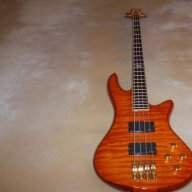
Hopkins, any time you make an adjustment, you are working. Once you move that neck, the other adjustments have now been compromised. I will say, guitars are similar to marine fish. They both do not do well with changes. A guitar must be slowly acclimated into a new environment. Or at least this is a common practice for me. Changes are to be made slowly, hence my reason for never needing to make these adjustments. What you do is your business. I enjoy playing my instruments. They all appear brand new as you can see in my photo. This Schecter Elite 4 Bass is from 2003. I still have the box and all packing materials. I also use it to play out and never experience issues. I would also assume, for me to play your bass would feel uncomfortable. I'm positive the setup in incorrect due to you not understanding.

My other point to one of your earlier comments, I do not buy anything unless I am knowledgeable and confident to make the purchase. I do not nor have I ever owned cheep or low line equipment. I got it right the first time. I now understand.

Seeing as though people pay me money to repair and set up their instruments, as well as the random custom build like the bass in my avatar, I would say there are plenty of people, including people on this forum that would say I know exactly what I am doing. Guitars do not have mystical properties, wood moves with humidity and climate, metal does not. So if a bass has a proper set up, and humidity causes the neck to move, you adjust the neck back into spec and the bridge adjustment that did not move will fall back into place. I work on instruments that are gigged, these guitars and basses are taken out of hot or cold trailers, and taken into venues that are either air conditioned or heated. Gigging musicians (like people I have done tech work for) don't have the luxury of letting a guitar sit in a case for 24 hours to adjust to its environment. They rely on the adjustments that are built into the instruments. I have teched for bands whos gear had been in a trailer in freezing conditions one night, and on a cruise ship to the Bahamas the next day. Of course every one of their guitars and basses needed to be adjusted. I am pretty sure if you played any one of my guitars or basses, from my most custom high dollar 5 string to my $80 Squier Jaguar bass, they would all be set up extremely well. Maybe not to your tastes, everyone is different, but they would all have the same low action, with no fret buzz at all, and intonation would be spot on on every one of them.
 
Hopkins, a few years ago, I designed and built my first 6 string guitar. It plays lightening fast, sounds fantastic, and looks incredible. Unfortunately, I do not have a commercial press, so I had to purchase the neck. There are many different guitar makers as there are players. In my years of experience, I have never even slightly adjusted a neck and all other specifications remained the same. If you set up a guitar, then adjust the neck, and nothing else changed, you must be using magic tools and a magic bench.

When adjusting necks and mentioning the words "snaps back," please do not be offended, but you can not touch any my guitars. I make precise adjustments that require days before making a second adjustment. Very minute adjustments are made with skilled hands. I do not turn adjustments as players turn volume controls. You can set up anyway your heart desires. I have too much experience to argue. I would like a set of those magic tools.

Also, how many guitars have you worked on and scratched ?? This should be interesting.
 
Last edited:
This thread spun into an interesting direction...

But here's the deal - the way I see it. Sometimes, the answer is just NO - no matter how much you want to be otherwise. I know, I know - the "It's all good, bro" community wants to stay positive, but the OP asked a reasonable question: Can you go pro with, what is, like it not, amateur instrument. The answer is "Sure - if you are good enough" - but I wouldn't own one. I'd buy my nephew one to learn on - but I wouldn't gig on it.
 
  • Like
Reactions: RedHotFuzz
Hopkins, a few years ago, I designed and built my first 6 string guitar. It plays lightening fast, sounds fantastic, and looks incredible. There are many different guitar makers as there are players. In my years of experience, I have never even slightly adjusted a neck and all other specifications remained the same. If you set up a guitar, then adjust the neck, and nothing else changed, you must be using magic tools and a magic bench.

When adjusting necks and mentioning the words "snaps back," please do not be offended, but you can touch any my guitars. I make precise adjustments that require days before making a second adjustment. Very minute adjustments are made with skilled hands. I do not turn adjustments as players turn volume controls. You can set up anyway your heart desires. I have too much experience to argue. I would like a set of those magic tools.

Also, how many guitars have you worked on and scratched ?? This should be interesting.

There are no precise adjustments that require days before making a second adjustment. That is the biggest load of nonsense I have ever heard. You adjust the neck until the relief is set correctly, then you check action and intonation. No magic tools required, just a few different sizes of Allen wrenches maybe a small flat head screwdriver and a capo.

Here are some of the guitars I have built, a few of them are played on some pretty big stages

20130107_164411_zps8863709e.jpg

20131019_143231_zpsa0675f5f.jpg

IMAG0356.jpg

20130712_083201_zps62c4a22f.jpg

20130331_124910_zps4896ae4d.jpg

IMAG0195.jpg

20131106_171237_zps396262f7.jpg


There, I have put my money where my mouth is. If you want to try to come in and kick the door down on a forum after only being a member for one day and sling insults my way. I suggest you do the same.


But please, tell me, what are these ultra precise adjustments that you do to your ultra premium, boutique, high end, luxury, $700 Schecter that makes it to where you can play out in all weather with out ever needing to adjust it?
 
Last edited:
The Affinity is a Walmart bass because Walmart sells Affinity instruments. The end.

And I neither like nor dislike them. The OP didn't ask if people liked them. He asked if he should audition for a pro gig with one. And there's no way I would. And I doubt you - or most the responders on this thread, despite what they say - would either.

Holy crap, man, are you kidding!? I said 3 separate times in this thread that I won't be auditioning!! I have already been invited to play with other pros. They have not seen my gear, but they are NOT expecting me to audition. I will audition drummers and singers, though.

I got my squier at probably a George's Music (like Guitar Center, not sure if it's a national chain or if they even still exist). I haven't been in a walmart for years, but I've played a $30 ukulele at a gig before, I guess that makes me kind of "Walmart", right?

Be gone.

As for neck warping, the action is high (funk machine? Lol...) but it hasn't really changed over the years (and seasons)

I am not sure it would be worth the money to get fret leveling/dressing tools to do full setup on such a cheap instrument (I have basic lutherie skills but would rather focus my efforts on improving my real crafts)

I have decided on my next bass, but I can't afford it - Tony Franklin PJ Fretless. (I like that it has no lines. Cellist, remember?)

Any other ideas on how to get a p body w pj pickups and a fretless (line less) neck with a vintage P headstock? I don't have $1700!:-D
 
Btw just found a local squier jazz vintage mod fretless for $150 - good buy if I can talk him down to $100? I know, headstock is important, but I think people would notice more that it's a fretless than a squier...

Thoughts on this?
 
There are no precise adjustments that require days before making a second adjustment. That is the biggest load of nonsense I have ever heard. You adjust the neck until the relief is set correctly, then you check action and intonation. No magic tools required, just a few different sizes of Allen wrenches maybe a small flat head screwdriver and a capo.

Here are some of the guitars I have built, a few of them are played on some pretty big stages

20130107_164411_zps8863709e.jpg

20131019_143231_zpsa0675f5f.jpg

IMAG0356.jpg

20130712_083201_zps62c4a22f.jpg

20130331_124910_zps4896ae4d.jpg

IMAG0195.jpg

20131106_171237_zps396262f7.jpg


There, I have put my money where my mouth is. If you want to try to come in and kick the door down on a forum after only being a member for one day and sling insults my way. I suggest you do the same.


But please, tell me, what are these ultra precise adjustments that you do to your ultra premium, boutique, high end, luxury, $700 Schecter that makes it to where you can play out with out ever needing to adjust it?
ImageUploadedByTalkBass1405740452.757093.jpg
 
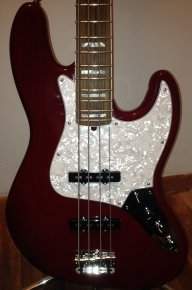
Btw just found a local squier jazz vintage mod fretless for $150 - good buy if I can talk him down to $100? I know, headstock is important, but I think people would notice more that it's a fretless than a squier...

Thoughts on this?
As a fellow bow user who is accustomed to a wooden unlined fingerboard, you might not care for the lined fretless offering. To me the feel and sound were off and slightly disconcerting. I prefer natural wood to plastic/synthetic something. Give it a play and see what you think. With some nice tapewound Labellas they can be fair enough, but I found the short "fretboard" enough to turn me off from most fender offerings. I'm used to having 2 octaves++ on my violin and other instruments and found the limitation frustrating at times. Since you have the Squier it may not bother you too much, but I find fretless to be a different animal than fretted and it just didn't do it for me.
 
Status
Not open for further replies.