• TalkBass has been independent since 1998. Add your voice.
    Create a free account to reply to discussions, view embedded media, and browse with fewer display ads.
    Join freeLog in
    Want zero display ads or expanded classifieds tools? Compare plans.

Can I reattach this broken nut piece?

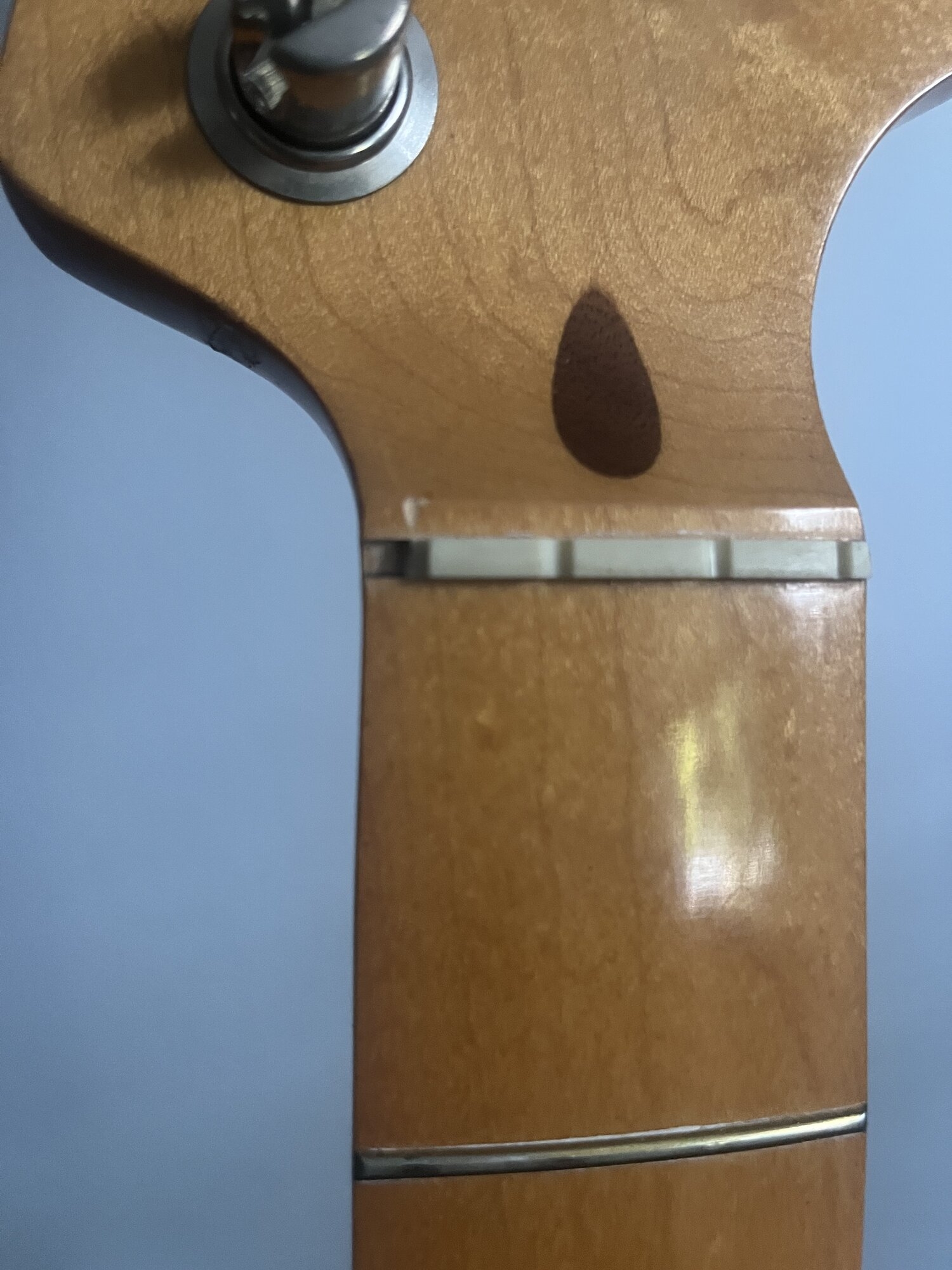
A small piece of the nut from my p-bass just broke off at the E string, and I still have the broken piece. Is it possible for me to glue this back on, or do I need to bite the bullet and replace the whole nut? It's a vintage bass that's all original so I'd rather not replace it if possible.

IMG_3731.jpeg
 
IMHO it's past due for a new nut, since repairing a broken nut that broke under a string is going to be "challenging" at best. And if it's plastic, old plastic gets brittle and may break elsewhere. But given you are trying to preserve as much "all-original" as possible:

If I wanted to attempt a repair of the old one, I'd pop the rest of it out, clamp the parts together, shave or sand the bottom slightly, mix up about a gram of epoxy, un-clamp the parts, dab a tiny drop on the broken surface, re-clamp the parts together, and add a carbon fiber tow strand to the bottom surface with more of the epoxy, then let it cure, un-clamp, clean up, and re-install. Be sure to separate the nut from the clamps with something like packing tape that epoxy won't stick to.

The added carbon fiber and epoxy (both quite thin if done right) are why the bottom would be slightly shaved. The carbon adds tensile strength to resist the string's natural tendency to break it again at the small-area glue joint under the string. Doing it this way means you haven't messed up the neck by trying to glue the broken bits into the nut-slot so firmly they won't come apart again, and if the nut is replaced in the future it should come out as easily as any normally "or or two dots of glue" installed nut.

If the old nut falls apart when removing it, then I'm back to "brittle, time to replace it." At least assuming it's supposed to be playable, not just a no-longer-musical artifact.
 
Well you just got some great input already in the first reply and I'm going to say pretty much the same thing about it being best to replace, but if you must repair I would start with a hole drilled into the two pieces being joined.
Many won't have bits small enough, but any jeweler you know will be able to drill the holes and help you epoxy it back together.
The worst thing is that it's broken in the single worst place possible and the benefit of drilling it is that it'll get the additional strength right up under the area needing reinforcement the most.
Just to illustrate, here's a repair from a couple years ago which was actually more difficult. The steel post is just an identical drill bit cut off to the right length before epoxying it all together.
IMG_6811.jpeg
 

Attachments

  • IMG_6810.jpeg
    IMG_6810.jpeg
    1.1 MB · Views: 20
  • IMG_6809.jpeg
    IMG_6809.jpeg
    701 KB · Views: 21
It happened to me some years ago in a EBMM Stingray. First repair I did was with epoxy, but nothing fancy or curious, just to let me play some days before going to the luthier,
Then, the luthier changed the nut, but he had 2 issues: the expoxy ultrahardened the zone and he had to recarv the rail. Second, he had to get an original compensated nut. Total work cost: something around 150€ (180 $ ?).
I learned the hard way not to put strings with greater gauge that what the nut space fits.
 

Attachments

  • nut.jpg
    nut.jpg
    179.5 KB · Views: 28
Last edited:
If you can't afford the ~$20 to drop a new one in, that's fine. What I'd do in that case is grab whatever glue I could and put a tiny drop on the bottom and side, wait approximately how long the bottle suggests then tighten a zip tie around the neck/headstock just passed the nut. I use those on a few of my instruments as a longer-than-i-would-like temporary fix until I can put proper string retainers on.

If you've got the money, just order a new bone nut and a string retainer that looks nice and either put it all on yourself or find a local shoppe who can. They might be able to order the parts as well and in a week or so you'll be back to playing him.

Old parts fail. This is part of the overall maintenance. "Vintage" doesn't mean "super special". This is a case of less-than ideal crafting because a nut is just supposed to be spacing the springs. Another part is supposed to be holding them taught in place. I'd go as far as to add a zero fret as well for better consistency and to leave each piece to do it's intended sole purpose. Afterwards, I'd be bragging about upgrading and modernizing an old instrument. :p
 
Yep. Stick the old one (both pieces) in the case. Anyone OCD enough to care will be happy to repair it themselves on resale. Tusq makes some nice ones, but no shortage of pre-cut ones out there. All they need is final filing for slot depth. If you don’t have the skills or tools, take it to a tech, but it’s not difficult. Watch a few YT videos.
 
I’ve been doing brass nuts on all my builds, mostly for appearance sake. It’s a fair bit of work. There might be some slight sustain advantage, but only on open notes. It can be useful in grounding the strings too, but the bridge usually handles that already if it’s wired to ground. I tried bone once, but wow, what a stink when you grind it down! I have a Strat with a Tusq “graphite” nut, kinda self-lubricating.
 
(as much as I love "all original" when it comes to vintage)
Vintage instruments (and amps) still require maintenance - and this is a common maintenance item.
A broken nut can affect tone - even if "repaired"

If I'm looking at a vintage bass "replaced nut" would be at the bottom of my list of concerns.
you can keep the old nut in a baggie inside the case for posterity. :)
My '64 P actually came with the original nut and frets that way! ¯\_(ツ)_/¯

(I put them under my pillow and am still waiting for the fret fairy to come. - not sure if there's a nut fairy)
 
Last edited:
  • Like
Reactions: MechaSparky