• TalkBass has been independent since 1998. Add your voice.
    Create a free account to reply to discussions, view embedded media, and browse with fewer display ads.
    Join freeLog in
    Want zero display ads or expanded classifieds tools? Compare plans.

Can someone(s) critique my walking bassline i compose over some changes?

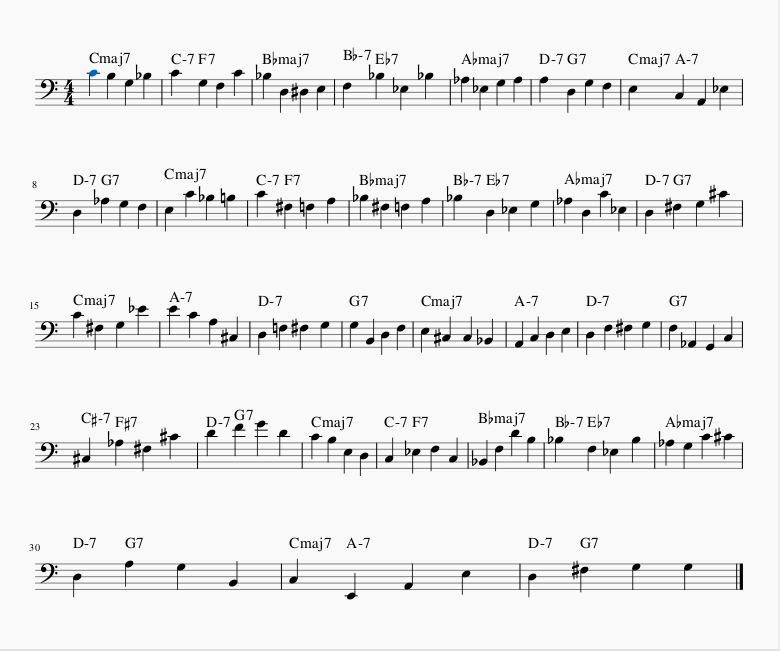
I know walking bass lines are supposed to be improvised but i'm trying to learn the technique through composing walking bass line parts on each chord and i want to know what you guys think about them and what are some ways to improve on my walking skills; what should I keep next time when i'm improvising bass lines? What should I scrap? Who should I listen to? All that stuff.
Walkingbass 1.png


I kept things as simple as possible for a walking bass lines (kept everything in quarter notes/crotchets) But what do i know?
 
Last edited:
Jeb Miku,
Try to respect the 3rds and 7ths more literally -
m.1 - you have a Bb in a Cmaj7 chord
m.9 - again... you have a Bb in a Cmaj7 chord
m.12 - you have a standalone D in a Bbmin7 chord
m.14 - you have an F# in a Dmin7 chord (going to a G7 - that F# is not supportive of either chord)
m.15 - you have an Eb in a Cmaj7 chord
m.16 - you have a C# in an Amin7 chord
etc., etc.
NOTE": I think there are stronger note choices and paths to explore before disregarding the actual stated Harmony that the chord changes are indicating.
Full Disclosure - Others may have different approaches - some folks around here utilize a kind of "unrestrained chromaticism" in the construction of their bassslines. I'm not at all a fan of that approach in my hearing/playing/teaching.
And.... good for you for writing out basslines - this is a great way to explore bassline construction in support of written Harmony.
Hey! m.30-31 is a solidly constructed line to support Dmin7 to G7...Cmaj7 to Amin7.
BUT....m.32....the F# is not in either Dmin7 or G7. ("unrestrained chromaticism".)
I'm curious to see what you'll write for your next written exercise.
Just my $0.03.
IMO/IME.
Thanks, and good luck.
 
Jeb Miku,
Try to respect the 3rds and 7ths more literally -
m.1 - you have a Bb in a Cmaj7 chord
m.9 - again... you have a Bb in a Cmaj7 chord
m.12 - you have a standalone D in a Bbmin7 chord
m.14 - you have an F# in a Dmin7 chord (going to a G7 - that F# is not supportive of either chord)
m.15 - you have an Eb in a Cmaj7 chord
m.16 - you have a C# in an Amin7 chord
etc., etc.
NOTE": I think there are stronger note choices and paths to explore before disregarding the actual stated Harmony that the chord changes are indicating.
Full Disclosure - Others may have different approaches - some folks around here utilize a kind of "unrestrained chromaticism" in the construction of their bassslines. I'm not at all a fan of that approach in my hearing/playing/teaching.
And.... good for you for writing out basslines - this is a great way to explore bassline construction in support of written Harmony.
Hey! m.30-31 is a solidly constructed line to support Dmin7 to G7...Cmaj7 to Amin7.
BUT....m.32....the F# is not in either Dmin7 or G7. ("unrestrained chromaticism".)
I'm curious to see what you'll write for your next written exercise.
Just my $0.03.
IMO/IME.
Thanks, and good luck.
Thx for the feedback! this helps a lot. Well I made a new one I hope it's better than the last one I made but there are more things I can improve on this one. I just hope it helps me with rock/funk writing when comes to bass lines but i'm not sure if the fundamentals are the same in each genre. Hopefully this helps write better bass lines in general.

Walkingbass 2.png
 
Thx for the feedback! this helps a lot. Well I made a new one I hope it's better than the last one I made but there are more things I can improve on this one. I just hope it helps me with rock/funk writing when comes to bass lines but i'm not sure if the fundamentals are the same in each genre. Hopefully this helps write better bass lines in general.

View attachment 3837284
Yes...This is much better - more "inside" the Harmony - always a great place to start.
I would suggest adding more scalar (whole-step/half-step) movement and maybe smaller interval "leaps". (see m.23, for example - that F# up to E, is not very user-friendly on most basses, IMO.)
Thanks for you interest.
(Also - Why don't you post an example of rock/funk music that you're listening too? There is some definite crossover from walking basslines to other genres, when it comes to supporting Harmony. IMO.)
 
Yes...This is much better - more "inside" the Harmony - always a great place to start.
I would suggest adding more scalar (whole-step/half-step) movement and maybe smaller interval "leaps". (see m.23, for example - that F# up to E, is not very user-friendly on most basses, IMO.)
Thanks for you interest.
(Also - Why don't you post an example of rock/funk music that you're listening too? There is some definite crossover from walking basslines to other genres, when it comes to supporting Harmony. IMO.)
I know you said an example But I couldn't resist. You can pick one

Rock


R&B/Funk


OK....can you tell me the root names and/or types of chords in "The Bottle"? Start with just the 2 chords in the verse. (from 0:00 to 1:00, or so.)
Hint - the bassline is 95% (or so) "inside" the harmony there.
Thanks.
I believe the root notes on the verse is A to D and the chorus is A to G to F to E to D. Idk I suck at this stuff.
 
I believe the root notes on the verse is A to D and the chorus is A to G to F to E to D. Idk I suck at this stuff.
Yes! Very Good - you have correctly captured and identified the Root Movement of the Harmony. Next step is to try and identify the basic chord types (major, minor, etc.) of each of those Roots.
Your ability to hear the Root Movement is a good sign that your "ears" are working fine. You do not "suck....".
IMO/IME.
Thanks.
 
Do you have something like iReal Pro or Band in a Box to play with. If not consider a purchase, it's worth every penny.

Something that has helped me is to get a standard tune, whatever you like. Go through the form and play the root on the downbeat (something your examples do a lot). 2nd time through the form put the 3rd on the downbeat. (yup you guessed it) 3rd play the 5th on the downbeat. This shows you many things, but the 2 biggest are, 1.) learning to spell the chord members quickly, and 2.) you don't always have to have the root on the downbeat.

When you've gotten the ear and mind freed up on the chord members, you'll find you have a lot more options at your fingertips as you improv a walking line. Note that 4-1, 5-1, and half steps are very powerful interval movements to clearly show a downbeat (you don't always need the root). For instance moving from Cmaj7 to Cm7 putting the E natural on the fourth beat and moving to the Eb first beat of next measure is a strong move and really shows the modal change.
Another thing to consider is the shape of the phrase. Using the root on the downbeat for the opening of the phrase and the closing is strong, but then using other chord tones for the middle measures can give some direction to the energy and make the phrase stronger. This applies well to the standards and can also work well with other styles.

Lastly, if you can play the melody (again, good practice with iReal Pro) then avoiding melody pitches on strong metric beats makes your line stronger and the music more complete. Flat 5's are very lovely sounding pitches and they are very fun to play in a walking line, but if that's the melody note, the effect is lessened. (Autumn Leaves is a good example of b5's in the melody).

One more thought... try to do a different line every time you play a song. Don't find an answer and stick with it, you'll not learn as much.
 
Yes! Very Good - you have correctly captured and identified the Root Movement of the Harmony. Next step is to try and identify the basic chord types (major, minor, etc.) of each of those Roots.
Your ability to hear the Root Movement is a good sign that your "ears" are working fine. You do not "suck....".
IMO/IME.
Thanks.
ok I worked these chords on guitar but I think i'm pretty happy with the chords I figured out

the verse plays Am11 to dm7 (dm7 playing that high C on guitar) then the chorus goes Am7 to Gm7 to Fmajor7 to Em7 to Dm7. I hope it's correct.
 
  • Like
Reactions: Whousedtoplay
ok I worked these chords on guitar but I think i'm pretty happy with the chords I figured out

the verse plays Am11 to dm7 (dm7 playing that high C on guitar) then the chorus goes Am7 to Gm7 to Fmajor7 to Em7 to Dm7. I hope it's correct.
Dude.
You're nailing this. Yes - that is what I hear as the chords, as well.
Now, just try to cop/copy the exact notes/rhythms of the bassline.
Your ears are working better than most.
IMO/IME.
Thanks.
 
Thx for the feedback! this helps a lot. Well I made a new one I hope it's better than the last one I made but there are more things I can improve on this one. I just hope it helps me with rock/funk writing when comes to bass lines but i'm not sure if the fundamentals are the same in each genre. Hopefully this helps write better bass lines in general.

View attachment 3837284
Don helped you a lot in here. He pointed out the right stuff.

I would like to add only few things that I think it would make your lines better.
When a chord changes with the same root like on the first 2 bars you over-complicated your line for nothing. You don't have to go far because you are coming back to the same point. Try to play something like the major 7 arpeggio or play the 1-2-3-5, 1-5-3-2 or 1-5-6-7.

Also on bar 3 I'm not sure if your last note is a B or Bb. Either way it is a problem because the 1/2 step from above without preparation on a major 7th chord is not the best approach or repeating the same note as a connection is not great either.

Hope this helps
 
Last edited:
  • Like
Reactions: Whousedtoplay
Don helped you a lot in here. He pointed out the right stuff.

I would like to add only few things that I think it would make your lines better.
When a chord changes with the same root like on the first 2 bars you over-complicated your line for nothing. You don't have to go far because you are coming back to the same point. Try to play something like the major 7 arpeggio or play the 1-2-3-5, 1-5-3-2 or 1-5-6-7.

Also on bar 3 I'm not sure if your last note is a B or Bb. Either way it is a problem because the 1/2 step from above without preparation on a major 7th chord is not the best approach or repeating the same note as a connection is not great either.

Hope this helps

Would you interpret that provided chord progression as a sequence/chain of short sections of ii-V7 - I?
 
  • Like
Reactions: Groove Master
I know walking bass lines are supposed to be improvised but i'm trying to learn the technique through composing walking bass line parts on each chord and i want to know what you guys think about them and what are some ways to improve on my walking skills; what should I keep next time when i'm improvising bass lines? What should I scrap? Who should I listen to? All that stuff.View attachment 3834954

I kept things as simple as possible for a walking bass lines (kept everything in quarter notes/crotchets) But what do i know?
I notice you have a major or minor second connecting one measure to the next. This is good. Think about using a fifth in between as well. Makes for a smooth line and gives you more options. Good luck.