• TalkBass has been independent since 1998. Add your voice.
    Create a free account to reply to discussions, view embedded media, and browse with fewer display ads.
    Join freeLog in
    Want zero display ads or expanded classifieds tools? Compare plans.

Cause of blown speaker

Situation: Fender Bassman 100 solid state combo amp. MXR Octave pedal (not using battery, using adaptor), G&L L-1500 bass. I plugged everything in, turn amp on with bass volume off, and the amp makes a loud rumble noise and I see the speaker bouncing hard up and down. I unplug the cable going into the amp, and it stops. I am at a complete loss as to what to even look for. The speaker is toast, but I want to find the problem to make sure it doesn't happen again. Any suggestions would be appreciated!

Thanks,
Greg
The first thing that came to mind for me was some sort of low frequency oscillation. In the old days we called that motor boating because that's what it sounded like. Try a battery in the octave pedal instead of the external power supply. Or unplug the cable at the input to the pedal. Your bass isn't leaning up against the cab is it, and causing feedback?
 
  • Like
Reactions: bassmeknik
This post is worthless w/o pics.......

just sayin.
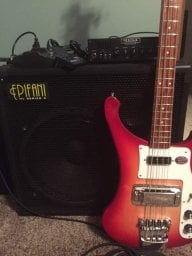
Here is the amp...
2015.JPG
 
Try hooking up another (hopefully old extra) speaker (any will do as long as you start with the volume off and limit the maximum volume during the test) to test the amp and pedal with, when you are ready start with the amps volumes all off and the pedal not connected. Very slowly turn up the amp and listen for oscillation. If oscillation occurs the problem is likely in the amp. Get it serviced. If you got normal operation try connecting the pedal and repeat the test starting with the amp volume off. If you hear oscillation stop. The octave pedal has a problem.

As a general rule I always try and fire my amps up with the mute on and volumes off. Also be aware that octave pedals can blow speakers with the ultra low frequencies they produce, limit your bass tone knob settings as to much lows will increase the likelihood of problems. Your 15 year old speaker didn't just blow due to age, I have 40 year old woofers that work perfectly, there is something wrong that caused the failure. Proceed with caution until the problem is identified and corrected.

A faulty power adapter or the wrong power adapter could be another explanation. A shorted cable would not cause this (you would get silence) but a open cable might (but only if another problem existed in the amp or pedal), so check your cables or try using different cables during the test. Good Luck.
 
  • Like
Reactions: gbrooding
Is it possible that you turned the volume down on the bass prior to turning the amp on, but after turning the pedal on? If so you could have sent a signal through to the pedal from your bass that created the low frequency oscillation noted above before the amp was turned on.
Hope this makes sense. Another way to illustrate this would be if you had bass>delay pedal>amp. With volume up on bass and pedal on play a note. Turn volume down on bass and then turn amp on. If the delay decay is long enough you will still hear the note that you played repeated even though it was played prior to the amp being turned on.
 
As a general rule I always try and fire my amps up with the mute on and volumes off.
This.
Standard operating procedure. Every time.
I compare it to: treating a gun like it's loaded. Don't point it at anything you don't want to shoot, even if you are cleaning it.
Your amplifier is a gun that's always pointed at your speaker. Be careful how you handle it.
 
  • Like
Reactions: bassmeknik
Hi Greg do you have a multimeter or access to one and someone that can use it if you are not sure? I would do a rough check on the pedal before plugging it in to an amp again. Check as follows; plug in the power supply you used and connect up the bass as you had it before, with the lead coming from the pedal that you would plug into the amp, take a reading with the meter between the tip and sleeve set the meter on ac and use the lowest setting, an analogue meter works well for this, there should be no voltage present, if you pick up a reading it could be an oscillation in the pedal either pedal fault or bad power supply. There will be a momentary reading if power is connected or disconnected from the pedal. If you turned up the bass and played a note you should pick up a reading, these are low say 0.2 - 0.5 v. With bass volume off there should be no reading. Hope this helps you :)
 
  • Like
Reactions: gbrooding
The original post makes it sound like the pedal and/or the bass caused the destruction, because it stopped when he unplugged the cord from the amp. But the OP said he has played the Bass and pedal through 3 different rigs. I doubt it would be the bass, even though that was the new piece.

It is possible that a component failed in the amp, killed the speaker and the noise stopped due to the amp shutting down or the speakers voice coil melting at the same moment the cord was unplugged. It would probably be best to take the amp to a tech who can do some basic tests without risking another speaker.

Or if you are a die hard DIYer like me, here is what I would do to see if the amp killed the speaker:
  1. Buy a 8 ohm 10 watt or so resistor
  2. Connect it in place of the speaker with a length of wire. .
  3. Take the amp outside where smoke won't be an issue and place the resistor on the ground away from the cabinet.
  4. Turn volume and gain all the way down. don't plug anything into the input.
  5. Power up the amp
  6. Observe the resistor
  7. Turn up the gain and master to 5 slowly.
  8. If the amp has a major malfunction that is causing it to put out speaker killing current, that resistor will burn up.
Keep in mind if you start putting some signal into the amp, the 10 watt resistor won't last long.
 
  • Like
Reactions: bassmeknik
Yeah, but at this point he thinks the amp may have killed the speaker and there is no sound. He doesn't want to test it with another speaker in case the amp blows that one.

Gbrooding, I would pull the speaker out to see what happens when you push on the speaker cone. Does it move at all? Is there a scraping sound?
 
Scraping noise ain't good.

You may have multiple problems. I expect none of the fixes will add value to your amp.

I'm with @JimmyM you're due an amp upgrade anyways. Why not do some shopping. I bet you can find a lighter combo that you like the sound of better.
 
Scraping noise ain't good.

You may have multiple problems. I expect none of the fixes will add value to your amp.

I'm with @JimmyM you're due an amp upgrade anyways. Why not do some shopping. I bet you can find a lighter combo that you like the sound of better.
This is an amp that I use once a week at church, mainly as my monitor. I run through the system for FOH. I don't use this amp for regulars gigs, etc and just leave it at the church. Pretty convenient so far, but, hey, new gear is always fun to think about!!