Also, yes you could run your cab off one of the stereos channels. Remember, if you play your A speakers with your cab on one of the B speaker outputs together, the stereo will see the two speakers in parallel. So assuming speaker A is 8 ohm and your cab is 8 ohm, that channel, whether it be the left or right, will see a 4 ohm load.

Enjoy the benefits of a premium membership!
Upgrade Account
-
TalkBass has been independent since 1998. Add your voice.
Create a free account to reply to discussions, view embedded media, and browse with fewer display ads.
Join free Log in
Want zero display ads or expanded classifieds tools? Compare plans.
You are using an out of date browser. It may not display this or other websites correctly.
You should upgrade or use an alternative browser.
You should upgrade or use an alternative browser.
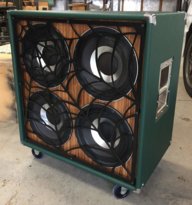
Celestion Pulse XL 10.40 Cab
- Thread starter LeighOnSea
- Start date
More options
Who Replied?

It looks like this one was converted to RCA when they probably lost the speaker plugs like in this vidDon’t do this unless you want to destroy your amp. RCA speaker jacks were used by some low end models for convenience but caused more problems than they solved.
And mine looks like this
Last edited:
OK, Hence that silver 'CAUTION' sticker on the back of the amp I guessAlso, yes you could run your cab off one of the stereos channels. Remember, if you play your A speakers with your cab on one of the B speaker outputs together, the stereo will see the two speakers in parallel. So assuming speaker A is 8 ohm and your cab is 8 ohm, that channel, whether it be the left or right, will see a 4 ohm load.
What about this kind of thing?
 www.soundonsound.com
The Rane link in post 2 ([Invalid or Expired Link Removed]) is dead but good old WayBackMachine comes to the rescue:
Or will those resistors mess up the 8 ohm impedance?
-------------
Wye-connectors (or "Y"-connectors, if you prefer) should never have been created.
Anything that can be hooked-up wrong, will be. You-know-who said that, and she was right. A wye-connector used to split a signal into two lines is being used properly; a wye-connector used to mix two signals into one is being abused and may even damage the equipment involved.
Here is the rule: Outputs are low impedance and must only be connected to high impedance inputs -- never, never tie two outputs directly together -- never. If you do, then each output tries to drive the very low impedance of the other, forcing both outputs into current-limit and possible damage. As a minimum, severe signal loss results.
One of the most common examples of tying two outputs together is in "monoing" the low end of multiway active crossover systems. This combined signal is then used to drive a sub-woofer system.
Since low frequencies below about 100Hz have such long wavelengths (several feet), it is very difficult to tell where they are coming from (like some of your friends). They are just there -- everywhere. Due to this phenomenon, a single sub-woofer system is a popular cost-effective way to add low frequency energy to small systems.
So the question arises as how best to do the monoing, or summing, of the two signals? It is done very easily by tying the two low frequency outputs of your crossovers together using the resistive networks described below. You do not do it with a wye-cord.
Figure 1 shows the required network for sources with Invalid Link Removed outputs. Two resistors tie each input together to the junction of a third resistor, which connects to signal common. This is routed to the single output jack. The resistor values can vary about those shown over a wide range and not change things much. As designed, the input [Invalid or Expired Link Removed] is about 1k ohms and the line driving output impedance is around 250 ohms. The output impedance is small enough that long lines may still be driven, even though this is a passive box. The input impedance is really quite low and requires 600 ohm line-driving capability from the crossover, but this should not create problems for modern active crossover units.
The rings are tied to each other, as are the sleeves; however, the rings and sleeves are not tied together. Floating the output in this manner makes the box compatible with either Invalid Link Removed or unbalanced systems. It also makes the box ambidextrous: It is now compatible with either unbalanced (mono, 1-wire) or balanced (stereo, 2-wire) 1/4" cables. Using mono cables shorts the ring to the sleeve and the box acts as a normal unbalanced system; while using stereo cables takes full advantage of the floating benefits.
Figure 2 shows a network for combining a stereo input to a mono output. The input and output are either a 1/4" TRS, or a mini 1/8" TRS jack. The comments regarding values for Figure 1 apply equally here.
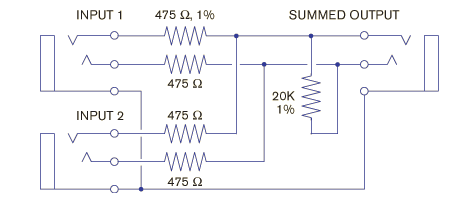
Figures 3 and 4 show wiring and parts for creating a balanced summing box. The design is a natural extension of that appearing in Figure 1. Here both the tip (pin 2, positive) and the ring (pin 3, negative) tie together through the resistive networks shown. Use at least 1% matched resistors. Any mismatch between like-valued resistors degrades the common-mode rejection capability of the system.
Life is wonderful and then you stub your toe. The corner of the dresser lurking in the night of this Note has to do with applications where you want to sum two outputs together and you want to continue to use each of these outputs separately. If all you want to do is sum two outputs together and use only the summed results (the usual application), skip this section.
The problem arising from using all three outputs (the two original and the new summed output) is one of channel separation, or [Invalid or Expired Link Removed]. If the driving unit truly has zero output impedance, than channel separation is not degraded by using this summing box. However, when dealing with real-world units you deal with finite output impedances (ranging from a low of 47 ohms to a high of 600 ohms). Even a low output impedance of 47 ohms produces a startling channel separation spec of only 27 dB, i.e., the unwanted channel is only 27 dB below the desired signal. (Technical details: the unwanted channel, driving through the summing network, looks like 1011.3 ohms driving the 47 ohms output impedance of the desired channel, producing 27 dB of crosstalk.)
Now 27 dB isn't as bad as first imagined. To put this into perspective, remember that even the best of the old phono cartridges had channel separation specs of about this same magnitude. Therefore stereo separation is maintained at about the same level as a high-qualifty hi-fi home system of the '70s.
For professional systems this may not be enough. If a trade-off is acceptable, things can be improved. If you scale all the resistors up by a factor of 10, then channel separation improves from 27 dB to 46 dB. As always though, this improvement is not free. The price is paid in reduced line driving capability. The box now has high output impedance, which prevents driving long lines. Driving a maximum of 3000 pF capacitance is the realistic limit. This amounts to only 60 feet of 50 pF/foot cable, a reasonable figure. So, if your system can stand a limitation of driving less than 60 feet, scaling the resistors is an option for increased channel separation.
 "Why Not Wye?" Download this note as PDF.
Forum
The Rane link in post 2 ([Invalid or Expired Link Removed]) is dead but good old WayBackMachine comes to the rescue:
Why Not Wye?
Wye-connectors (or "Y"-connectors) should never connect two outputs together, but Rane tells you how to use them correctly.
web.archive.org
Or will those resistors mess up the 8 ohm impedance?
-------------
Why Not Wye?
Dennis Bohn, Rane
RaneNote 109 written 1991; last revised 4/04
- Splitting Signals
- Subwoofing in Mono
- Unbalanced Summing
- Balanced Summing
- Output Impedances
Introduction
Wye-connectors (or "Y"-connectors, if you prefer) should never have been created.
Anything that can be hooked-up wrong, will be. You-know-who said that, and she was right. A wye-connector used to split a signal into two lines is being used properly; a wye-connector used to mix two signals into one is being abused and may even damage the equipment involved.
Here is the rule: Outputs are low impedance and must only be connected to high impedance inputs -- never, never tie two outputs directly together -- never. If you do, then each output tries to drive the very low impedance of the other, forcing both outputs into current-limit and possible damage. As a minimum, severe signal loss results.
Monoing Your Low End
One of the most common examples of tying two outputs together is in "monoing" the low end of multiway active crossover systems. This combined signal is then used to drive a sub-woofer system.
Since low frequencies below about 100Hz have such long wavelengths (several feet), it is very difficult to tell where they are coming from (like some of your friends). They are just there -- everywhere. Due to this phenomenon, a single sub-woofer system is a popular cost-effective way to add low frequency energy to small systems.
So the question arises as how best to do the monoing, or summing, of the two signals? It is done very easily by tying the two low frequency outputs of your crossovers together using the resistive networks described below. You do not do it with a wye-cord.
Summing Boxes
Unbalanced Summing Box
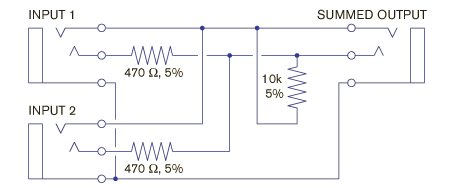
Figure 1 shows the required network for sources with Invalid Link Removed outputs. Two resistors tie each input together to the junction of a third resistor, which connects to signal common. This is routed to the single output jack. The resistor values can vary about those shown over a wide range and not change things much. As designed, the input [Invalid or Expired Link Removed] is about 1k ohms and the line driving output impedance is around 250 ohms. The output impedance is small enough that long lines may still be driven, even though this is a passive box. The input impedance is really quite low and requires 600 ohm line-driving capability from the crossover, but this should not create problems for modern active crossover units.
Figure 1. Unbalanced Summing Box
The rings are tied to each other, as are the sleeves; however, the rings and sleeves are not tied together. Floating the output in this manner makes the box compatible with either Invalid Link Removed or unbalanced systems. It also makes the box ambidextrous: It is now compatible with either unbalanced (mono, 1-wire) or balanced (stereo, 2-wire) 1/4" cables. Using mono cables shorts the ring to the sleeve and the box acts as a normal unbalanced system; while using stereo cables takes full advantage of the floating benefits.
Stereo-to-Mono Summing Box
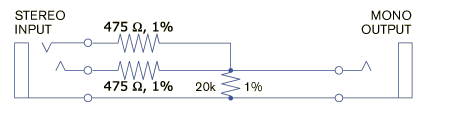
Figure 2 shows a network for combining a stereo input to a mono output. The input and output are either a 1/4" TRS, or a mini 1/8" TRS jack. The comments regarding values for Figure 1 apply equally here.
Figure 2. Stereo-to-Mono Summing Box
Balanced Summing Boxes
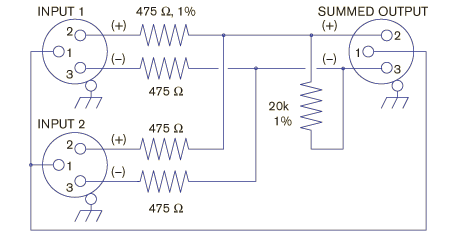
Figures 3 and 4 show wiring and parts for creating a balanced summing box. The design is a natural extension of that appearing in Figure 1. Here both the tip (pin 2, positive) and the ring (pin 3, negative) tie together through the resistive networks shown. Use at least 1% matched resistors. Any mismatch between like-valued resistors degrades the common-mode rejection capability of the system.
Figure 3. Balanced summing box using XLR connectors
Figure 4. Balanced summing box using 1/4" TRS connectors
Termites in the Woodpile
Life is wonderful and then you stub your toe. The corner of the dresser lurking in the night of this Note has to do with applications where you want to sum two outputs together and you want to continue to use each of these outputs separately. If all you want to do is sum two outputs together and use only the summed results (the usual application), skip this section.
The problem arising from using all three outputs (the two original and the new summed output) is one of channel separation, or [Invalid or Expired Link Removed]. If the driving unit truly has zero output impedance, than channel separation is not degraded by using this summing box. However, when dealing with real-world units you deal with finite output impedances (ranging from a low of 47 ohms to a high of 600 ohms). Even a low output impedance of 47 ohms produces a startling channel separation spec of only 27 dB, i.e., the unwanted channel is only 27 dB below the desired signal. (Technical details: the unwanted channel, driving through the summing network, looks like 1011.3 ohms driving the 47 ohms output impedance of the desired channel, producing 27 dB of crosstalk.)
Now 27 dB isn't as bad as first imagined. To put this into perspective, remember that even the best of the old phono cartridges had channel separation specs of about this same magnitude. Therefore stereo separation is maintained at about the same level as a high-qualifty hi-fi home system of the '70s.
For professional systems this may not be enough. If a trade-off is acceptable, things can be improved. If you scale all the resistors up by a factor of 10, then channel separation improves from 27 dB to 46 dB. As always though, this improvement is not free. The price is paid in reduced line driving capability. The box now has high output impedance, which prevents driving long lines. Driving a maximum of 3000 pF capacitance is the realistic limit. This amounts to only 60 feet of 50 pF/foot cable, a reasonable figure. So, if your system can stand a limitation of driving less than 60 feet, scaling the resistors is an option for increased channel separation.
Last edited:

- Feb 12, 2006
- 60,986
- 5
- 220,768
- Disclosures
- Development Engineer-Mesa Boogie, Development Engineer-Genzler (pedals), Product Support-Genz Benz
Not always. There were older receivers that used RCA jacks for speaker outputs.Absolutely no. Your missing the point that most amplifiers/receivers don't use RCAs for speaker outputs. So looking at things like that, that use RCA connectors, are for preamp level voltages.
Forgot trying to run that cab off of that stereo, you got lucky it didn't toast it.
To get what your after it's gonna take a lot more that just hooking up a cable.
It’s very much a possibility.
- Feb 12, 2006
- 60,986
- 5
- 220,768
- Disclosures
- Development Engineer-Mesa Boogie, Development Engineer-Genzler (pedals), Product Support-Genz Benz
Almost all line level outputs (not speaker level) can be safely combined with a Y cord because the build-out resistors are built into the output circuit.
The Rane notes are for different types of outputs intended drive very long lines at low impedances. This is unrelated to most domestic “hi-fi” systems.
The Rane notes are for different types of outputs intended drive very long lines at low impedances. This is unrelated to most domestic “hi-fi” systems.
Last edited:
Thanks @agedhorseAlmost all line level outputs (not speaker level) can be safely combines with a Y cord because the build-out resistors are built into the output circuit.
The Rane notes are for different types of outputs intended drive very long lines at low impedances. This is unrelated to most domestic “hi-fi” systems.
I will let this one lie then - and that's hard for me to do

Pity
or I should more correctly say, 'BUGGER!'
Last edited:
But I think in this case, given the amateur aspect of the RCA outputs with wood, hand written L & R in biro and pop-rivets in my photos and the fact that the originals have easily loosable plugs, that the outputs I am using are normal speaker outputs.Not always. There were older receivers that used RCA jacks for speaker outputs.
It’s very much a possibility.
But seems to be a possibility in other cases, from what you say
Exactly, hence why I said most. (I had one...long long time ago)Not always. There were older receivers that used RCA jacks for speaker outputs.
It’s very much a possibility.
Which upon remembering that, I watched it go up in smoke when lightning hit my house. Also my buddy was playing my bass through his guitar amp and was literally shocked when it happened! Didn't kill the guitar amp...or him! Crazy night.
I understand his does, that's why I stated most things RCA now are all line level/ preamp level stuff, not gonna work for what he's trying to do.

Perhaps you could get a separate amplifier and use a Y splitter to summ up the left and right output into 1 channel and drive the speaker like a sub that way.
If memory serves me right the tape connectors are 2 inputs and 2 outputs (Left and Right), you could use the the tape outputs to power another amp possibly.
If memory serves me right the tape connectors are 2 inputs and 2 outputs (Left and Right), you could use the the tape outputs to power another amp possibly.
- Feb 12, 2006
- 60,986
- 5
- 220,768
- Disclosures
- Development Engineer-Mesa Boogie, Development Engineer-Genzler (pedals), Product Support-Genz Benz
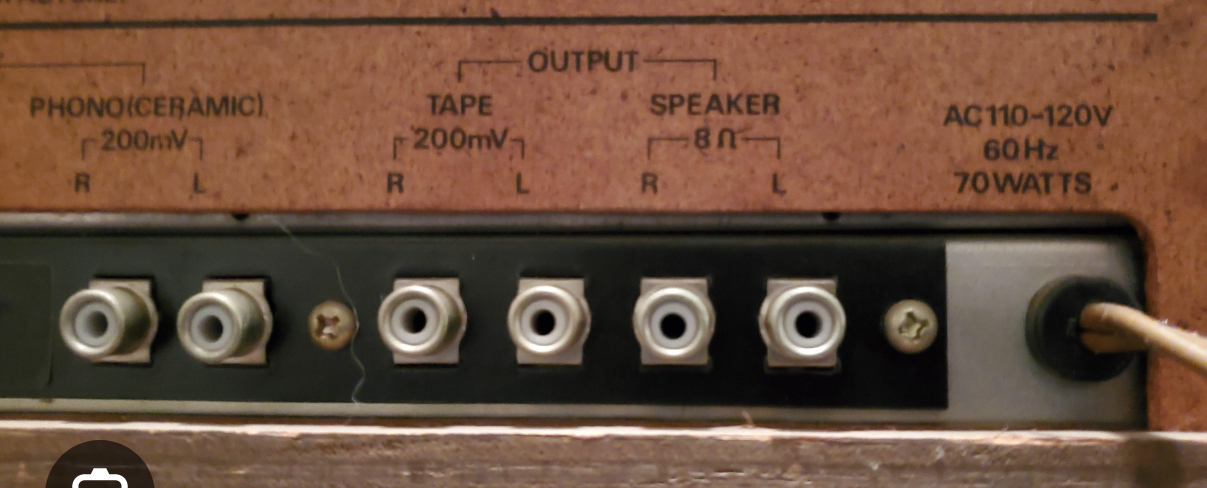
Here's an example of why I cautioned about RCA possibly being speaker level, this was common in the 1960's and 70's with department store type systems:
- Feb 12, 2006
- 60,986
- 5
- 220,768
- Disclosures
- Development Engineer-Mesa Boogie, Development Engineer-Genzler (pedals), Product Support-Genz Benz
It looks like this one was converted to RCA when they probably lost the speaker plugs like in this vid
View attachment 7028281
View attachment 7028284View attachment 7028285
And mine looks like this
That was an old Pioneer amplifier that used the pioneer specific plugs. It was in fact converted as a DIY type project. I used to stock those plugs back when I was putting myself through university as a service tech and then service manager.
I could always make a second cab and have them as stereo speakers on the stereo and stack them for my bass
How do you connect two cabs to a single head (In this case using the exterior speaker output of my Markbass combo) with one output?
How do you connect two cabs to a single head (In this case using the exterior speaker output of my Markbass combo) with one output?
That was going to be my next suggestion.
Unless it unhooks the internal speaker, you probably can't do that with the Markbass.
Although, if you end up with a stand alone head, it'd be great. Most amps will support 4ohm.
I say...do it
Unless it unhooks the internal speaker, you probably can't do that with the Markbass.
Although, if you end up with a stand alone head, it'd be great. Most amps will support 4ohm.
I say...do it
There is a switch to cut off the internal speaker but it says min 8 Ohm for the external speakerThat was going to be my next suggestion.
Unless it unhooks the internal speaker, you probably can't do that with the Markbass.
Although, if you end up with a stand alone head, it'd be great. Most amps will support 4ohm.
I say...do it
I am trying to find out the exact model of the head I am getting
I just know it is a Trace Elliot AH something, maybe a 600 or 500, with a silver casing
So, since you mention 4 ohms then you just connect two cabs in parallel?
I will have to save my pennies, but I am sorely tempted.
I could do the second one much quicker, and probly a bit cheaper too
PS thanks for being The Voice of Reason and dissuading me from such a daft idea
Last edited:
Yes, parallel. Either your amplifier would have two outputs or install a jack plate on the next cab you build that has two jacks wired parallel. Maybe even go back and retrofit that into the cab you have now.
It's always easier to build the second one. Save up, you'll be glad you did.
It's always easier to build the second one. Save up, you'll be glad you did.
Still no second Build - too busy practicing!
I am still crap tho
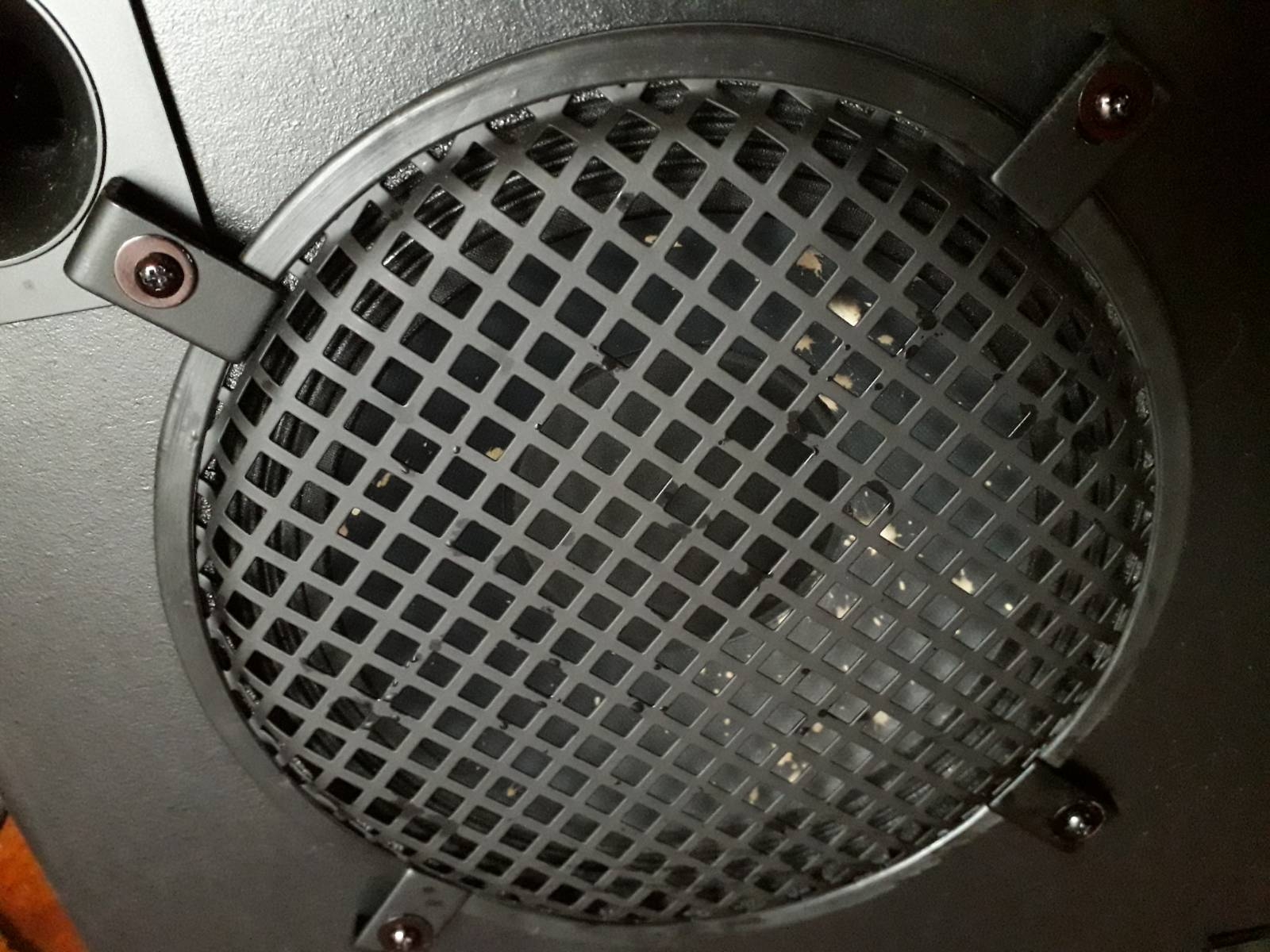
The cleaning lady dropped a bottle of 'neat' bleach from height in the living room (tiled luckily) and I have just noticed that it must have splashed the driver of my cab (see below)
I thought of washing it off carefully but I only noticed 5 hours after she did it, so thought it wasnt worth it and best to leave well alone
I wonder if it will burn holes in cone or later make it fail under load?
I quite like the look though, but dont suggest it as a way of customising
From their site
Cone material - Cellulose
A fabric dust dome contributes to a particularly articulate treble response.

I am still crap tho
The cleaning lady dropped a bottle of 'neat' bleach from height in the living room (tiled luckily) and I have just noticed that it must have splashed the driver of my cab (see below)
I thought of washing it off carefully but I only noticed 5 hours after she did it, so thought it wasnt worth it and best to leave well alone
I wonder if it will burn holes in cone or later make it fail under load?
I quite like the look though, but dont suggest it as a way of customising
From their site
Cone material - Cellulose
A fabric dust dome contributes to a particularly articulate treble response.


