• TalkBass has been independent since 1998. Add your voice.
    Create a free account to reply to discussions, view embedded media, and browse with fewer display ads.
    Join freeLog in
    Want zero display ads or expanded classifieds tools? Compare plans.
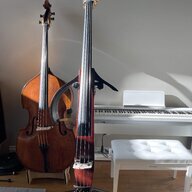
Double Bass "Cheater Lines" or not? (position markers)

I need to use marks, I am extremely visual. Even when playing guitar, I need to look at the fretboard unless I am in the middle of playing a single note or chord for an extended amount of time. I drew square and triangle shapes near the edge of the fingerboard that would correspond to where dots would be on a guitar. I know that my visual orientation is a handicap, but that's just how my brain is wired.


Wow! I'm exactly the same. Thanks for having the courage to express it.

There's some stigma attached to it by others. Like it means you're not really a cat because you look at the fretboard while you play.

For me, I think it's because my visual sense is prominent. My other serious hobby is photographing.
 
I can weigh in a bit here; I bought a used Eminence a couple of years ago. It has lines on the edge of the neck (closest to your body). It is an option for which there is a slight up-charge. It doesn't help me in the least, in fact I ended up covering the lines up with a Sharpie. It seems more disorienting to me, and it certainly reinforces what I think to be a not very helpful habit.
JS
 
Look, I'm going through a "muscle-memory" issue myself right now. When I first learned to play electric I taught myself by practing for hours... open strings... root & fifth etc. I did not give into my impulse to play for fun.... strictly discipline. The fun (and there was plenty of it that left many others behind) came later.

Now on my EUB I'm working with Jamie Abersold stuff and keeping it simple. I've got to make playing instinctive again so I don't use the markings on the EUB unless I'm doing multi-positional jumps (I want to see where I'm going wrong).... and yes I'm playing simple lines... drilling & re-drilling the positions and sounds into my head. This too will start to change as my developing muscle-memory takes a backseat to the less mechanical and more creative aspects of playing. Start slow... do it right... then do it right some more. It'll happen, but you'll probably be the last one to realize it ! Good luck.
 
For almost all beginners it is far easier to look at a fingerboard and play, especially from BG. BG doesn't require ear training to play, it helps a lot to have it, but it isn't a prerequisite. All in all it doesn't matter how you play it, when bass is just another hobby because it does take a lot of commitment and time to grow in musicianship.

The thinking isn't "where do I put my finger to play this note", it's "where do I place my finger to generate the pitch or interval that I'm hearing in my head" and "does the pitch that I'm hearing sound sharp or flat"? If you're thinking pitches, visual becomes irrelevant because you know when you're sharp/flat or that you've played the wrong interval. You just get used to moving your fingers until they are in the right place. It's part of developing as a DBer.
 
I started off on a Violin when I was 7 as my very first instrument. My teacher put tape on there as she did with all of us wee ones. It was much simpler for her to teach that way obviously being able to just say, "2nd tape line, open then the 4th and back to open on the D string." I practiced a lot/loved it. I had a good ear, was always playing in tune and a few months afterwards my teacher noticed I wasn't looking at the tape whenever I was playing after 6 months. Following year I was playing with the junior high orchestra and removed the tape myself and never looked back.

I just bought an upright as well with the tape on it. Got some songs up on my computer and played along.

Even though you're using markers, they'll never be exact because of position changes and shifting later on. Intonation is more dependent on who you play with as opposed to just playing a bass. That's why whenever I hear a guitarist say they can play an Upright and it's no big whoop, if I have the chance I tell them to play a G, not the 3rd fret on the E or open string, 10th Fret A string but on the Upright. I've done this 6 times so far and 2 of them had big enough balls to try to ring that open G first then match it. I go, "No, you get one shot, put your finger down, if it ain't on you don't got it." I have them hit their fingered note, then the open string to see if they match, never do, then they sit around for a few seconds until they match it.

As my rebuttle, "Now is that how I sound whenever I play?"

Tape is a good beginner's utility so you have a visual of the finger spacing and as a preamble to ear training so you can develop physically first. I mean think about how you first began, the early days, did you just pick up your first instrument and wail or was it, "omg! :O, this really hurts my fingers!11! n0 l33t, n0 l33t." You can't really use the tape when playing with others because your goal is to be on pitch, not on the tape. Even if you were to set up the tape with how you play now and beginning, your technique is going to develop and your visual will change maybe even enough to justify retaping so it's "in tune".

There's no substitution to playing in tune so just because you're on the tape doesn't mean that guy in the 3rd row is going to say, "well... he's dreadfully flat but he's on the tape." On TOP of all of that. How I bow and pizz, the louder I start to play or get "into" it I start to go sharp. Left hand technique aside, I tested it on open strings. There is no substitution for playing in tune or a good ear.

My summary.

Tape = Good for beginning and grasping finger spacing, Bad to look at on a daily basis and believe that's proper rudiment

No Tape = If you play with others and play in tune then you saved yourself $2 and the sense of false awareness


I teach Violin and I don't let any of my students use tape, not even in the beginning. It takes more time and effort in the beginning but sure as hell pays off in the long run. My belief on tape is that it's a benefit to the instructor, not the student.
 
This came from a VERY experienced DB player/tutor in the UK when the same question was posed....im just passing his advice on....
Must admit..i found it quite surprising myself.

How much experience are we talking about here? I haven't seen any DBers using dots or lines since grade school, and definitely not experienced ones. Switching basses doesn't necessitate the need for dots.

Dots create a habit and reliance of looking at the fingerboard. Trust your ears not your eyes. The notes that you hear on the DB and BG are the same notes and in the same octave. Just as you hear the notes in your head before you strike it on the BG, do the same on the DB. Just play the same pitches and adjust as necessary.
 
I have tiny side dots on the side of the neck at the E string's G, A, and B notes and a small paper dot at the octave at the octave between the D and G strings.

Most of my playing is in a blues band and it's not always easy to hear intonation. It gives me a good chance of hitting a note in tune at the start of a song.

I would say though that it's a crutch I'm trying to get away from, because it hurts the ability to play in tune while reading music, since my muscle memory doesn't develop as well.
 
If it helps you play better music then go for it, because the end results is all that matters. When I play EBG it has markers all over the neck, and frets. I rarely ever look at the bass when I'm playing it. Side marks on a UB or EUB will become a non factor as your skill developes. It's a art form, not a contest about who can play blind folded in a dark room.

 
  • Like
Reactions: james condino
If it helps you play better music then go for it, because the end results is all that matters. When I play EBG it has markers all over the neck, and frets. I rarely ever look at the bass when I'm playing it. Side marks on a UB or EUB will become a non factor as your skill developes. It's a art form, not a contest about who can play blind folded in a dark room.

A big +1
 
go ahead and put some dots on..... if you have a good ear your hands will come around and you won't need the dots after a while......If you DON'T have a great ear, your audience will appreciate it.:cool:

a great , cheap, and removable dot system is a little speck of white-out.
here's the kicker, however...... HOW do you find the correct location???? here's the hint. go to stew-mac and use their fret scale calculator.

but by all means I demand that you have fun!
 
I just used a tuner to locate the thin strips of tape I was using. I took most of them off now and only have a strip at "3" and "7" that I just use when I first pick up the EUB after playing my electric bass to get myself re-aquainted with the positions. They just need to get me close and I use my ear to fine tune my placement.

Havin lots of fun and can't believe I waited this long to play upright!
 
I don't believe in "cheating" in an activity that has no real rules or winners/losers, but I will say that learning to play a fretless without lines has advantages. For one, it truly helps a live setting to not have to look at the bass.. fretless is all based on familiar hand positioning to determine notes. It frees up your eyes to look at bandmates for cues or other communications, or to just close your eyes and let it "rip". Besides, you may end up in a situation where you have to borrow a bass without the lines.. what will you do then?

That being said, it's your bass and your playing so do as you please.
 
Yeah, I agree with most of what you said. During a typical gig, I'll play a five string Spector, six string lead guitar, and a short scale Ibanez before switching to the EUB. It is quite a change going from the ultra short scale, fretted Ibanez to the upright Pal, and a couple lines on the side of the neck eases the transition. No one knows but me because the black tape blends in with the fingerboard well and no one really gets a close look at the side of the neck. I never really get in any situations where I'd need to borrow an upright, because I'd just play the parts on one of my electric basses.

I am fairly confident I'd be able to play just fine on a borrowed upright if I took a bit of time to find my positions, but don't anticipate that need arising. When I started this thread, I was concerned about becoming dependant upon the lines, but I think I've struck a workable balance and need the lines rarely now after I've re-aclimated myself to the instrument.
 
MOP dots can easily be obtained either in a local music store or eBay. You as easily get tiny, unobtrusive dots in abalone as well as large, easily seen dots in MOP (and everything in between). You can even find (apologies) glow-in-the-dark position markers. They are all easily installed with a drill and epoxy. If you come to hate them, they can be removed and the hole filled with a mix of epoxy and a blackening agent like charcoal or ebony dust. Get the small abalone ones, place them off center (I would recommend on the bass side, right if you are right handed) and I bet you could easily learn to ignore them when you don't need them. Audience will probably not even see them (but then who cares what audience thinks anyway?).