
Enjoy the benefits of a premium membership!
Upgrade Account
-
TalkBass has been independent since 1998. Add your voice.
Create a free account to reply to discussions, view embedded media, and browse with fewer display ads.
Join free Log in
Want zero display ads or expanded classifieds tools? Compare plans.
You are using an out of date browser. It may not display this or other websites correctly.
You should upgrade or use an alternative browser.
You should upgrade or use an alternative browser.
Circle K strings...
- Thread starter James Hart
- Start date
More options
Who Replied?
knuckle_head
Commercial User
- Jul 30, 2002
- 2,621
- 58
- Disclosures
- Owner; Knuckle Guitar Works & Circle K Strings
Any plans for flatwounds in the near future?
They're down the list a bit - first is sets for touch/throughbody basses, and then steels.

E and larger are tapered - and a tight taper at that. It's why through body guys can't use Circle K's - yet.
What makes them unsuitable for through-body?
I'm assuming (always a dangerous thing) that it's because the windings could separate due to the sharper angle over the saddle.
I don't see how it would be any worse than non-tapered strings?
I'm asking because I have my primary 6er strung up with Circle Ks, and would like to do the same with my backup 6, which is thru' body.
knuckle_head
Commercial User
- Jul 30, 2002
- 2,621
- 58
- Disclosures
- Owner; Knuckle Guitar Works & Circle K Strings
What makes them unsuitable for through-body?
I'm assuming (always a dangerous thing) that it's because the windings could separate due to the sharper angle over the saddle.
I don't see how it would be any worse than non-tapered strings?
I'm asking because I have my primary 6er strung up with Circle Ks, and would like to do the same with my backup 6, which is thru' body.
The taper at the ball end is 1.625". Depending on the depth of your ferules the full width of the string could potentially be made to bend at the bridge plate.
I suspect the larger gauges would be prone to breaking at the bend point.
I did it this way to minimize the exposed amount of taper to preempt inharmonicity.
Thank you for the info, sir.
The ferules on the bass in question are 1" +/- deep, with 3/4" +/- from the ball end to the top of the bridge plate.
Seems that your strings should work on this bass without a problem.
The ferules on the bass in question are 1" +/- deep, with 3/4" +/- from the ball end to the top of the bridge plate.
Seems that your strings should work on this bass without a problem.
What bugs me is that I've read lot of comments (your website included) that Circle K feels more flexible than other similiar tension strings. While it sound logical that also means more even and richer harmonic contet, do they actually feel flabby-er (I allways strive for lowest action possible, will this "higher flexibility" set me off?).
These strings feel flexible, but the tension is not that low. The two things are different. I put my first set of Balanced Standard 106 on my Ric 4003, with a straight neck and lowest possible action being the setup it was already at. These strings perform perfectly well in that setting--it's not that "excessive buzz" thing you might have pictured, just the regular amount of quieter buzz when digging in that doesn't really transmit through the amp. These strings really are a different breed, not just a floppier version of what you're used to. You've got to remember that feel and tension aren't exactly the same thing.

Understandable. But tension will always affect the feel of a string. If you haven't tried a circle k string yet, you have to go by the gauge/tension and the fact everyone says they're supple feeling. This is why I really need to freakin try a set already, looking forward to my school bills finally being paid off so I can start buying things again...These strings feel flexible, but the tension is not that low. The two things are different. I put my first set of Balanced Standard 106 on my Ric 4003, with a straight neck and lowest possible action being the setup it was already at. These strings perform perfectly well in that setting--it's not that "excessive buzz" thing you might have pictured, just the regular amount of quieter buzz when digging in that doesn't really transmit through the amp. These strings really are a different breed, not just a floppier version of what you're used to. You've got to remember that feel and tension aren't exactly the same thing.
Finaly, one weird question: have you tried, or you know someone has tried, "inverted tension" set, something like 106 76 55 40 ?
I'm very enthusiastic about inverted tension and always design my sets this way. There are many advantages, but I won't go into detail on a Circle K thread.
The original SIT power steel ERB set, sold on the Conklin Guitars website, had gauges designed by Talkbass administrator John Turner and was inverse from E up (approximate tensions):
Eb .007p 13 lbf
Bb .011p 18 lbf
F .018p 26 lbf
C .025 27 lbf
G .035 29 lbf
D .055 38 lbf
A .080 44 lbf
E .110 47 lbf
B .135 39 lbf
F# .165 32 lbf
C# .194 25 lbf
lbf = pound force.
The idea was to make tapping, chording and string bending easier on the high strings. Also of course to avoid breaking the highest plain string which cannot withstand anything more than guitar tension.
knuckle_head
Commercial User
- Jul 30, 2002
- 2,621
- 58
- Disclosures
- Owner; Knuckle Guitar Works & Circle K Strings
Thank you for the info, sir.
The ferules on the bass in question are 1" +/- deep, with 3/4" +/- from the ball end to the top of the bridge plate.
Seems that your strings should work on this bass without a problem.
Another thing to consider is that you are consuming string length by going through-body and will likely need to get mediums to get past the nut with a full thickness.
There is a PDF on the site that gives you lengths/distances - give it a good hard look before you part with money to be certain you're getting what will work.
It's not that just buzzing bothers me that much, but "floppy" thick strings are really hard for me to play (thicker the string, worse the effect; when E is flappy I feel like im plucking piece of felt, completely losing sensing and control, unlike D and G which I like a bit loose; I think it's about my picking, it doesn't bother me nearly that much when I play with fingers). Maybe it's just some unquantifiable "resposivness" factor in string, maybe tense-but-elastic Cirlce K will be just pefect, but I'll know when I string them.These strings perform perfectly well in that setting--it's not that "excessive buzz" thing you might have pictured, just the regular amount of quieter buzz.
While I agree, my reasons are much more prosaic: IMveryHO, lower tension strings are less "twangy/bright", so I figured out that inverted tension set would be a bit better balanced tonaly for my taste, so I want to try that one day.The idea was to make tapping, chording and string bending easier on the high strings. Also of course to avoid breaking the highest plain string which cannot withstand anything more than guitar tension.
Dunlop nickels are my favorite rounds right now. I've been using flats for a while on my 44-02, but want to go back to rounds. I've read all the stuff on the balanced sets of these CK strings, and I'm intrigued. I really like the feel of the Dunlops. Stiffer than Slinkys but not as tight as Roto's. I used High-Beams but only for a little while so I can't comment on those. I use the standard 45-105 guage. I understand that my lighter strings are going to be tighter than my lower ones, and now that I'm looking for it I do notice the difference in tension. I really like how my E feels though. So, anyone in here make the switch from Dunlops? If you did what guage CK did you choose and how would you compare the feel between the E strings?
knuckle_head
Commercial User
- Jul 30, 2002
- 2,621
- 58
- Disclosures
- Owner; Knuckle Guitar Works & Circle K Strings
I really like how my E feels .....
This is how you should select your set - by what you're comfortable with at E.
Dunlop nickels are my favorite rounds right now. I've been using flats for a while on my 44-02, but want to go back to rounds. I've read all the stuff on the balanced sets of these CK strings, and I'm intrigued. I really like the feel of the Dunlops. Stiffer than Slinkys but not as tight as Roto's. I used High-Beams but only for a little while so I can't comment on those. I use the standard 45-105 guage. I understand that my lighter strings are going to be tighter than my lower ones, and now that I'm looking for it I do notice the difference in tension. I really like how my E feels though. So, anyone in here make the switch from Dunlops? If you did what guage CK did you choose and how would you compare the feel between the E strings?
I used the Dunlop 45-130 set on my Modulus, which I actually really dug. They are quite impressive for the price, but the weaknesses are the same as with any other set I've used....
So after trolling around here for a bit I got a Balanced 142 set, and have not looked back.
You will find (amazingly enough, as most of these claims are patently false) that reduced hand fatigue, and balanced tone do indeed occur with these strings. They do seem to last quite a while too... I was a die-hard steel player for YEARS, and I don't feel the need to change 'em any more often....
I wrote a BGRA review which can be found here: [Invalid or Expired Link Removed]

put a set of .136 balanced standards on my Lakland DJ5through the bridge. very nice overall. I'm getting a little overtone problem on the E and B, i think i might have a little too much of the taper core past the saddles, over .500 on the E and over .600 on the B. I may shim the ball end at the tailstock if this is an issue in a mix, to see if that helps. This is only noticable when playing solo, I've got gigs tonight and tomorrow, modern country, lots of B string stuff, so i'll let you know how they do. great feeling and sounding strings.
Bill
Bill
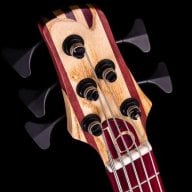
So I just strung up my Lecompte with the "5 String Set - Balanced Medium 142".
I chose that set because I really enjoyed my Dunlops (40-60-80-100-125). This Circle K set is 43-58-80-106-142.
My initial impressions were that they had a nice feel to my fingers and were very clear sounding. Seems quite pleasing. A+ so far.
Except the B string sounds terrible. Incredibly dull and lifeless with no tonal definition which strikes me oddly since I was told here that the three wrap string would be more sonically lively and that this is a 36" scale B.
Is this a dead string or should it be like this? I'm letting the strings sit a couple of nights and seeing how they sound Sunday morning. I really hoping this string issue somehow resolves itself because I had to file the nut just for the string to fit in the first place.
I chose that set because I really enjoyed my Dunlops (40-60-80-100-125). This Circle K set is 43-58-80-106-142.
My initial impressions were that they had a nice feel to my fingers and were very clear sounding. Seems quite pleasing. A+ so far.
Except the B string sounds terrible. Incredibly dull and lifeless with no tonal definition which strikes me oddly since I was told here that the three wrap string would be more sonically lively and that this is a 36" scale B.
Is this a dead string or should it be like this? I'm letting the strings sit a couple of nights and seeing how they sound Sunday morning. I really hoping this string issue somehow resolves itself because I had to file the nut just for the string to fit in the first place.
knuckle_head
Commercial User
- Jul 30, 2002
- 2,621
- 58
- Disclosures
- Owner; Knuckle Guitar Works & Circle K Strings
Sounds like a bad string - let it set on the bass for a time, but I'm happy to get a replacement to you if it continues to sound as you suggest it does.
Really interesting thread! Seattle too! Add another cool company to the list of PacNW audio and MI manufacturers (musicians friend do NOT count).
I'd love to see how they are made, I'm a freak for manufacturing porn, it'd be cool to see how it's done. I've been a die hard D'Addario XL170-6 fan for the last 10 years or so. I don't want a balanced set tension wise, I've mixes and matched and done the math. The B ends up too tight and has no voice. Acoustically it makes sense but it's too much mass over the pickup (inertia too). I like the lighter bottom strings, but I'm not asking for a low A or F#.
I'd love to see how they are made, I'm a freak for manufacturing porn, it'd be cool to see how it's done. I've been a die hard D'Addario XL170-6 fan for the last 10 years or so. I don't want a balanced set tension wise, I've mixes and matched and done the math. The B ends up too tight and has no voice. Acoustically it makes sense but it's too much mass over the pickup (inertia too). I like the lighter bottom strings, but I'm not asking for a low A or F#.

put a set of .136 balanced standards on my Lakland DJ5through the bridge. very nice overall. I'm getting a little overtone problem on the E and B < ... > This is only noticable when playing solo
I definitely noticed the overtone problem. I have had this problem with all tapered core (at the bridge) strings I have ever tried, and every bass. I guess I'm sensitive to it, because I never hear other people complaining about it.
On my Sadowsky 5, the A through G sounded great, but the B and E had that out-of-tune harmonic sound that sounds like the string is too close to the pickup. The out-of-tune sound can't be heard with a band, but it makes the sound less focused, and the blurriness of the B and E bothered me, even though I love the snap and tone of the higher strings.
If I could get these strings with no tapered bridge on all 5 strings, I would love it. As it is, I am currently on Fatbeams, which have a more solid low end but less zing which I miss.
Also, I like the sound of a .125 B. Circle K's .136 sounded better than other thick strings, but I like the focus and midrange emphasis that seems to come from a thinner string.
I had more intonation problems with non-tapered B strings than I did with tapered. My B sounds great but I have to feather it. Hoping when I get this circle k set that won't be a problem. Due to the shear thickness of the B string I prefer to have a taper at the bridge. But I haven't tried very many non-taperedI definitely noticed the overtone problem. I have had this problem with all tapered core (at the bridge) strings I have ever tried, and every bass. I guess I'm sensitive to it, because I never hear other people complaining about it.
On my Sadowsky 5, the A through G sounded great, but the B and E had that out-of-tune harmonic sound that sounds like the string is too close to the pickup. The out-of-tune sound can't be heard with a band, but it makes the sound less focused, and the blurriness of the B and E bothered me, even though I love the snap and tone of the higher strings.
If I could get these strings with no tapered bridge on all 5 strings, I would love it. As it is, I am currently on Fatbeams, which have a more solid low end but less zing which I miss.
Also, I like the sound of a .125 B. Circle K's .136 sounded better than other thick strings, but I like the focus and midrange emphasis that seems to come from a thinner string.
Bs yet. Guess we'll just have to wait and see.


