
Enjoy the benefits of a premium membership!
Upgrade Account
-
TalkBass has been independent since 1998. Add your voice.
Create a free account to reply to discussions, view embedded media, and browse with fewer display ads.
Join free Log in
Want zero display ads or expanded classifieds tools? Compare plans.
You are using an out of date browser. It may not display this or other websites correctly.
You should upgrade or use an alternative browser.
You should upgrade or use an alternative browser.
Double Bass Cleaning rosin block
- Thread starter afroblue
- Start date
More options
Who Replied?
For full disclosure, I am a string bass player that's highest profile gig was playing with a community concert band 30 years after being principle bass in my high school orchestra.
I would put the rosin in the fridge to chill it, then gently scrape off the top layer with a razor. An X-acto knife would work well.
I would not try any chemical cleaner, as it may impart some residual chemicals into the rosin. I also would not use sandpaper, as small particals might also come off and inbed in the rosin.
I'm sure a classically trained bassist may have other ideas.
You could also just get a new rosin block and scrap the old one.
I would put the rosin in the fridge to chill it, then gently scrape off the top layer with a razor. An X-acto knife would work well.
I would not try any chemical cleaner, as it may impart some residual chemicals into the rosin. I also would not use sandpaper, as small particals might also come off and inbed in the rosin.
I'm sure a classically trained bassist may have other ideas.
You could also just get a new rosin block and scrap the old one.

This classically trained bassist would probably just toss it and then rue the prohibitive costs of Leatherwood products.
Were I feeling particularly frugal (read: stubborn) I would soften it up in the microwave and peel the top layer off using a cheese wire or a fine blade.
Were I feeling particularly frugal (read: stubborn) I would soften it up in the microwave and peel the top layer off using a cheese wire or a fine blade.


Good idea, but put it in the FREEZER, and scrape off the top 1/8in., or so.put the rosin in the fridge to chill it, then gently scrape off the top layer with a razor. An X-acto knife would work well.
I've done this many times and it works just fine.
You can then smooth over the scraped area by holding it (upside down) over a stove burner to gently melt the top and let it settle at room temp. for a few hours.
Good Luck.
Scrape it with any knife or scrub it with any scour pad. However... Rosin lives in an airtight silicone sleeve for all but 5-10 seconds per day. I seriously doubt it has anything other than its own rosin dust on the surface. YMMV, I suppose.
I will scrape the very top layer as it dries out every couple of months or so. If you are going to melt the rosin to reform it, I would suggest scraping before melting, as our esteemed Don Kasper does. Otherwise, you're just mixing the dried outer layer into the good stuff.
I will scrape the very top layer as it dries out every couple of months or so. If you are going to melt the rosin to reform it, I would suggest scraping before melting, as our esteemed Don Kasper does. Otherwise, you're just mixing the dried outer layer into the good stuff.

Scraping should work. What temperature you need it at to be scraped effectively depends on the hardness or softness of the particular rosin, and I have no sense of where Leatherwood sits on that scale. My rosin (Sherman's) would scrape fine at room temperature, but we've long since established that I'm not using the usual soft-sticky rosins.

My first instinct would be to use a hot blade to slice off a layer. I have a hot wire foam cutter that would be perfect, but any long thin blade heated on a burner or a flame could work.
After reading the other suggestions, however, I’m rather fond of the freezing idea. I think an hour in the freezer and a quick swipe on some 60 grit sandpaper would probably do the trick. If it doesn’t do all of it, you could just throw it back in the freezer for another swipe. This would probably be much neater than using heat or a blade, which could make a mess.
After reading the other suggestions, however, I’m rather fond of the freezing idea. I think an hour in the freezer and a quick swipe on some 60 grit sandpaper would probably do the trick. If it doesn’t do all of it, you could just throw it back in the freezer for another swipe. This would probably be much neater than using heat or a blade, which could make a mess.
Thanks for the replies everyone. Leatherwood is great (but costly!) so I want to use what I have. I have 3 cakes and they range from hard to quite sticky. The rosin has acquired some dirt from the old bow hair which was on for 3 years (!!) What a difference the rehair has made 
I scrape directly over/into the garbage can using a pocket knife on room temperature rosin, from bernardel to wiedoeft.
Unless I'm doing the whole melting process, I only scrape the edge I'm about to swipe.
You can also take the cake out of the silicone completely, flip it upside down, et voila - four fresh new edges! By the time you wear this side down, you'll be ready for a full scrape/melt/stir.
Unless I'm doing the whole melting process, I only scrape the edge I'm about to swipe.
You can also take the cake out of the silicone completely, flip it upside down, et voila - four fresh new edges! By the time you wear this side down, you'll be ready for a full scrape/melt/stir.

I would just scrape it gently with something that fits into the little groove, or if it's the cake, something wide and flat. Yes, a pocket knife, or some sort of plane or woodworking tool might be good. Just remove the dirty layer, then use a bow to even things out. Introducing chemicals or heat is asking for trouble, given how the Leatherwood is put together. Definitely too expensive to trash.
Here (see below) is what my Oak Rosin looks like after slowly/gently melting the surface (being held upside down) over an open flame to smooth out the deep "ruts" that develop over time.
Note the marks in the surface - confirming that an even application of rosin has been applied evenly across the width of the hair.
I do this every few months or so, as needed.
TMI - I prefer a square cake, (vs. round) to ensure an even application. This container is from a Silicone ice-cube tray. I liberated a few of the "cubes" and now I have a supply of containers for melting/mixing/storing/applying my collection of "rosins". (I've got a few...!)
(I'm loving this Oak Rosin - it was the best $50 I ever spent. I wish it was still being made...)
Thanks.
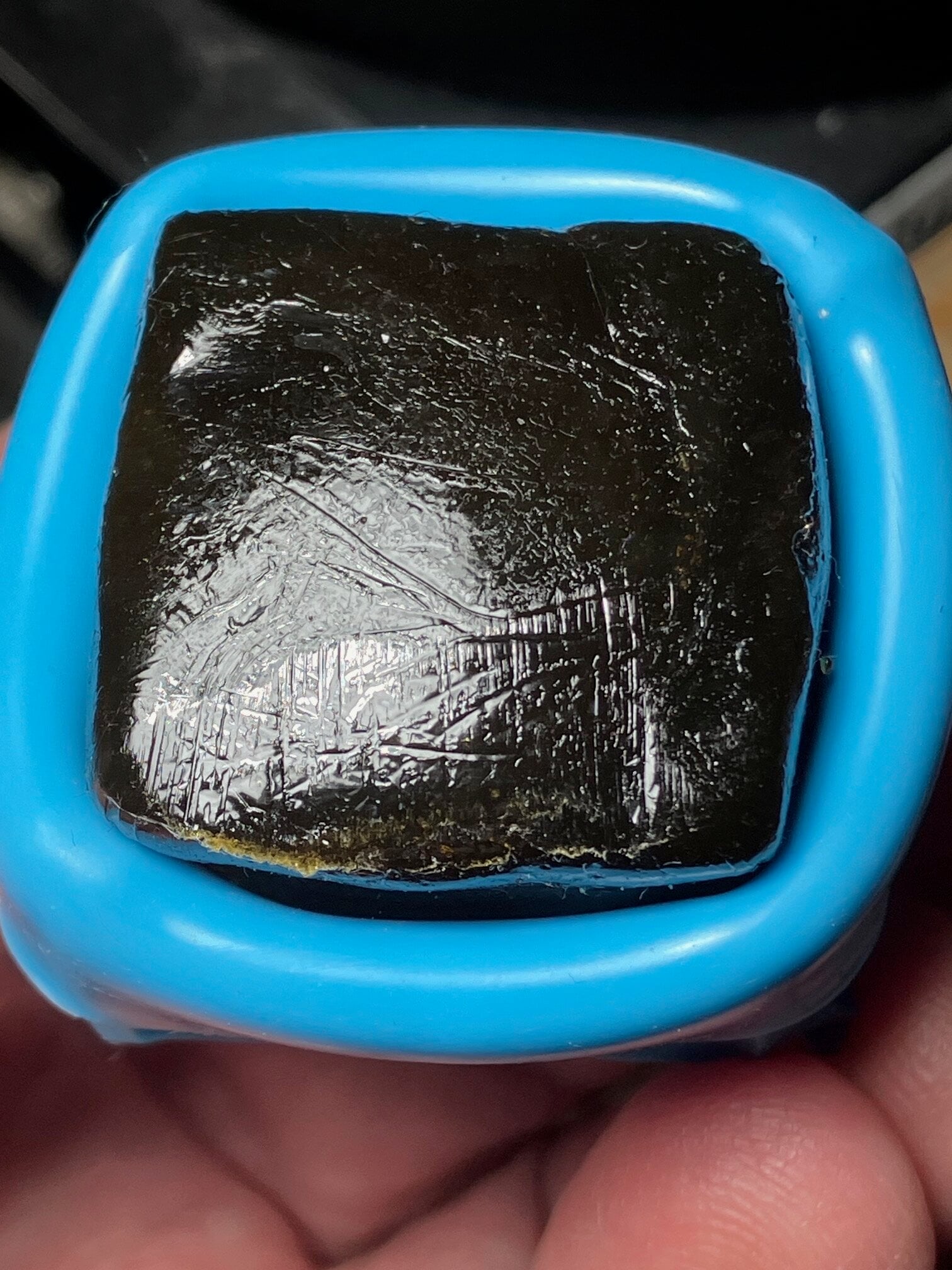
Note the marks in the surface - confirming that an even application of rosin has been applied evenly across the width of the hair.
I do this every few months or so, as needed.
TMI - I prefer a square cake, (vs. round) to ensure an even application. This container is from a Silicone ice-cube tray. I liberated a few of the "cubes" and now I have a supply of containers for melting/mixing/storing/applying my collection of "rosins". (I've got a few...!)
(I'm loving this Oak Rosin - it was the best $50 I ever spent. I wish it was still being made...)
Thanks.
I really liked Oak rosin, too, and I wish it were still available. I have a cake that's about 10 years old. It has gotten pretty hard, plus there is a lot of dust (or something) on it. I was thinking of melting it in a Nalgene beaker, hoping the crud will float up to the top, then just scrape that off. Does anyone have an opinion on that?Here (see below) is what my Oak Rosin looks like after slowly/gently melting the surface (being held upside down) over an open flame to smooth out the deep "ruts" that develop over time.
Note the marks in the surface - confirming that an even application of rosin has been applied evenly across the width of the hair.
I do this every few months or so, as needed.
TMI - I prefer a square cake, (vs. round) to ensure an even application. This container is from a Silicone ice-cube tray. I liberated a few of the "cubes" and now I have a supply of containers for melting/mixing/storing/applying my collection of "rosins". (I've got a few...!)
(I'm loving this Oak Rosin - it was the best $50 I ever spent. I wish it was still being made...)
Thanks.
View attachment 7080091
Hi Ross,I really liked Oak rosin, too, and I wish it were still available. I have a cake that's about 10 years old. It has gotten pretty hard, plus there is a lot of dust (or something) on it. I was thinking of melting it in a Nalgene beaker, hoping the crud will float up to the top, then just scrape that off. Does anyone have an opinion on that?
Yes.
Try this - can you use a microwave friendly container (silicone or paper?) and slowly melt the cake in a microwave?
If so, When it is molten, use a toothpick or popsicle stick to "grab" the top layer which will be floating on the liquid. You can then remove that top layer, which is dried out, and then stir and mix the remaining (molten) rosin...You'll be amazed at how rejuvenated it becomes.(Cool it in the freezer, and then air-cool for 12 hours before using.)
There are some posts of mine (and others) in this Forum regarding this process.
Let me know how it goes, and if you have any questions.
Thanks.
Last edited:
Thanks, Don, I'll give that a try! Never thought of using the microwave, and only intuitively guessed that the crud will float to the top.Hi Ross,
Yes.
Try this - can you use a microwave friendly container (silicone or paper?) and slowly melt the cake in a microwave?
If so, When it is molten, use a toothpick or popsicle stick to "grab" the top layer which will be floating on the liquid. You can then remove that top layer, which is dried out, and then stir and mix the remaining (molten) rosin...You'll be amazed at how rejuvenated it becomes.(Cool it in the freezer, and then air-cool for 12 hours before using.)
There are some posts of mine (and others) in this Forum regarding this process.
Let me know how it goes, and if you have any questions.
Thanks.
Yes, and...the "crud" will actually stay on top - you'll be able to remove that top layer (skin) of dried-out crud with a toothpick - it will be floating on the surface.the crud will float to the top.
Don't forget to stir & mix the remaining molten Oak before cooling.
Thx.
Hi Don,Hi Ross,
Yes.
Try this - can you use a microwave friendly container (silicone or paper?) and slowly melt the cake in a microwave?
If so, When it is molten, use a toothpick or popsicle stick to "grab" the top layer which will be floating on the liquid. You can then remove that top layer, which is dried out, and then stir and mix the remaining (molten) rosin...You'll be amazed at how rejuvenated it becomes.(Cool it in the freezer, and then air-cool for 12 hours before using.)
There are some posts of mine (and others) in this Forum regarding this process.
Let me know how it goes, and if you have any questions.
Thanks.
I tried melting the Oak rosin and scooping out the bad stuff. There was stuff on the bottom and the top. I was hoping it would all float to the top but it did not. So after scooping out the dirt on top, I cooled it down and flipped it over to get the other side. It turned out as good as new - thanks for the tip!
Latest posts
-
 Stradi custom build commission thread - The Inception of Nightwing
- Latest: Gopherbassist
-

-


