• TalkBass has been independent since 1998. Add your voice.
    Create a free account to reply to discussions, view embedded media, and browse with fewer display ads.
    Join freeLog in
    Want zero display ads or expanded classifieds tools? Compare plans.

Cloning the fuzz circuit from a Dan-O-Wah

I've been on a bit of a wah quest for a few months, but I've recently purchased an Ibanez Weeping Demon that I'm quite happy with and I'm willing to call my quest compete (for now). But, for a while I was using a Danelectro Dan-O-Wah, which sounded really good despite being made of plastic and looking like a truck.

I prefer the Ibanez wah, but the Danelectro had this really over the top fuzz built in that I'd like to keep on my board. My goal here is to copy just the fuzz part of the Danelectro wah into a very simple tiny pedal (ideally a 1590LB, but a 1590A or something else small would work too). The original has no knobs or controls of any kind aside from an on off button and I'm aiming for that kind of simplicity too, I've got a Swollen Pickle if I want versatility.

I'm fairly handy with a soldering iron, but I've never done a pedal or cloned a circuit before so I'm looking for some help.
I've found one source online saying that the fuzz/octave part of the wah is a clone of the Foxx Tone Machine. This would make some sense because Danelectro has a stand alone copy of that pedal, so it wouldn't be hard for them to add it to this pedal. Can anyone confirm or deny this?
I've attached some pictures of the inside of the pedal, I'm fairly certain the fuzz/ octave stuff is the top circuit board. The fuzz is activated by a button on the top of the pedal (on the right side from the perspective of these pictures) and the octave is activated by the lowest button on either of the banks running down the side. Any ideas on how to parse out what does what?
In general, how do I get started on this?
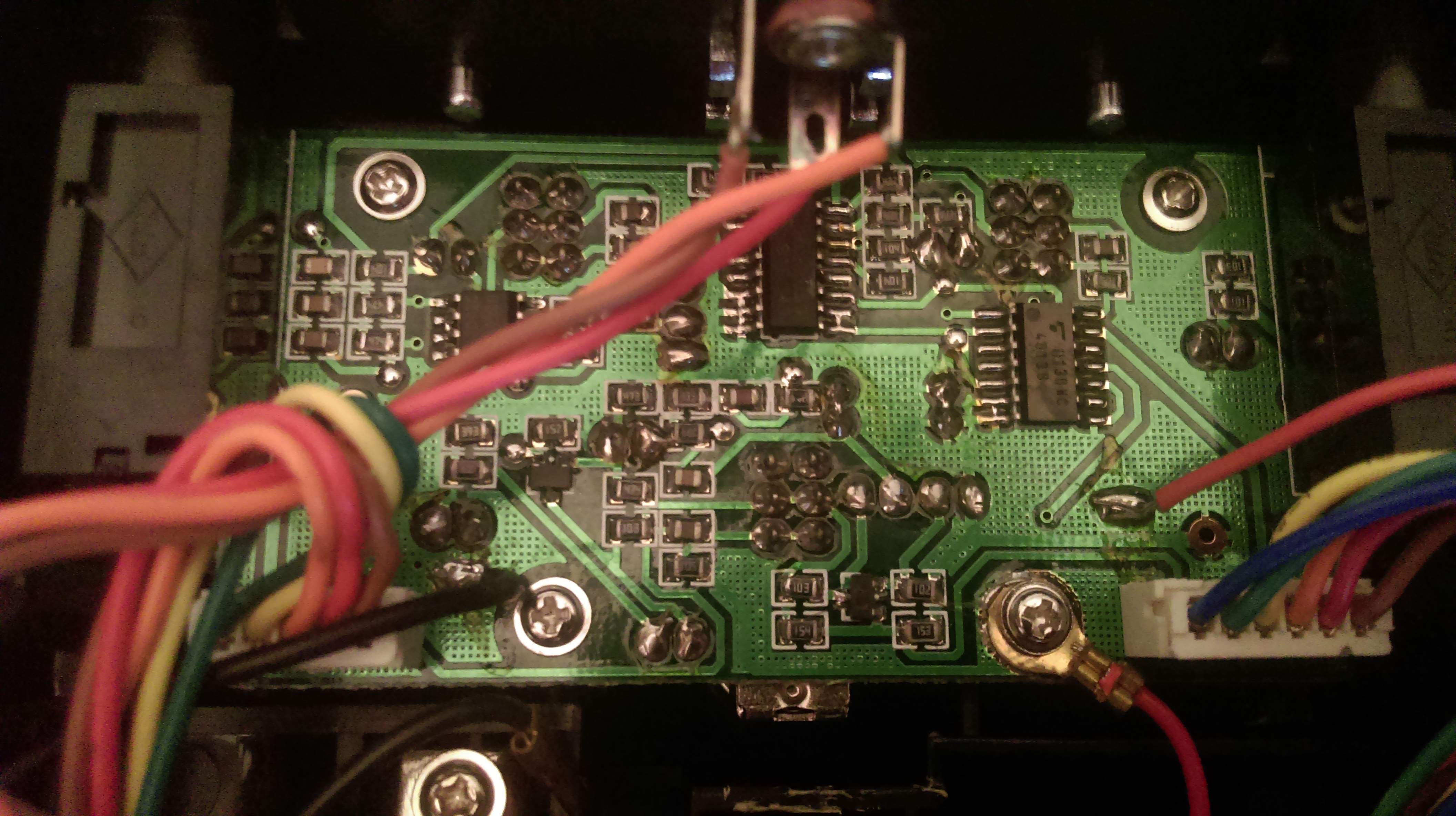
IMAG0628.jpg
1466439150672-417755773.jpg
 
The Foxx Tone Machine is rather complicated for a fuzz circuit.
I considered the kit route, or buying a clone someone else already made. But, both of those end up with features I don't want/ need. I was hoping that removing the octave function and eliminating the complexity of extra controls beyond on/off would end up with something simple enough for me to do myself. It would also give me something much smaller and easier to fit on a crowded board.
 
I'm also not sure that what I want is based on the Foxx, that's just what one person online said without any evidence or explaination, I was hoping someone here would knew about these pedals to confirm or deny that before I go to far in that direction.
 
Adding more info, this is a picture of the other side of the board, the fuzz is activated by the button on the right side.

I'd really appreciate any help or info anyone can give me.
 

Attachments

  • 1466452607475-1575191278.jpg
    1466452607475-1575191278.jpg
    861.1 KB · Views: 339
  • 14664527194491212555447.jpg
    14664527194491212555447.jpg
    899 KB · Views: 232
The Foxx Tone Machine does have a lot of electolytic capacitors, as does the PCB in your photo (the round blue components) - but I'm only speculating. A Foxx can be built into a 1590A, but it's not really a beginner friendly project - depends how ambitious you are. If you fancy a stab at DIY maybe buy a kit and see how it sounds. If it's the sound you're after then it's something you could reverse engineer into a 1590A. If not, then it's decent DIY experience, or you could maybe sell it on (although first builds aren't always sellable with regard to build quality - no offence intended, it's often a trial and error process that takes practice!)

Unfortunately there's often no substitute for knowing the topology of a circuit if you're planning something of this nature. Hopefully someone who does can help you, but if not then th Foxx kit isn't a bad bet.
 
The Danelectro pedal that is based on the Foxx Tone Machine is the Danelectro French Toast. It's still available new for about $30-40. It has a presumably cheesy plastic enclosure and hardware, but at that price, the least-effort way to try it out is to buy one. If you don't like it, sell it; or if you love it so much that you want to have a solid all-metal version, sell it and build one of the kits.

On the diy pedal sites, there are people very good at reverse engineering pedals. However, it's easier to do with physical access to the circuit board. Also, the board photo you posted shows that it has a lot of small surface mount components. These make reverse engineering much harder (IMO) because you can't quickly read value labels off them. A clever person might be able to follow the circuit traces and reconstruct much of the circuit topology without getting the values. But this is significant work.

FWIW, a Foxx Tone Machine is a 4-transistor circuit. The PCB photo you have has three ICs, and I can't tell if it has any transistors - I see one thing that might be a surface mount transistor. I would guess that the ICs are something to do with the switching (the 16-pin one in the middle) and the other two chips have multiple op-amps, but this is just a wild guess based on having inspected some pedals and schematics.
 
This would mean that it isn't based on the Foxx Tone Machine, yes? So something like the French Toast is unlikely to do it?

I really don't know. There are circuits where pedal makers have replaced transistor stages with op-amps; for example a Big Muff is a 4 transistor circuit, but there's also an op-amp version of the Big Muff. I don't know if the French Toast uses op-amps, transistors, or both. There's one gut-shot on the internet of the underside of the French Toast PC board that shows ICs are present, but I have no idea if they're used in the fuzz or the switching.

I think my point is that your question about "what is the circuit on this board" is actually fairly involved, and would take at least some large clear shots of both sides of the board and an experienced circuit-tracer to address. The DIY pedal forums should have a better idea. While the French Toast is an unusually easy pedal to try out, because it's still available and cheap.
 
This would mean that it isn't based on the Foxx Tone Machine, yes? So something like the French Toast is unlikely to do it?
Wrong, the circuit board you pictured with the SMDs and chips appears to be some kind of logic/buffer/switching board. I'm quite sure all the fuzz/wah goodness is taking place on the brown printed circuit board on the bottom. The donut of copper wire is the inductor for the wah circuit.

Just go to YouTube and search for demo videos of the Foxx tone machine, the Danelectro French toast, and see if that's the fuzz tone you're looking for.