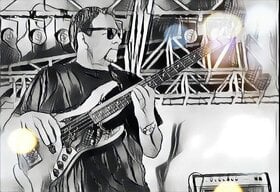
I've just found this review of the first Back Door album at 'Rolling Stone' magazine's website.
Back Door
'Back Door'
Warner Brothers, 1973
The inner gatefold of this one comes complete with the musings of no fewer than five English scribes, who between them manage to invoke the music and/or spirits of Jimi Hendrix, the Beatles, the Rolling Stones, the Yardbirds, Charlie Parker, Ornette Coleman, John Coltrane, Colloseum, King Curtis, the Hulk, the Thing, Cream, and Emerson, Lake and Palmer. The comparisons are unfair to the band as well as the consumer. How could any individual be a cross between Eric Clapton and Bruce Banner? Back Door's claim to our attention is not that they have succeeded in doing things past men have done but that they have breathed new life into the concepts of the instrumental trio and, in particular, bass playing. They have achieved this in such a spectacular way that Back Door is not only an impressive debut but important by any standards.
Colin Hodgkinson gives the Fender bass a role it has not been accustomed to. Instead of repetitively supporting the other instruments, Hodgkinson's bass at times plays lead. His solo on "Catcote Rag" is remarkable. He is the only guitarist in the group, yet he performs all the expected guitar chores and more.
Drummer Tony Hicks shows imagination but no desire to outshine companions. Refraining from extended solos, he remains an integral part of a tight unit.
Saxophonist/flautist Ron Aspery's playing is one moment aggressive ("Vienna Breakdown") and the next soothing ("Plantagenet"). Comparisons with prominent jazz musicians would be hackneyed, boring and inaccurate. The important thing is that he is playing well. Varying the approach produces almost a sampler album, a sampler of the kinds of things Aspery and Back Door are capable of. There must be more.
And there will be. The group has already recorded its second album, this one under Felix Pappalardi's direction at Electric Ladyland. Pappalardi had heard Back Door in its original limited edition on the Blakey label, a name inspired by England's Blakey Ridge where the group played for two years in a pub run by a man named (honest) Brian Jones. They recorded an album in London on June 3rd and 4th, 1972, and sold it in Jones's bar. A few copies fell into the hands of the British music press. Most importantly, a copy came into the possession of Warner Brothers, which has repackaged and distributed the album without touching the music. There are still no overdubs, vocals or electronic studio effects, just the unlikely instrumental trio of bass, drums and saxophone. The only intruding noise on the LP is the motorbike revving of two friends of Aspery, a confessed speedway buff.
It is hard to believe that a group like this could win over a pub audience. It is harder to believe that they did it for two years and nobody picked up on them. Whether they have strutted all the stuff they have to show or not we don't know. For now, Mr. Jones, it's more Guinness, please. And more Back Door. (RS 142)
PAUL GAMBACCINI
(Not a bad review, eh!)
David