• TalkBass has been independent since 1998. Add your voice.
    Create a free account to reply to discussions, view embedded media, and browse with fewer display ads.
    Join freeLog in
    Want zero display ads or expanded classifieds tools? Compare plans.

Composite 2x12 cabinet DIY

About 5 years ago, I built my first 2x8 composite cab from honeycomb sheets fiberglass and polyester resin, I was curoius how much weight it would save and It became a very nice, smooth sounding and comfortable to carry little cab. It is being used regularly for small gigs and rehersals.
With the arrival of the Quilter v803, I wanted something with a little bit more power handling capabilities. BUT, I wanted to build the lightest possible enclosure for the 2 Eminence Deltalite II 2512 I was able to get my hands on. Living in Kenya, I don't have access to many parts and materials that most of you just order or buy, XPS — Extruded Polystyrene for example, is not available here. After researching and talking to some composite experts, I was recommended to use EPS — Expanded Polystyrene but use thicker sheets than what I would use if there was XPS.
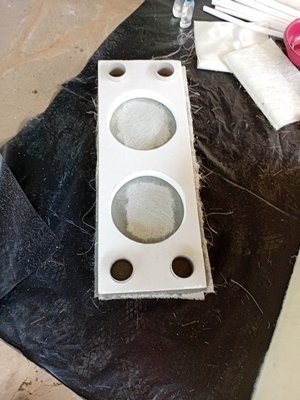
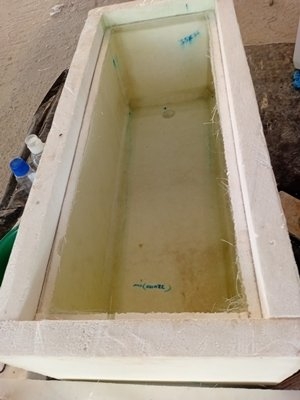
I used 50mm thick sheets which I cut using a bread knife and a jigsaw. I have never really worked with EPS but it is pleasant to work and by far not as messy as I feared. I used wood glue and wood skewers to glue the 5 sheets together, the baffle remained separate.
Then the fiberglass team took over and laminated inside and outside with one layer each of woven and chopped strand fiberglass mats using slow curing epoxy. It turned out that with 4.2kg it is the heaviest component of the cab.
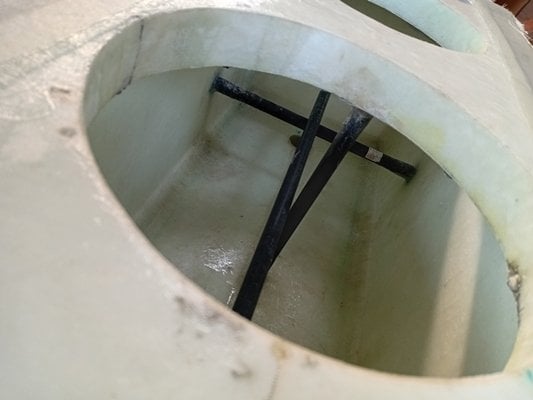
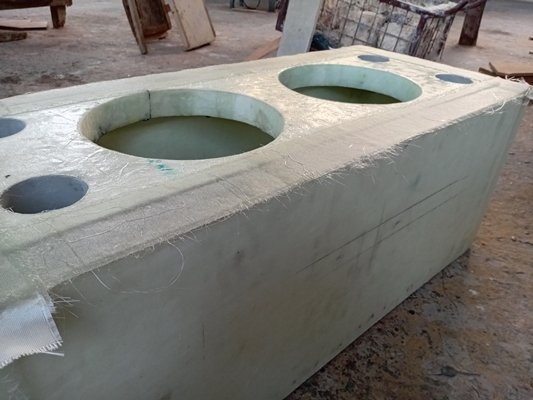
Once all surfaces were laminated, they added the PVC braces on all 3 axes, installed the baffle and that was it. What remained was drilling the screw holes, some gentle sanding, 2 cans of matt black spray paint and installing the hardware.
The result is a big cab, but at 12.9kg it is way below the average for a 2x12. Soundwise it delivers too, I am very pleased with the tight, well defined sound, a little mid-forward, no boom, no crisp either.
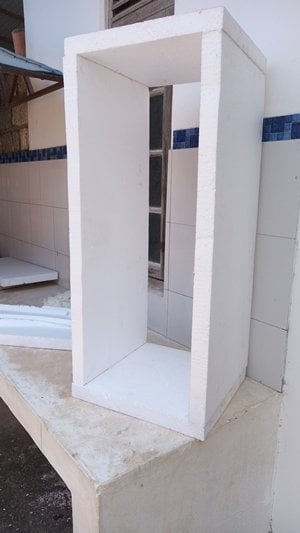
20250711_132000.jpg
20250711_134327.jpg
20250715_171050.jpg
20250902_152739.jpg
20250926_154235.jpg
20251119_165752.jpg
20251119_165810.jpg
IMG-20251201-WA0002.jpg
 
Nice work. An EPS core isn't going to be very dent resistant so it will want careful handling on the road, but the flip side is that it should be really dead acoustically and have minimal resonance, which can only be a good thing.
True observations, but l'm not a touring bassist, just the occasional gig or recording so the more delicate nature of the material do not really pose a problem. The cab still fits perfectly onto the back seat of my car so when it's moved it's a cushy job.
 
  • Love
Reactions: murphy
Very cool! My Dad was in the EPS business for most of his career, so I grew up seeing all manner of interesting products built with that material ...but this is the first time I've ever seen it used to build a speaker cabinet.
Thanks!
I could not find any reference anywhere to a composite cabinet with EPS core, several other materials but not EPS. So I read up and asked people. Eventually I pulled the trigger since there was just nothing indicating that this would be a bad idea. And it works! It's not particularly pretty to look at but noone cares enough about that :smug:
 
Last edited:
i think this kind of build is the future of bass cabs being always too heavy.
The price you pay is in roadworthiness. It only takes quite a thin layer of glass to be strong enough if noone touches the cabinet. You could have a very light cab indeed if it permanently lived in its own flightcase and only came out on set, but of course that would defeat the object! There are two related factors, how easily it dents and how easily you make holes in it. Dents are mostly about the core. between the glass. EPS is light but as we all know you can crush it between two fingers. Plywood on the other hand barely dents but is heavy. GR bass probably use a structural foam core which is reasonably light and reasonably dent resistant, but more expensive than ply or eps. Light/dent resistant/cheap - pick any two. Holes are mostly about the skin. A mix of csm and woven is moderately strong, moderately hole resistant, and reasonably cheap. Three skins of kevlar would be expensive, hole resistant, and a bit heavy. Plywood again is pretty hole resistant. GRbass I think use carbon which is tops for structural strength, and not bad for dent resistance (depending how thick), but at a price. Plywood will continue to tick a lot of boxes, especially for quantity production. My home built cabs are pretty light, but ply because I've fallen out of love with working with composites, but I use thin ply very heavily braced which would be vciously expensive commercially. I've thought about thin ply/end grain balsa/thin ply as a more roadworthy and natural materials cab build, like a WW2 DH Mosquito aircraft, but the complcation and price goes way up and the gain isn't that great.
 
There was a round of composite DIY cabs back when the Greenboy cabs first started coming out that used the pink rigid foam insulation sheets from Home Depot as the core. They worked pretty well. I believe one manufacturer (started with and "A", but I cant remember) even started commercually producing carbon fearful/less cabs using that technique.
 
I love this idea. Another option that could have added some strength to this (not that it needs it) is to "skin" the inside and outside of a thinner EPS core with plain old cardboard saturated with epoxy. The cardboard from plain old boxes that has the corrugated center, once saturated with epoxy resin, is extremely strong and rigid, it would be a great inner/outer skin layer for an EPS core.
 
Nice... always a method of interest to me. I think you are (by necessity) the first to post a build with EPS instead of XPS. Since panel rigidity is related to the distance between the skins, you probably didn't lose much.

I'm reminded of two old composite build threads, by zac2944 (XPS/fiberglass/epoxy). They were well conceived, executed, and documented. But in digging up those old links, I found that they were older than I thought, and sadly, the pics are dead links now. Still some good info for someone wanting to go this route.

DIY Lightweight Composite Cab Build (May 2008)

DIY Lightweight Composite Cab Build II - ZL1263, 3-way (Jun 2009)
 
Last edited:
Every time I look at a commercial composite design, I keep coming to the same conclusion that to do it well (as robust as a traditional cabinet) is very expensive, and the weight savings isn’t all that much.

Trade off robustness and weight/cost shrink somewhat.

I first looked at composite cabinets when we were doing the Genz Benz thing and we were owned by KMC. KMC had a composite division in house with Ovation guitars, and the parent company Kaman Corp. was a leader in composite technologies with their Kaman Aircraft division (composite helicopter rotor blades and components. Even with (really) deep resources, it didn’t make sense.