• TalkBass has been independent since 1998. Add your voice.
    Create a free account to reply to discussions, view embedded media, and browse with fewer display ads.
    Join freeLog in
    Want zero display ads or expanded classifieds tools? Compare plans.

Double Bass Construction Factors That Shape Tone

John Dilworth has written a number of luthier articles for the Strad.
Tone of an instrument is an interesting topic.

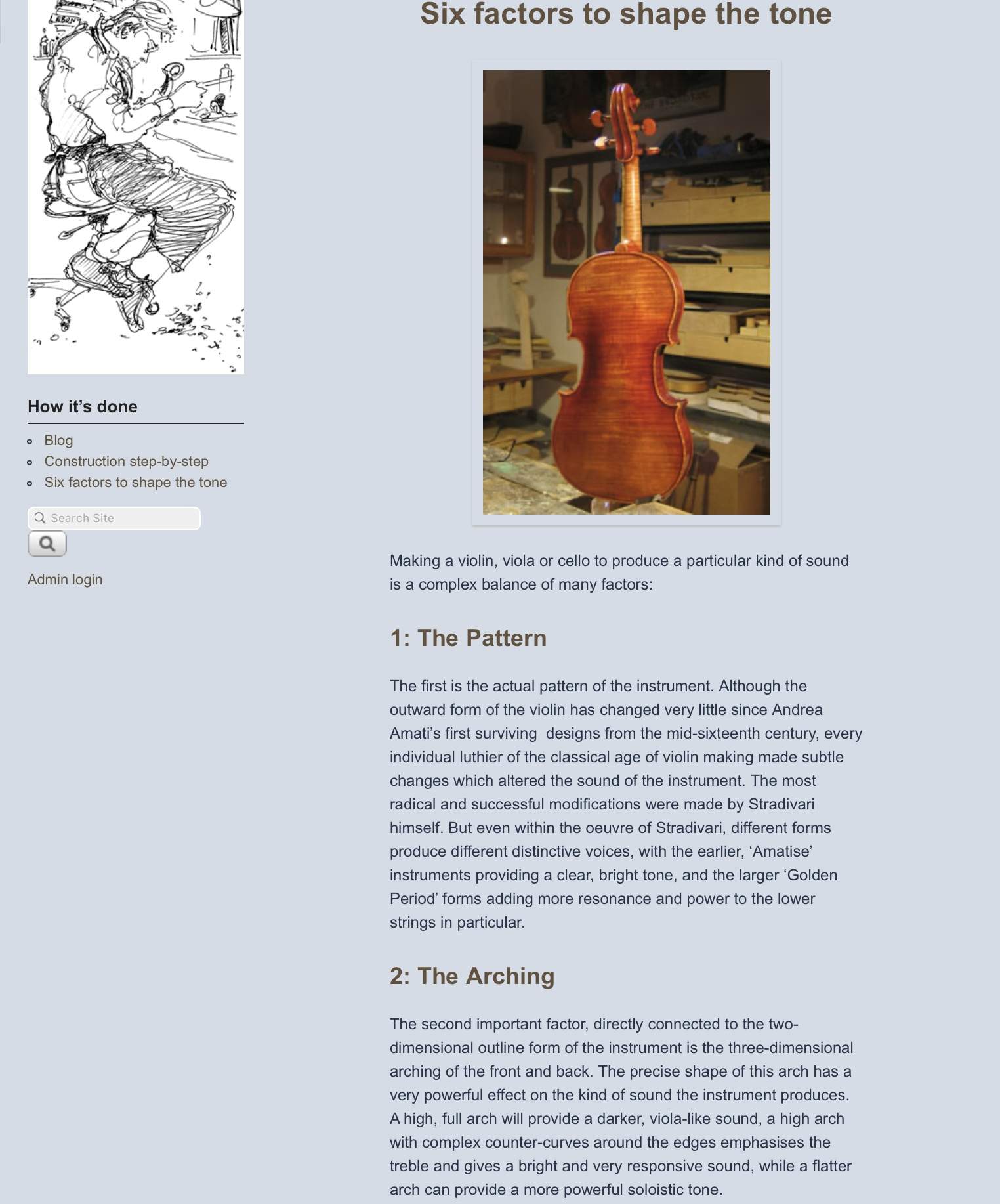
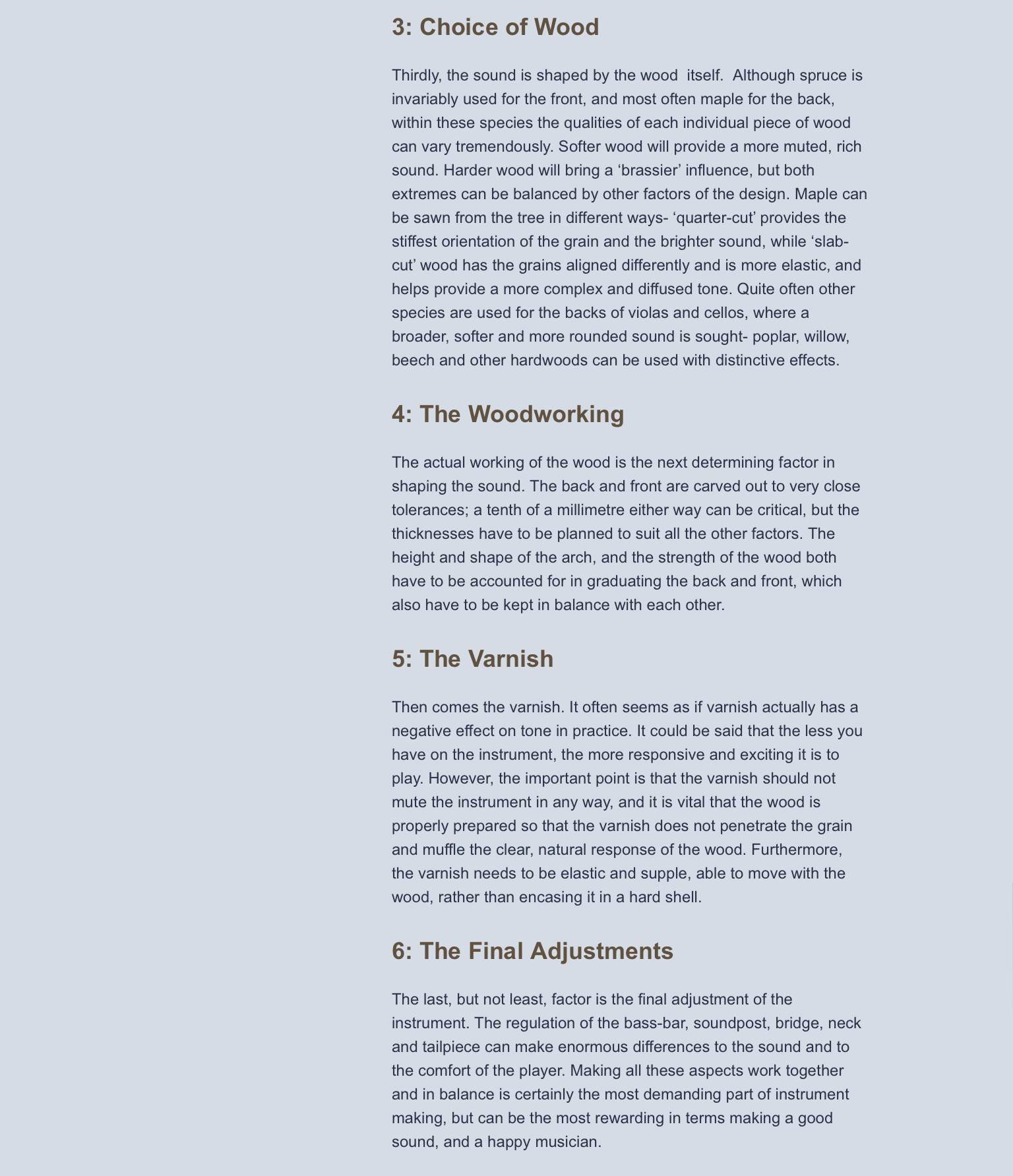
From his website he lists six construction factors that shape a string instrument’s tone. (double bass may have a different take on some of this, especially regarding body shape, size and string length)
An expert could write a very long chapter on each of the six.

He does not include choice of strings in the final adjustments, perhaps just an oversight.

IMG_3695.jpeg
IMG_3694.jpeg
 
Last edited:
There some long-lost thread hypothesizing (jokingly) that bussetto corners caused "eddies in the sound" or something. I'm sorry it didn't make the list, but I'm still laughing about that one.

Lots of modern bass luthiers are using walnut for backs to great success. I am pretty sure I've read about old Italian instruments made with pear, although when I look at the scrawny pear trees in my backyard I can't imagine a pear tree big enough to make a bass. I admit, when I look at trees, I can't help picturing how you'd get a bass of of them, if only to imagine how big a tree it must take.

My bass has a Ponderosa pine top. You can find lots of disparaging posts about pine on luthiers' forums but I think my bass sounds pretty good. There are historical precedents for pine in the bass world (Italian and American both) and I think a lot of the luthiers there are more concerned with the world of "chin fiddles" than they are with "floor fiddles". I've seen/heard of cedar and redwood tops, too.
 
There some long-lost thread hypothesizing (jokingly) that bussetto corners caused "eddies in the sound" or something. I'm sorry it didn't make the list, but I'm still laughing about that one.

Lots of modern bass luthiers are using walnut for backs to great success. I am pretty sure I've read about old Italian instruments made with pear, although when I look at the scrawny pear trees in my backyard I can't imagine a pear tree big enough to make a bass. I admit, when I look at trees, I can't help picturing how you'd get a bass of of them, if only to imagine how big a tree it must take.

My bass has a Ponderosa pine top. You can find lots of disparaging posts about pine on luthiers' forums but I think my bass sounds pretty good. There are historical precedents for pine in the bass world (Italian and American both) and I think a lot of the luthiers there are more concerned with the world of "chin fiddles" than they are with "floor fiddles". I've seen/heard of cedar and redwood tops, too.

walnut, and many other alternate woods, work fabulously. my bass has a catalpa back and sides, which i'd never heard of until speaking with the gentleman who made my bass. obviously, and as per the article, the wood is just one of the factor but i really, really like the sound of catalpa. i've played several instruments of this wood, and they all had a characteristic richness/complexity that was very desirable. it's almost like "maple, but better" as far as I can tell. it also looks wonderful under varnish.

pear most certainly is a historical choice. a number of years ago upton had for sale on commission a lovely old italian bass of pear back/sides, owned by (i believe) i retiring member of the boston symphony. it was a really nice solo bass - many of you probably know the bass i'm talking about.

before the passing of Andrea Spada, he and I had worked up plans for a violin that was to be a true homage to the brescian masters. Andrea was extremely passionate and knowledgeable on this style of making. we settled on flamed pear for the neck, scroll, back and sides. both because he had some nice pieces, but also for this historical accuracy.

by the way, is your pine-topped bass made by Kimmel? I've played two basses he made with that wood. very nice stuff.
 
  • Like
Reactions: CaseyVancouver
walnut, and many other alternate woods, work fabulously. my bass has a catalpa back and sides, which i'd never heard of until speaking with the gentleman who made my bass. obviously, and as per the article, the wood is just one of the factor but i really, really like the sound of catalpa. i've played several instruments of this wood, and they all had a characteristic richness/complexity that was very desirable. it's almost like "maple, but better" as far as I can tell. it also looks wonderful under varnish.

pear most certainly is a historical choice. a number of years ago upton had for sale on commission a lovely old italian bass of pear back/sides, owned by (i believe) i retiring member of the boston symphony. it was a really nice solo bass - many of you probably know the bass i'm talking about.

by the way, is your pine-topped bass made by Kimmel? I've played two basses he made with that wood. very nice stuff.

When we lived in Copenhagen, we'd ride our bikes past a bunch of beautiful flowering trees in Assistens Kirkegård that I later learned were a variety of catalpa. They were smaller, spindly trees that probably wouldn't add up to a violin even with another hundred years' growth, though. I wonder what the catalpa that went into your bass looked like. I gather that Ed Maday was personally familiar with the tree.

My pine bass is one of Seth Kimmel's. I've played three of his pine basses, mine included, and they sound great to my ear. Speaking of familiarity with the tree, the maple that Seth used for the neck, back, and sides (and original tailpiece) on my bass was all from a single large bigleaf maple that stood in Eugene just a few blocks from Seth's workshop at the time*. That tree was harvested to make way for a larger building on the spot and Seth acquired a number of large pieces of it. The tree was apparently so large that my bass was made not from the trunk, but from some of the branches. He's used that same tree for a number of basses now. If you know where to look, you can actually find images of the tree on Google Maps in street view, although the images are not great (it would have been early days of street view, because the tree came down and the wood was processed and dried for a while before it ended up in a bass).

I am not certain I am recalling that specific bass that Upton had for sale, but I believe I've read descriptions of Testore or similar makers in Italy who used wood like pear. The thing that I was left wondering was whether pear was a sufficiently distinctive looking wood that one could distinguish it under the dark varnishes used back then, as well as a few hundred years' patina.

* Seth relocated recently, so although he's still in the Eugene area he's no longer in the workshop where he built his first 75 or so basses, mine included
 
Last edited:
  • Like
Reactions: groooooove
Lots of modern bass luthiers are using walnut for backs to great success. I am pretty sure I've read about old Italian instruments made with pear, although when I look at the scrawny pear trees in my backyard I can't imagine a pear tree big enough to make a bass. I admit, when I look at trees, I can't help picturing how you'd get a bass of of them, if only to imagine how big a tree it must take.

upload_2023-7-10_11-58-21.png
 
When we lived in Copenhagen, we'd ride our bikes past a bunch of beautiful flowering trees in Assistens Kirkegård that I later learned were a variety of catalpa. They were smaller, spindly trees that probably wouldn't add up to a violin even with another hundred years' growth, though. I wonder what the catalpa that went into your bass looked like. I gather that Ed Maday was personally familiar with the tree.

Perhaps those trees were not catalpas. I based that on a placard at J. C. Jacobsens Have, a park close to our appartment there, but it's possible the placard was for a different tree. Based on pictures, I think the flowering trees I was thinking of were laburnums.
 
When we lived in Copenhagen, we'd ride our bikes past a bunch of beautiful flowering trees in Assistens Kirkegård that I later learned were a variety of catalpa. They were smaller, spindly trees that probably wouldn't add up to a violin even with another hundred years' growth, though. I wonder what the catalpa that went into your bass looked like. I gather that Ed Maday was personally familiar with the tree.

My pine bass is one of Seth Kimmel's. I've played three of his pine basses, mine included, and they sound great to my ear. Speaking of familiarity with the tree, the maple that Seth used for the neck, back, and sides (and original tailpiece) on my bass was all from a single large bigleaf maple that stood in Eugene just a few blocks from Seth's workshop at the time. That tree was harvested to make way for a larger building on the spot and Seth acquired a number of large pieces of it. The tree was apparently so large that my bass was made not from the trunk, but from some of the branches. He's used that same tree for a number of basses now. If you know where to look, you can actually find images of the tree on Google Maps in street view, although the images are not great (it would have been early days of street view, because the tree came down and the wood was processed and dried for a while before it ended up in a bass).

I am not certain I am recalling that specific bass that Upton had for sale, but I believe I've read descriptions of Testore or similar makers in Italy who used wood like pear. The thing that I was left wondering was whether pear was a sufficiently distinctive looking wood that one could distinguish it under the dark varnishes used back then, as well as a few hundred years' patina.

ed milled two catalpa trees - one from the school parking lot in his town, the other a few blocks away from his house in his friends yard. my bass is from the latter.
 
  • Like
Reactions: mjt0229
I asked my wood guy about catalpa and he told me he loves it and thought it might work well for basses. I’m definitely going to consider some.

Years ago I was at Gage's in NYC and heard a bass made from Catalpa, I was told, being played. Sounded excellent. I seem to remember it was made in Mexico. I went back a few days later and that bass had a long
crack down the top. Don't know if any conclusions can be drawn but your post spurred the memory.
 
I am currently about to have my new bass (Gliga "Vasile" 3/4) professionally set up by The Bass Shop,Sydney. It has been crudely set up with an untreated bridge and a sound post with too many growth rings, both shaped and supplied by Gliga.
Indications are that the sound will be rather bright because the lovely quarter sawn Carpathian Spruce used has very straight and evenly spaced growth rings across its front that do not broaden out towards the top and bottom sides. D'Addario Orchestral strings came with the bass.

In a discussion with the luthier, Richard, he suggested that the brightness of sound would be reduced by using a treated better quality bridge, a sound post with a lot less growth rings, a lighter old soft wood tailpiece which I have, and Evah Pirazzi Medium Gauge strings. He also spotted that I had not quite filed down the grooves in the nut in line with the lay of the strings, saying that they needed to move more freely. His thoughts are that these give the best chance to transmit the low frequencies to the front

My observation after owning many basses is that my best sounding basses for arco/orchestral use have had fronts with growth rings that widen from the centre to the edges. I am looking forward to seeing the results of Richard's suggestions.
 
Virtually all violin-family front plates have “grains that get progressively wider approaching the edges.”
The center seam is gluing together the outermost grains (away from the center of the tree) where the rings are usually very close together in any tree large enough to build a bass. The grains at the edges are from closer to the center of the tree, from when the tree was young and the growth rings were broader.
 
Wasn't sure where best to put this, so I chose this old thread. Thought this might be of interest to some of you. It describes an upcoming presentation in a group my wife belongs to. Folk often debate what contributes to an instrument having a better sound. This abstract suggests how challenging it can be to measure accurately.


Developing methodologies to study perceived sound qualities of violins
Claudia Fritz

Friday May 2, 2025, 1-3pm Eastern US Time
Zoom Registration link: [Invalid or Expired Link Removed]
Violin makers and acousticians have long sought correlations between sound qualities, construction parameters and vibroacoustic measurements. This is challenging for three main reasons: it is difficult to build violins reliably enough to ensure that the change in the sound is only a result of the intended change of construction parameters; no clear link has been found so far between measurements and perceived qualities; and when listening to violins being played, differences tend to be smoothed out by the players who adapt very quickly. Therefore, while we have previously preferred using players in our experiments to maximise ecological validity and account for the complexity of the interaction between the player and the instrument, in this study we test whether other methods that reduce the player's influence, though more artificial, may be useful for exploring the impact of certain construction parameters on the sound. In the context of a set of violins built with controlled thickness variations in their plates, we conducted two listening tests, based on real recordings of a player and a bowing machine, along with synthesised sounds created from an excerpt recorded with piezo sensors by convolution with radiation measurements in an anechoic chamber. The hybrid synthesis was found to be the most effective of the three in highlighting instrument differences, capturing properties perceived in the actual instruments, and correlating with radiation measurements. This work, conducted with George Stoppani, has led to an article which is currently in press: Fritz C. Stoppani G. Igartua U. Woodhouse J. (2025) Developing methodologies to study perceived sound qualities of violins. Acta Acustica. When published, it will be freely available here: https://doi.org/10.1051/aacus/2025014
 
The bass at Upton belonged to Ed Barker of the BSO, I believe. When we were doing the full-on, top off, sides out etc restoration of my 1810 Tyrolean, we opted to replace the (non-original) flat back with a round, hand carved pear back. The pear is not the loudest wood, but the warmth, focus and tone it brings to the bass really turned it from a "Tyrolean" to an "Italian" in terms of sound quality.
 
  • Like
Reactions: james condino