• TalkBass has been independent since 1998. Add your voice.
    Create a free account to reply to discussions, view embedded media, and browse with fewer display ads.
    Join freeLog in
    Want zero display ads or expanded classifieds tools? Compare plans.

Custom 6 string F# B E A D G

Hi, I am building a custom bass. 6 string, tuning above. and to get that low F# i am using the MEC twin jazz bridge and jazz neck like the Warwick Dark Lord. Unfortunately, these do not come in 6 string pickups, only four. So, i decided to have an MEC MM bridge and P neck pickup for the top four strings (EADG) so i could essentially switch between a four string or a extended range 6 string. By the way, the TJ, J, and P pickups are active while the MM is passive. To top off these crazy electronics I wand a 3 band active EQ with mid range selector. So to sum up: 4 pickups, 1 passive, 3 active, and active 3 band EQ. I have two questions now:

1) how many batteries do i need?

2) i have decided on 3 balance controls: 1 between the TJ and the J on the bottom 4 strings, 1 between the MM and the P on the top four strings, and 1 between the two pairs (TJJ and MMP). How could i wire this and have the EQ section i want?

 
What scale were planning to use on this bass? I would go for something longer than the 35" scale Warwick is using for their Dark Lord bass. Fanned frets would probably be ideal, but maybe too complex if this is your first build (don't know if it is or not).

I don't know anything specific about these pickups, but personally I think you would be better off finding some 6-string pickups that are similar. I kind of doubt they are really special as far as jazz pickups go. Warwick just likes to sound like they specially select everything for each bass (strangely, they "specially select" an MEC eq for every bass... ;)) You could find some good 6-string jazz pickups and have a MUCH more sensible control layout, IMHO.
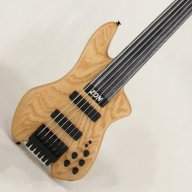

It's a cool project, good luck with it.
 
this is my first. I was going to do a string through body and adjust the length there ( like the 14 string bass project).

I think MECs have good pickups. but i was wondering what other people thought would pick up that low F# well ( it is 23Hz).

As for sensible controls, i don't care, right now with the layout i get a jazz, a precision, and a musicman all in one
 
Adjusting the length of the string past the bridge will have absolutely no effect on the tension of the string. I believe Dusty G did that on his 14 string because the scale is short and he wants the tapered part of his low strings to wrap onto the tuner. Just to repeat, because this is a really common misconception:

The length of the string past the bridge and nut has absolutely no effect on tension.

Ok, so with that out of the way, I think the key here is active jazz pickups, shifted towards the bridge, to keep the F# from being too muddy. Pickups matter, and they do all sound different, but I wouldn't choose the specific sound of a pickup over the ability to play all the strings on my instrument at the same time. Also, I would go crazy trying to adjust 3 blend knobs, plus 4 eq knobs and at least one volume. That's 8 knobs you have there. These are just my opinions, though, and I wouldn't want to dissuade you from your dream bass. This is what I wanted in my dream bass, and I am currently having this bass made. It's what I want, even though some people didn't see the utility in it, so don't let me tell you what you want.

I have a Warwick, which has an MEC pickup, and I love it. But they are not the only pickups in the world with an aggresive, hifi sound. Have you ever played the Dark Lord? If you're just copying it because you see that Warwick chose those pickups, I think you should reconsider. In the past few years, especially, some really great pickups have been coming out. I suggest you check out the pickups forum and get an idea of what's out there. Start a thread about what pickups can handle low strings (there are people with lower-pitched strings on their basses than F#) Also, basstasters.com has recordings of tons of different pickups, so you can get an idea of what you like. You could still get P, J, and MM pickups on your bass, but you could get 6-string versions of each, and probably still retain the aggressive MEC character, so you can play all your strings at the same time without having to switch pickups.
 
I'm kinda going the same way as the OP - please do point me towards some specific models! The pickupforum is a jungle!

Well, this is kind of impossible since I don't know what kind of sound you want, or what the other parameters of your bass are (wood is the other big one, of course, after pickups). I also am not by any means an expert on pickups, as I have not played instruments with all of the different pickups available.

Go to this website: [Invalid or Expired Link Removed]. There are recordings of many different pickups.

Off the top of my head, if you want the aggressive, hifi sound of the MEC pickups, you could try EMGs. Their Invalid Link Removed (<- click that) has both a single coil jazz pickup, and a dual coil MM pickup in a single case. That's the 6-string version. If you had one of those in the mid position, and one right up against the bridge, plus a 3-band EQ, you would have a ton of tonal options (MM-MM, MM-J, J-MM, J-J) with a simpler control scheme, a great sound, and (I can't believe I have to keep saying this ;)) the ability to use all your strings simultaneously! Maybe I'm crazy, but I think in the year 2007 we bassists deserve to be able to play a line across the B and E strings without having to fool with our pickup blend. :eyebrow:
 
also, i have never built a bass. where or how is the best way to learn how to build a neck?

I would suggest reading the FAQs at the top of the page. There's plenty of great information there. A lot of people also like the Melvin Hiscock book (not sure if I spelled that right, but it's in the FAQ).

If you just want the bass, and you are building it as a means to get it, rather than out of interest in building a bass, consider buying a Warmoth neck (and possibly body). They have a million options and do very nice work.
 
Adjusting the length of the string past the bridge will have absolutely no effect on the tension of the string. I believe Dusty G did that on his 14 string because the scale is short and he wants the tapered part of his low strings to wrap onto the tuner. Just to repeat, because this is a really common misconception:

The length of the string past the bridge and nut has absolutely no effect on tension.

I was wondering what your reference for this might be. I'm not arguing with you necessarily. I'm not an engineer or anything like that but after thinking about it, I would be of the mind that unless the string beyond the bridge and nut bear no load at all it would have some impact on tension. I am guessing that this is probably minimal, but I wouldn't imagine it was completely nullified.
 
I was wondering what your reference for this might be. I'm not arguing with you necessarily. I'm not an engineer or anything like that but after thinking about it, I would be of the mind that unless the string beyond the bridge and nut bear no load at all it would have some impact on tension. I am guessing that this is probably minimal, but I wouldn't imagine it was completely nullified.

Here is a great post by PilotJones (he is an engineer).
 
Well, this is kind of impossible since I don't know what kind of sound you want...

Not to go hijacking or anything - just want to conserve space, but here's a quick rundown on the specs and what I'm looking for - 6-string "39.55 headless, tuned down one step. Neckthrough maple and maple body.
What I'm looking for is basically a very dry and defined (read - non-boomy) lowend, while having growly mids. Sort of like a Warwick, minus the slightly nasal tendency, and with a slightly better singing, sweeter top-end.
Sorry to crash the party.
 
I guess it does make sense, by deduction. I thought it out and thought that if you were to tune a string to pitch and lock off the ends with some kind of holding device and then cut the ends of the string so they were only held by the device, the pitch would probably remain constant and therefor the tension would not change.
Wow, that sounds familiar.

http://www.talkbass.com/forum/showpost.php?p=493391&postcount=8

;)

Wow again. I've been here for over five years!
 

Latest posts