• TalkBass has been independent since 1998. Add your voice.
    Create a free account to reply to discussions, view embedded media, and browse with fewer display ads.
    Join freeLog in
    Want zero display ads or expanded classifieds tools? Compare plans.

"Cut through the mix"

Here's another thread starter where perhaps one third of respondents will seem angry at me for bringing it up, one third will misinterpret my idea, and one third will agree. So here goes;

One of the most common phrases I see used here is ' cut through the mix ' or variations thereof. And indeed, I've probably used it myself at some point. Further, like all who have spent time in a band, I've longed to be able to hear what I'm playing on the bass in a live mix.

Additionally, there are some bass sounds that are indeed very cutting, and which can sound very cool.

But I also enjoy music where the bass is perhaps not so distinct, where it does in fact tend to blur somewhat with the kick drum, or is perhaps a big warm pillow under a guitar chord. I suppose to some this will just sound like I'm advocating for old school sound, but this is every bit as pertinent across many modern scenarios too I think.

Similarly in recording, yes it's marvellous to employ frequency slotting to make everything nice and clear, but it's also cool when sometimes the bass and kick ( and whatever else ) all crash together and hit the " tape " hard temporarily. Stuff like that.

It's minus three degrees Farenheit here this morning. And windy. Gotta talk about something 🙋🏻‍♂️
 
I tend to think of cutting through the mix as the opposite of getting lost in the mix. It doesn't have to be so present that you you say, "whoa, there's the bass!", but it's definitely not, "whoa, where's the bass!". There are varying degrees of cut and everyone will have different preferences. But I like it where I can find it if I'm listening for it, but it's not so present that it sounds like it's sitting on top of everything else. I think I fall into the one-third that agrees with you.
 
It's all about the mix! There are scenarios where I want to "cut", and others where I just want to be present. And I'm only talking about my relatively small musical niche (heavy metal)! When I want to "cut", I often use a Rat-derivative or maybe something in the Damnation MBD or Darkglass BxK family. When I need to support the mix, I use my Dunwich ODB, modded Pork Loin, or - if I also need a hefty amount of dirt - a "Russian Muff" of some kind. But I often use "cut" interchangeably with "be audible" in the mix.
 
  • Like
Reactions: Wasnex and dbflats
Further, like all who have spent time in a band, I've longed to be able to hear what I'm playing on the bass in a live mix.

Being heard in a mix - live or in studio - is a non-negotiable for me. But that doesn't mean *dominating* the mix... it just means knowing the problem areas to treat right off the bat to give yourself a fighting chance. High-pass filtering, not dumping all of the mids, and having a working knowledge of what frequencies sound AND feel like so you can make pragmatic choices about what to cut first, and boost as a last resort. The live gig is different from a studio deal mostly because of the room influence. No 2 rooms are alike, and there will always be compromises to be heard AND felt. Outdoor gigs are a different animal, because the room isn't a factor... but bloated subs often are.

There's a middle ground, and it's called simply being HEARD and not just FELT. We all hate mixes (live or studio) where the bass's attack and 'substance' is lost under a sea of guitars and overly heavy kick drum. Consequently, even as a bassist I don't always like when the bass is so upper-mid and treble heavy that it dominates the mix (unless that's the design of the band or song in question). You should be able to be heard AND felt without having to go to extremes. If that's the case, it's time for a talk with your band and engineer.
 
Last edited:
As to the aspect of "hearing yourself" better, I've always found that getting the cab closer to your ears, like on a stand, is a big help in that area. As someone who played in an 8 piece, special event/ wedding type band for 20 years, I always raised my cabs, even a 215, to hear myself better. The drummer also liked it!
 
Here's another thread starter where perhaps one third of respondents will seem angry at me for bringing it up, one third will misinterpret my idea, and one third will agree. So here goes;

One of the most common phrases I see used here is ' cut through the mix ' or variations thereof. And indeed, I've probably used it myself at some point. Further, like all who have spent time in a band, I've longed to be able to hear what I'm playing on the bass in a live mix.

Additionally, there are some bass sounds that are indeed very cutting, and which can sound very cool.

But I also enjoy music where the bass is perhaps not so distinct, where it does in fact tend to blur somewhat with the kick drum, or is perhaps a big warm pillow under a guitar chord. I suppose to some this will just sound like I'm advocating for old school sound, but this is every bit as pertinent across many modern scenarios too I think.

Similarly in recording, yes it's marvellous to employ frequency slotting to make everything nice and clear, but it's also cool when sometimes the bass and kick ( and whatever else ) all crash together and hit the " tape " hard temporarily. Stuff like that.

It's minus three degrees Farenheit here this morning. And windy. Gotta talk about something 🙋🏻‍♂️
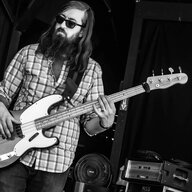
For me, I draw a distinction between live performance and recording. Mostly I’ve been playing with FOH support for the last 20 some years. I’ve been resigned to the fact that the sound tech has dominion over the house mix. So I’m not about to throw him a bunch of “curveballs”. They get a pre effect feed to the board. My stage monitor EQ is generally a flat EQ with a bump at 165 hz. I use Fender Basses with the tone control and volume controls wide open. As long as I can hear it, I’m good. If the band mates want anything else in their monitor, they can ask the sound tech for it.

Further, at every gig, before, at breaks and afterwords, I debrief with sound tech, politely and respectfully.

As for playing in an ambient setting, I’m all about playing with dynamics and tonal textures you described.
 
  • Like
Reactions: Wasnex and dbflats
There is also this concept of separating the kick attack from the bass. You can do that with spidechain compression, where you trigger the bass compressor with the kick drum signal, but I prefer to modify whether I’m playing ahead, on top of, or behind the kick. For purposes of deconflicting my bass from the kick, this works really well.
 
It was -24F here this morning, so HA!

Different music calls for different things. I find that most music that I really enjoy has prominent, fairly aggressive bass. I dislike the soft pillowy stuff and the music that comes with it. But, that’s just me, and everyone gets to like what they like.
 
  • Like
Reactions: dbflats
My favorite P bass pickup is the dreaded '08. I believe the general consensus is it is mid scooped. But it does what I need it to do perfectly, which is (borrowing from above) "support from below". The band is a Zep format, and the guitarist uses old Marshalls, which seem to be very mid forward. Surprisingly, I don't believe we are loud, and I usually get compliments on how full the mix sounds. I have no problems hearing myself on stage.
 
  • Like
Reactions: dbflats
I went to a 10k person concert this past summer. There was no sound coming from the bassist for half the set. He was playing, but nothing. I kept looking around the audience to see if anyone else noticed. But no one did. They were all just singing and having a good time. The kick drum was so loud that was enough bass for them. Eventually the issue got worked out and you could hear the bassist. Again no one in the audience seemed to notice. So depending on the type of music and situation it doesn’t matter at all. lol
 
My favorite P bass pickup is the dreaded '08. I believe the general consensus is it is mid scooped. But it does what I need it to do perfectly, which is (borrowing from above) "support from below". The band is a Zep format, and the guitarist uses old Marshalls, which seem to be very mid forward. Surprisingly, I don't believe we are loud, and I usually get compliments on how full the mix sounds. I have no problems hearing myself on stage.
Never heard of this ‘08 P Bass pickup issue, what’s this?
 
If the rhythm guitar tracks closely with the bass (not my favorite way to fly), cutting through is not essential, blend is more appropriate, and the guitar is going to take precedence because the high frequencies are so dominant.

If the rhythm guitar or accompanying keyboard is different than the bass, then they also need to stay outta the way. This can mean their tone (avoiding bass frequencies), where they play (avoiding lower registers), or when they play (filling in space rather than competing for it). Note length too. If the bass line is important and if the bass player is the only one playing it, then the bass needs to cut through and this is not just the bass player's responsibility.

For the bass, avoiding a muddy/scooped sound is key. Emphasize mids but also cutting lowest lows and highest highs.

The middle range of sounds, say from the E on the D string (2nd fret), to the octave on the G string (12th fret), can come through stronger if played on a lower string higher up on the neck. This seems slightly less important with flatwound strings. Staccato notes project better. Where and how you pluck matters, and a bit of drive helps.

For some reason, my fenders (Precision and Jazz) almost always cut through across all the strings, while my active EQ Stingrays and Spector have weaker projection on the D and especially the G strings, by comparison.

The worst bass I ever had for being heard was a 6 string Ibanez SR665. It just disappeared. Though, I sat in as a guest on an ESP 6 string once (didn't realize it was a 6er until I was on stage and started playing-gulp!) and it seemed to thoroughly disappear also.

Last example: the Fill Wars: if guitarists, and drums are doing fills every 2 bars, forget about your fills being heard or much less appreciated. Accept your lot or fight for your space! Or, find a new band where the members understand that everyone in the audience wants to hear the bass above all else!! 😎