• TalkBass has been independent since 1998. Add your voice.
    Create a free account to reply to discussions, view embedded media, and browse with fewer display ads.
    Join freeLog in
    Want zero display ads or expanded classifieds tools? Compare plans.

Dead spots

I agree with some of the comments above. Don't go looking for trouble.

Don’t go looking for things that you don’t know where they are or if they are even there.

Sometimes ignorance is bliss..... sometimes not.
When i got my fretless Warmoth leveled, epoxied and refinished i noticed what i thought was a problem with the fingerboard at the C# on the G string. I was thinking that there must be an unlevel area that was causing the note to choke out........ then I read about dead spots here on TB. I put the headstock against the wall, played the note again and it rang out much better. Now that i know that it is a dead spot i can ignore it and move on.

If a fret levelling and /or setup fix it, it was a choked note - a fret interfering with the vibration of a note played below a high fret, or a note played on a low fret, and again a higher fret is interfering with the vibration. A true dead spot has a different cause (the neck's resonant modes), that a fret levelling and/or setup will not fix.
Yep!
 
  • Like
Reactions: Kubicki Fan
Dead spots are places where resonant modes of the neck cause noticeable reduced sustain of a note. When you go looking for them, if you think you've found one, play a note on the neck on the same fret, but one string over - if that note rings much longer, then you've found a candidate for a dead spot. holding the headstock of the instrument against a wall will typically also help the note ring longer - that;'s another test you can try. ALL necks have places where there is reduced sustain. ALL of them. Many will be even enough the owner of the bass will say there's no "dead spot", and as there is no absolute criteria for that, there's no point in arguing with someone who says there neck has no dead spots, but...every neck will have variable sustain. A dead spot is probably best defined as a reduced sustain area that you notice in regular playing.

You can affect them by changing the stiffness of the neck (not easy), or by changing the mass loading at the end of the neck (the headstock). I've done this with lighter or heavier tuners, with some success, but it's relatively rare that they go away completely. One other thing that works sometimes (it certainly changes things) is a different tuning. A bass tuned to D standard will have different dead spots - maybe better, maybe worse, than one tuned to E standard. As I keep one bass tuned to D standard, the neck I have on that bass is one that reacts better in that tuning, and the neck that was originally on it is elsewhere, as it works better in E standard. Although the science of dead spots is well understood (at least to us Acoustical Physicists) There is no easy magic fix - you gotta try a few things.

This pretty much is spot on; the video is largely useless because the notes are not allowed to ring long enough for a good comparison. But even in the video you can hear the "dead" note ringing, just at the second harmonic.

For me, a dead spot is when the string simply stops vibrating; a simple touch test will verify that. If the string still is vibrating then the note ain't dead. Something else is going on.

A lot of what people call dead spots really are a change in the harmonic formula on certain notes -- usually the fundamental drops out and the second or higher harmonics attain prominence. I think this is what @micguy is driving at: the harmonic blend of notes in a certain zone of the fretboard on certain strings is different than in other zones. The tone changes, not the duration of the note. And this is a *very* common phenomenon.

Try it: start at the twelfth fret on the G string and let each note sustain at least four seconds. Slowly walk down by half steps. I bet most of you will notice the harmonic blend of G down to E is largely the same, then from D down to B you get into sort of a "pinched" zone, and then from Bb down to open string the ship tries to right itself. In that mid-zone most of the notes aren't dead; they just sound different.
 
  • Like
Reactions: B-Mac
The tone changes, not the duration of the note. And this is a *very* common phenomenon.

I'll semi-agree. What dies at the typical dead spot is largely the fundamental*. As that's a large part of the energy, the sustain is shorter, but there are harmonics that live on for a while. The worst part is there are often high harmonics (like the 7th harmonic) , which is typically masked by the fundamental, that you can now hear, and...it sounds pretty ugly, and very out of tune.


*Sometimes you can find a minor dead spot on the A string where the second harmonic dies out. I had one bass that had that - 3rd fret, A string. It's not nearly as unmusical as the one on the G string, but once you hear it, you kinda always know it's there.
 
I'll semi-agree. What dies at the typical dead spot is largely the fundamental*. As that's a large part of the energy, the sustain is shorter, but there are harmonics that live on for a while. The worst part is there are often high harmonics (like the 7th harmonic) , which is typically masked by the fundamental, that you can now hear, and...it sounds pretty ugly, and very out of tune.


*Sometimes you can find a minor dead spot on the A string where the second harmonic dies out. I had one bass that had that - 3rd fret, A string. It's not nearly as unmusical as the one on the G string, but once you hear it, you kinda always know it's there.
Yes, I think that the generally accepted definition of the term "dead spot" is the faster-than-normal decay of a note's fundamental.
 
  • Like
Reactions: Ewo


This video does a good job indicating what a dead spot sounds like. It's a totally muted position. As the video shows, the fat finger doesn't do much (I have one, and it's not much of a difference). I found that a fret leveling and a good setup can alleviate dead spots.

Thanks for the video, it addresses OP. I wish he'd have showed how the rest of the neck responded after the clip-on because dull areas (DAs) tend to move, so you don't entirely get rid of them with that method (as was mentioned by another poster).

I have a fretless (with a graphite reinforced neck from Warmoth) that has an incredibly tight neck to body coupling and sustains like mad except for the note nine fret positions up on the G string. No amount of setup will get rid of it. It is a stunning sounding and looking instrument and feels so good to play that on balance the DA is of no concern me.
 
Last edited:
  • Like
Reactions: PullThePlug
As has been said, fretting each note on each string at each position on the fingerboard should help you identify dead spots or places where there is unwanted buzz . You'll know them if you hear them. If you don't hear them, they probably aren't there, and certainly aren't problematic.

If they exist from about sixth through ninth position, a slight saddle adjustment on the offending string, or a bit of relief on the truss rod will often do the trick. But....it is important to make these adjustments with the offending string loosened and in small increments. Loosen, adjust slightly, tune up, check again for the dead spots and buzzes. Repeat, if necessary.

I recently had this problem with a bass I restrung. I made the adjustments described above and still couldn't get rid of the problem. I talked with a luthier friend about it and he suggested I remove the offending string and check it for imperfections, bends, twists, or kinks. Sure enough, I had kinked the string by gripping it tight, when getting it to a tension for winding, until the tension from my grip could be released. With the string off, I was able to work the kink out, as opposed to replacing the string, and the problem was solved. If the string is egregiously defective, it will need to be replaced.

Lesson learned. ...don't create tension by gripping strings when restringing and check for the kinks, bends, twists, and imperfections before making saddle and trust rod adjustments.

One more thing to remember is if you make saddle and / or trust rod adjustments, you will probably need to re-intonate. Easy enough to check and adjust, but very necessary.

Hope this is helpful.

Koog
 
  • Like
Reactions: Sands
We have a church bass that plays perfectly but the D string around the 8-11th fret doesn’t ring out good and sound dead just on those 3 spots. What can I do to fix that issue.
Q. How does Bill Gates change a light bulb? A. He doesn't, he makes darkness the industry standard.

live with it. or work with what you've got? :). I could not find a pic of a hunk of sponge under the strings at the bridge.
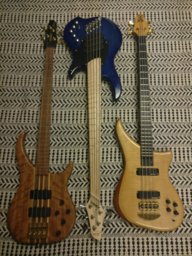

Fretwrap.jpg
 
Last edited:
My six string basses don't have any.
I wonder why?
Extra neck mass?Strings?

Extra neck stiffness is likely more important than the added mass. I'm sure if you let me look, I could find some areas with reduced sustain, but I'm also certain it wouldn't help you enjoy your bass. I have 4 stringers with graphite reinforcement rods and roasted maple, which push the reduced sustain areas up the neck (where yours likely are), and makes them less apparent - I could rightfully claim my 4's have no true dead spots, as you don't notice them in normal playing. Reduced sustain areas are there, though, if you know how to look/listen.
 

Latest posts