• TalkBass has been independent since 1998. Add your voice.
    Create a free account to reply to discussions, view embedded media, and browse with fewer display ads.
    Join freeLog in
    Want zero display ads or expanded classifieds tools? Compare plans.

Deep thoughts....on resonance?

OK, I'll try to put this into words as best as I am able.

When I am sitting at home practicing, being near the amp (at low volumes), I hear "the amp", and only the amp, as it were.

Now, if I move away from the amp, and sit and listen as I play (amp is still on, but I am out of the "sound cone"), it seems as though the bass ITSELF has a sound to it. I'm not talking about the strings, it seems sometimes like the sound is coming from the body (as though the body has its own integral speaker).

Is this the resonance of the body in action as the strings are struck? Or am I hallucinating because it's mostly Pink Floyd that I play? :smug: Thanks.

Chris
 
Yep, the body absorbs some of the energy from the strings and resonates as the strings are struck. This happens more on some basses than others, depending on things like the mass and density of the body and the bridge, the stiffness of the neck construction, etc.

In a sense, this is how the physical characteristics of the bass (and not just the pickups) affect the amplified sound.
 
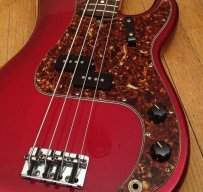
Good, glad I was on the right track. Interestingly, the bass in question is a Fender P - it's Indonesian made, is quite heavy, and feels really solid. This makes sense.

This would also explain why the MTD Kingston that I tried out had a very "non-dense" sound; it was extremely light (basswood body), and felt/looked great, but had no "oomph" whatsoever - which really turned me off.

Chris
 
As you move away, you will also reach the resonant point with some of the sound waves your amp is creating, which will cause the strings to resonate with that note.

When you are close, the distance is too short for any bass frequency resonance.
 
As a fun little experiment, bite down on your bass and play (or stick your head on the body, or whatever). You should hear the bass quite loudly and about as pure as it would sound if pickups and amplifiers were not necessary on a solid body.

Aesthetics aside, resonate properties of various woods are the reasons they are selected as tone woods. Whether you believe wood effects tone to any discernible level is entirely up to you, but this is why many of the boutique builders choose the woods they do.
 
As you move away, you will also reach the resonant point with some of the sound waves your amp is creating, which will cause the strings to resonate with that note.

When you are close, the distance is too short for any bass frequency resonance.

A good example is when a guitarist gets that high pitch feedback by sticking his guitar up to his amp - the sound waves are causing the strings to vibrate at some natural harmonic.
 
Good, glad I was on the right track. Interestingly, the bass in question is a Fender P - it's Indonesian made, is quite heavy, and feels really solid. This makes sense.

This would also explain why the MTD Kingston that I tried out had a very "non-dense" sound; it was extremely light (basswood body), and felt/looked great, but had no "oomph" whatsoever - which really turned me off.

Chris

Lighter basses absorb more vibrations from the strings, and will have a warmer tone and slightly slower attack. I mean very slightly.

The lighter the body gets, i.e., a hollow body, the greater that affect on the tone because it's easier to set into vibration. A banjo is the extreme opposite of a solid body. You have maximum about of energy dumped from the strings into the vibrating head which translates into a loud tone and minimum sustain.

You can mate a light resonant body with a very stiff neck and still have good punch and sustain. Much of your tone actually come from the neck, because it is the most flexible part of the bass.
 
You can mate a light resonant body with a very stiff neck and still have good punch and sustain. Much of your tone actually come from the neck, because it is the most flexible part of the bass.

My Curbow 6 kind of fits into that model--very stiff Rockwood neck, heavy brass plate under the bridge (it's not a light bass by any means!) but a completely hollow mahogany body. It's got both amazing punch and amazing sustain...
 
As a fun little experiment, bite down on your bass and play (or stick your head on the body, or whatever). You should hear the bass quite loudly and about as pure as it would sound if pickups and amplifiers were not necessary on a solid body.

Aesthetics aside, resonate properties of various woods are the reasons they are selected as tone woods. Whether you believe wood effects tone to any discernible level is entirely up to you, but this is why many of the boutique builders choose the woods they do.


OH NO YOU DIT'NT! YOU DIT'NT JUST SAY (blank)wood! :rollno::D
 
As a fun little experiment, bite down on your bass and play (or stick your head on the body, or whatever). You should hear the bass quite loudly and about as pure as it would sound if pickups and amplifiers were not necessary on a solid body.

Its funny, because for the longest time I didn't own a tuner and would just use online tuners and play the tone for each note, and match the vibrations up with my chin on the body.. Was always pretty close when I would match it up on a tuner too.
 
OH NO YOU DIT'NT! YOU DIT'NT JUST SAY (blank)wood! :rollno::D

(blank)woods make the best fires. Have you ever sat around an alder or maple campfire? It smells amazing. I have decided to have all future basses custom built from woods that will smell best when burned, in case I decide to go all Jimmy Hendrix on stage.
 
Its funny, because for the longest time I didn't own a tuner and would just use online tuners and play the tone for each note, and match the vibrations up with my chin on the body.. Was always pretty close when I would match it up on a tuner too.

I still do it if I'm nowhere near a tuner (ie, lazy). It's good ear training, and if I'm close enough and tuned relatively, I have no qualms.

I don't do it on stage, though. Although smacking a tuning fork and biting down on my bass' upper horn would make for an interesting show.
 
As you move away, you will also reach the resonant point with some of the sound waves your amp is creating, which will cause the strings to resonate with that note.

When you are close, the distance is too short for any bass frequency resonance.
that might be bogus.

a bass will "resonate" right next to an amp just fine (better in fact, due to the increased amplitude). in fact, put your headstock on the amp and you'll get all kinds of resonance, even though the distance is now zero.

your eardrum will "resonate" just fine with bass notes coming out of headphones, even though the wave is "too long" for your ear canal.

this is a variation on the ol' "bass only 'develops' at a distance" myth.
 
Aesthetics aside, resonate properties of various woods are the reasons they are selected as tone woods. Whether you believe wood effects tone to any discernible level is entirely up to you, but this is why many of the boutique builders choose the woods they do.

+1 All you need to do is build a few identical basses from different types of wood to hear that they do sound VERY different. This includes fingerboard woods. This is true of solid bodies as well as acoustic instruments.

Anyone that things wood type doesn't affect the tone never built a bass or guitar. Other myths are that glue lines ruin vibrations, and that the finish affects the tone on a slid body. Both are rubbish.

I choose certain woods to get certain tones, and it worked as I expected.

As far as "tone woods"... all wood has tone. That phrase is used to talk about softwoods, like spruce, when used for acoustic guitar tops. It has nothing to do with solid bodies, unless you are making them from spruce or douglas fur or something.
 

Latest posts