• TalkBass has been independent since 1998. Add your voice.
    Create a free account to reply to discussions, view embedded media, and browse with fewer display ads.
    Join freeLog in
    Want zero display ads or expanded classifieds tools? Compare plans.

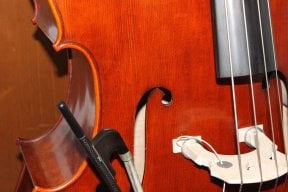
Double Bass different height bridge adjusters (as in different height on g than e side)

I just got a new bridge last week which really helped the sound of my bass. One thing that he told me was to keep the adjusters at the same height and not to only raise or lower one side of the bridge because it creates tension within the bridge that cuts sound.

Is there any room for variation though? For example would a full turn on one side really be that bad? I am just wondering for future reference, but also because I have always been used to a higher E because of my first bass having a beveled fingerboard.

Also I did try to search for this because I would have thought someone would have asked, but didn't find anything so apologies if this is a repeat question. :ninja:
 
Tell the guy that made the bridge that you would like your E string higher relative to the other strings. He should be able to tweak the bridge itself so that it works for you. In this case, lowering the other three strings. Then when you raise the bridge up equally on both adjusters your E string will be higher relative to the others. Changing one adjuster not only moves that side of the bridge up, it moves the strings over to a higher or lower spot on the curve of the fingerboard.
 
not many people realy know how to make a good,fully functional adjustable bridge.
the way most techs do it, if you raise or lower one side without the other, it will distort the fit of the bridge to the belly of the instrument. over time, this will ruin the top.

in my opinion, it is a great misfortune that so many people work in the industry, have no idea of what they're doing, and yet are more than happy to charge exhoritant amounts of $$ for BS repairs & set up jobs.

a proper adjustable bridge needs to have some lateral movement built into it.

i live in jersey. if your willing to drive to westfield, i'd be more than happy to fix this for you for a 12 pack of Warsteiner, but i recomend you seek something of a refund from the tech who sold you something that doesn't work.
smg.
 
are you talkin' to me ?
i do have a brother named Jim, and he is a bass player.
his ability to properly punctuate is not my problem, if he is the one of which you speak, although most bass players are experts in knowing what they want.
i'm sorry. i'm doing it again...
smg.
 
...but i recomend you seek something of a refund from the tech who sold you something that doesn't work.
smg.

...or just do as Eric suggested and ask the luthier to adjust the curvature of the bridge to your liking. There's no evidence that he did anything "wrong" at all.
 
Very often the luthier puts the bridge back on slightly too much town either f hole. Sometimes CAREFULLY tapping the bridge toward one side can make all of the difference. Ideally the adjusters should be the same, but most of us have one side a bit higher from time to time. Theoretically when one side is higher it puts more pressure on one side of the foot. I really like the idea of this guy that makes adjusters that pivot a bit so that the feet are always making consistent contact . The bridge would be freer to move, too. Don't know how it behaves in practice, but sounds like a good idea. Except for those of us who use the Full Circle. Oh well---
 
...or just do as Eric suggested and ask the luthier to adjust the curvature of the bridge to your liking. There's no evidence that he did anything "wrong" at all.

+1 I'm always happy to make the setup fit the player. I mean, that's the basic premise, right? :)

Sometimes when the player picks up the bass, there have been several changes and the sound and feel are completely different and distracting. Only later do they notice that say, the E string is lower than they like it...

I always tell clients to bring the instrument back if/when they discover anything not working for them.
 
...Ideally the adjusters should be the same, but most of us have one side a bit higher from time to time. Theoretically when one side is higher it puts more pressure on one side of the foot. I really like the idea of this guy that makes adjusters that pivot a bit so that the feet are always making consistent contact . The bridge would be freer to move, too. Don't know how it behaves in practice, but sounds like a good idea. Except for those of us who use the Full Circle. Oh well---

Indeed, it sounds like it might be a good idea but, as I understand the physics, if you want your E string a bit higher relative to the others, that cannot be accomplished by turning one adjuster without the unwanted side-effects mentioned by Chris and Eric.
 
One respected bass luthier told me to always keep the bridge adjusters turned equally. He even marks the adjusters when installing them, to calibrate them, so players can visually see that they are perfectly together after adjustments.

Another respected bass luthier told me, that keeping the adjusters perfectly equal is fine if the bass is so well built that everything balances out great, however, it's more important that the specific instrument in question be balanced properly. So if the top is sagging a bit to one side, or the neck is a bit crooked, or something is a bit odd with the construction of the instrument in a way that requires the bridge adjusters to be of unequal heights to get the bass balanced to be as good as possible without rebuilding it, then so be it.

Any thoughts on these opinions?
 
If you try to raise the E with the adjuster, you will end up rolling the bridge to the left and actually LOWERING the E string. The reason you want to keep the adjusters even is to avoid messing up your string heights... the geometry is such that you can't make a sensible differential string height difference. However, if the top sinks unevenly, I can't see any reason you shouldn't fix that temporarily with the adjusters... but temporarily only, as if the top sinks you really want someone to look at it.
 
Theoretically when one side is higher it puts more pressure on one side of the foot.

I've also been told to have the adjusters equal--but I've always wondered something: isn't the bass receiving different amounts of pressure on the bridge anyway? A typical 'E' has more PSI than a typical 'G', doesn't it? Wouldn't that make more pressure coming down the 'E' string bridge leg than the 'G' string bridge leg?

Just wondering...
 
Pressure on the G vs E is irrelevant. If you crank one side up and not the other, it distorts the angle in which the threaded rods of the adjusters will be pushing outwards on the thin parts of the bridge legs and could shatter them..
 
...I really like the idea of this guy that makes adjusters that pivot a bit so that the feet are always making consistent contact . The bridge would be freer to move, too. Don't know how it behaves in practice, but sounds like a good idea. Except for those of us who use the Full Circle. Oh well---

Indeed, it sounds like it might be a good idea but, as I understand the physics, if you want your E string a bit higher relative to the others, that cannot be accomplished by turning one adjuster without the unwanted side-effects mentioned by Chris and Eric.

Mike, you mean the Moser bridge adjusters we were talking about in the other thread. With a Moser the feet are completely flexible so they will always have perfect contact (assuming they are fitted exactly to begin with). But this feature of the Moser will not allow for varying the string height across the bass.

I get this info from Horst Gruenert who installed the Moser bridge adjusters for me. He told me to keep them always set at equal height. To have the E twisted higher than the G side would create an imbalance of pressure on the top. If that is so, the only way to vary string height is by trimming the top of the bridge...
 
I really like the idea of this guy that makes adjusters that pivot a bit so that the feet are always making consistent contact . The bridge would be freer to move, too. Don't know how it behaves in practice, but sounds like a good idea. Except for those of us who use the Full Circle. Oh well---

i have a moser/fc-combo.
works great
look at my posts here:
http://www.talkbass.com/forum/showthread.php?t=215707
 
yeah, the moser works great. very cool. :cool:

btw, your pictures don't show your bridge on your bass. The bridge is off the bass on some sort of soft cloth.

The topic here was whether both adjusters need to be set at the same height. Is that how you use the adjusters? Or do you crank up one side more than the other?

I was told by a "respectable luthier" -- and many here on TB have confirmed -- that raising the E side adjuster is not the way to set string height. That's what the first post of the thread here was asking... :confused: