• TalkBass has been independent since 1998. Add your voice.
    Create a free account to reply to discussions, view embedded media, and browse with fewer display ads.
    Join freeLog in
    Want zero display ads or expanded classifieds tools? Compare plans.

Double Bass DIY Impedance Buffer

Hi all, apologies if this has already been posted. There seems to be a lot of you on here using the Realist Copperhead and having issues with the required 10Mohn input impedance requirement.

I'm finding my Realist has poor low frequency response and sounds generally disappointing through every amp I have tried. I can't seem to find a solution available in my part of the world.

I discovered this circuit which appears to be a quick and easy solution. In communication with the designer, it has an input impedance of 4.8Mohm. While this is obviously an improvement on my amp's 1Mohm, I figure I may as well match it perfectly if I'm going to build this myself. He has suggested I change the resistors labelled below but did not specify new values.

I'm hoping there's some electrical engineer types, or someone who has attempted this before who can advise the new values of R1, R2, R3 to achieve 10Mohm. I haven't done such complex calcs in a very long time and will definitely get it wrong.

I figure if this is a success, this thread can be a reference for the next disappointed Realist owner.
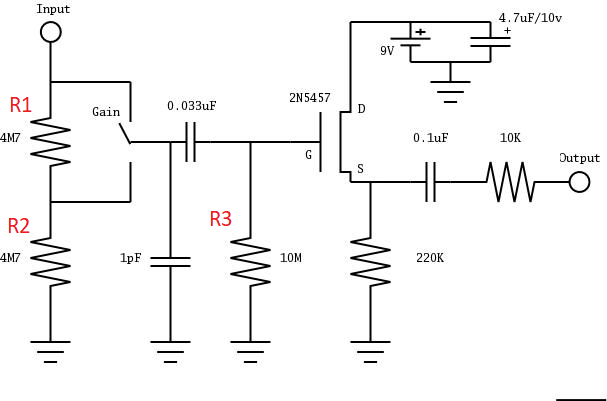
1643091627206.png
 
Great post. Will be interested to follow this as I would like to impedance match my piezo pickup too. I have been using a Zoom AC-2 pedal + HPF and endlessly experimenting without finding the sound I'm looking for. I might combine your circuit with the HPF which would result in something like an F-Deck??
 
Great post. Will be interested to follow this as I would like to impedance match my piezo pickup too. I have been using a Zoom AC-2 pedal + HPF and endlessly experimenting without finding the sound I'm looking for. I might combine your circuit with the HPF which would result in something like an F-Deck??
Haha another aussie deprived of access to things. From what I can tell, the Fdeck designs are much more complex and have many more features including a preamp. At this stage, I don't think I need those functions. More importantly, I can't seem to buy an Fdeck from anywhere.
 
Last edited:
Whatever the impedance is, it looks awesome. Did you notice a significant difference in tone with and without the buffer?

Yes, I have noticed that the frequency range from the bass is now "full range" after connecting to the buffer.

My first use of this buffer was when using my own created piezo pickup. This pickup created a real high pass filter when connected to my amps input connection. So I had a lot of high frequencies and that was not possible to dail in a decent bass sound. Then I put the buffer in the circuit and the bass sounded good right out of the box.
I have since then upgraded to the Copperhead pickup which implies that I do not neccessary need the additional buffer, but I can certaintly hear an enhancement in sound. I have also the EBS Stanley Clarke Signature Acoustic Preamp that sounds very similar to the simple red buffer "pedal".

I have also used the buffer when playing acoustic guitar with included piezo pickup. The buffer seems to enhance the sound of the guitar as well, even though subtle.
 
The mint box effectively put the series of two 4.7 MegOhms (add them up to 9.4 MegOhms) and the 10 MegOhms begging the capacitor in parallel. So you get about 5 MegOhms. You can switch the input for half amplitude if you have a large voltage coming in from your pickup.
So double the two 4.7 and one 10 MegOhms to two 10 MegOhms and one 22 MegOhms and you get about 10 MegOhms input impedance. Anything else can remain as in the original.

Personally if you do not need the input attenuation, I would drop the two resistors at the input and connect the input at the junction of the two capacitors.

If you want a switchable impedance, replace the 10 MegOhms resistor by two 4.7 MegOhms resistors in series.
Put a switch to shorten the resistor connected to ground to get 4.7 MegOhms instead 9.4 MegOhms. Any other combination of resistor is possible too as long as the add up to approximately 10 MegOhms.

FDecks Quick’n’dirty is very similar to the mint box. You might want to compare them.

BTW the characteristics of the 2N5457 and 2N5458 are different. Francis has made a nice diagram where he shows the operating voltage of different JFETs.
For a switchable phase it must be close to the middle of the supply voltage or you get distortion at higher levels. That’s the reason why he chooses the 2N4416/PN4416 for his HPFpre 1 and 2.
 
Having played the Realist Copper Foil pickup for a number of years. I always preferred the 5 Meg Ohm setting on my Headway EDB 1 and EDB 2 over the 10 Meg Ohm on my other preamp at the time. Just my take of course. :)
I also used a Walter Woods Electroacoustic Ultra with the Realist, it's input impedance is fixed at 1 Meg Ohm which sounded particularly great. Which leads me to believe, that the EQ section has to be stellar along with the input impedance
to get a pleasing timbre from the Double Bass.
 
The mint box effectively put the series of two 4.7 MegOhms (add them up to 9.4 MegOhms) and the 10 MegOhms begging the capacitor in parallel. So you get about 5 MegOhms. You can switch the input for half amplitude if you have a large voltage coming in from your pickup.
Thank you for the outstanding advice as always DoubleMIDI. I had suspected R1 and R2 were only for attenuation at the input and not necessary to match impedance, despite Scott's advice. To clarify your suggestion, if I remove everything before the capacitor junction and change nothing else, this would effectively give me the 10M input impedance? I figure most amps have a 'pad' button so this is mostly redundant.


@degrees I built an FDeck hpf/buffer (see COVID preamp ) some time ago. As I am not using it now, PM me if you would like to try it out / and you are not too worried about the cosmetics :laugh: :roflmao:.
Thank you for the generous offer! I have already placed orders for the more difficult to find parts so I guess I'm committed to building this thing now.
 
Last edited:
I'm finding my Realist has poor low frequency response and sounds generally disappointing through every amp I have tried. I can't seem to find a solution available in my part of the world.

Not to derail your thread, but I've found that the Realist is typically less sensitive to input impedance that other piezo pickups and should still sound good into a 1 MegOhm input. If your Realist sounds like you describe, it may be damaged, worn out, or not fit properly. I've also found that the Realist is very bass-dependent. It sounded great on my old Kay, but not so good on my current German bass. The solution to your problem may be have to the fit of the bridge checked (for even pressure on the piezo element), obtaining a new Realist, or trying a different pickup all together. This is just my $.02 based on my personal experience.

- Steve
 
  • Like
Reactions: Wasnex
Not to derail your thread, but I've found that the Realist is typically less sensitive to input impedance that other piezo pickups and should still sound good into a 1 MegOhm input. If your Realist sounds like you describe, it may be damaged, worn out, or not fit properly. I've also found that the Realist is very bass-dependent. It sounded great on my old Kay, but not so good on my current German bass. The solution to your problem may be have to the fit of the bridge checked (for even pressure on the piezo element), obtaining a new Realist, or trying a different pickup all together. This is just my $.02 based on my personal experience.

- Steve
Thanks Steve, yeah I'm mindful of those variables. This impedance matching is only one step in the isolation process. The pickup is brand new and was fitted by an orchestral strings technician. Hopefully I'll know after this if it has a manufacturing defect. This is a student level ply bass, but it sounds great with a condenser mic if that's any indication.
 
  • Like
Reactions: bassfiddlesteve
I had suspected R1 and R2 were only for attenuation at the input and not necessary to match impedance, despite Scott's advice. To clarify your suggestion, if I remove everything before the capacitor junction and change nothing else, this would effectively give me the 10M input impedance? I figure most amps have a 'pad' button so this is mostly redundant.
If you remove the R1 and R2 and connect to the capacitor junction you indeed get 10 MegOhms.

Splitting the 10 MegOhms was a suggestion to have a two switchable impedances. You don’t need to do that if you don’t want it.

The reduction by R1 and R2 before the JFET can avoid distortion by exceeding the linear part of the JFET, so it is not completely the same as reducing the level after the JFET, but a capacitive divider (instead of a resistive one like R1/R2) can do that too like the capacitor in the connector of the Full Circle. It also does not change the input impedance.
I think in most cases you don’t need it.

You might want to use sockets (broken from round sockets in a row with the black plastic removed) for the resistors to check things out, specially if you want to divide R3 to make the impedance switchable. You can solder them into the socket later if you have settled with a certain setting.
 
How would a circuit like this be modified to work on unbalanced phantom power instead of the battery? I'm talking about low voltage phantom power intended for electret condenser mics (9v-12v).

@degrees Did you build it? How is it working for you?
 
Not to derail your thread, but I've found that the Realist is typically less sensitive to input impedance that other piezo pickups and should still sound good into a 1 MegOhm input. If your Realist sounds like you describe, it may be damaged, worn out, or not fit properly. I've also found that the Realist is very bass-dependent. It sounded great on my old Kay, but not so good on my current German bass. The solution to your problem may be have to the fit of the bridge checked (for even pressure on the piezo element), obtaining a new Realist, or trying a different pickup all together. This is just my $.02 based on my personal experience.

- Steve

Same as my experience. No problems terminating the Realist with 1Meg. Not saying 5Meg would not be better.

@degrees

Don't assume 10Meg is the gold standard. The optimal load varies with the design of the pickup. If the impedance is too high the pickup can become underdamped and ringy (which would not be good for the Realist). My guess is the optimal load is somewhere between 2Meg and 5Meg, so your buffer is probably pretty close to ideal.
 
I really wish someone would make a box with sweepable hpf AND sweepable impedance buffering.

Getting those two things right seem to be the key with DB.
Yea, IDK why that's not more of a thing. I think part of the problem is that the most straight forward circuit would be a buffer with a very high value potentiometer in front, like 5 or 10 M-Ohm, and afaik, no one makes audio pots that high. HOWEVER, it could be done with a 6 or 12-position rotary switch connected to resistors of various values. That seems pretty straight forward. Personally, I would be more than happy with a 3-position switch for three different values.
 
I really wish someone would make a box with sweepable hpf AND sweepable impedance buffering.

Getting those two things right seem to be the key with DB.
Well, you could always use an Acoustic Image Clarus head which has sweepable HPF and both 1meg and 10 meg inputs. Works for me, although with a Zac Victor piezo I don't notice any difference between the two impedances.