Doesn't go into a land fill. I'm surrounded by trees. They love CO2.HUH?!!


TalkBass has been independent since 1998. Add your voice.
Create a free account to reply to discussions, view embedded media, and browse with fewer display ads.
Join free Log in
Want zero display ads or expanded classifieds tools? Compare plans.
Doesn't go into a land fill. I'm surrounded by trees. They love CO2.HUH?!!

Doesn't go into a land fill. I'm surrounded by trees. They love CO2.

Nope. Don't tell anybody, but things are getting GREENER because of CO2 lately. It's an important part of the existence of life on our planet. But it's cyclical. Levels have been cycling for at least the last several hundred thousand years. We're kind of in a medium spot right now. They've been higher and they've been lower.true,.. but i heard there's too much CO2. we recycle our plastics,.. even bags.


From nearly anyone else I would have though this was satire. Maybe we can give them a snappy name like dalit.If such a condition results in less landfill waste and useful items for those in need, isn't this a good thing? Otherwise, if everyone made $70,000/year, soon we would be surrounded by landfills everywhere.... no?
Yes. Burning plastics releases CO2 that has been sequestered from the system for hundreds of millions of years. It alters the relative proportions of gases in the atmosphere:true,.. but i heard there's too much CO2. we recycle our plastics,.. even bags.

That's why I do it!From nearly anyone else I would have though this was satire. Maybe we can give them a snappy name like dalit.
Yes. Burning plastics releases CO2 that has been sequestered from the system for hundreds of millions of years. It alters the relative proportions of gases in the atmosphere:
Invalid Link Removed

Whenever I have an item I don't want and I know the garbage truck won't take, I just put it out on the curb and it always disappears within a day. Win/win.
That's why I do it!
My trees love it.
Earth getting greener due to rising CO2, global snapshot showsLife (including plants) is essentially carbon neutral, releasing tons of long-stored carbon into the cycle is not beneficial and alters the atmosphere to dangerous conditions for current ecosystems and lifeforms that evolved when that excess carbon was not present.
Please don't turn this into a science denialism thread. You're simply wrong; that's okay, learn from your mistakes.
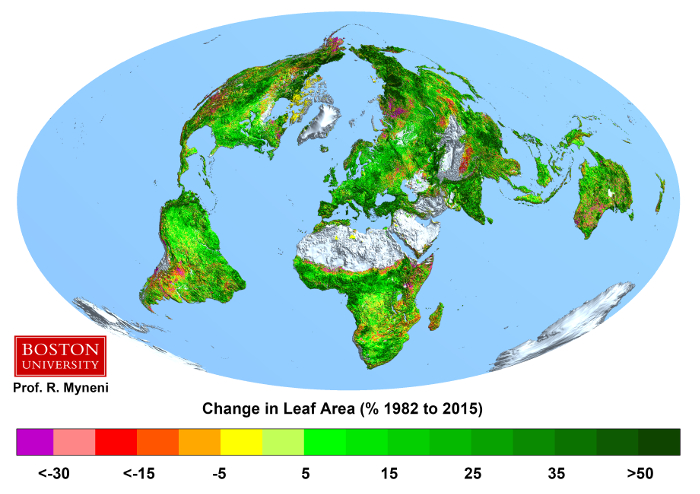
Rising carbon dioxide levels in the atmosphere have increased plant growth across the planet over the past three decades, a new study has found.
Key points
- A few areas on Earth have browned but the vast majority have greened
- Plant coverage has grown by 18 million square kilometres in a few decades
- The main cause is increase in atmospheric CO2
- Nitrogen from agricultural fertilisers has also contributed
The most comprehensive modelling of remote sensing data so far shows the area on Earth covered by plants in this time has increased by 18 million square kilometres — about 2.5 times the size of the Australian continent — largely due to the fertilising effect of carbon dioxide (CO2).
"[The greening] has the ability to fundamentally change the cycling of water and carbon in the climate system," said Dr Zaichun Zhu, from Peking University in China and lead author of the new study, which appears today in the journal Link Removed.
"Carbon fertilisation is the dominant process for greening across the globe, particularly in the tropics because there's so much leaf area there."
Dr Pep Canadell
"This is a snapshot of humans' global influence on the functioning of the entire global biosphere," said co-author CSIRO's Dr Pep Canadell of the Global Carbon Project.
[…]

You're simply wrong; that's okay, learn from your mistakes.

It has "benefits" for plant life but is net-detrimental. For example increased CO2 leads to bigger algal blooms which are bad for other aquatic life. Not to mention it's forcing on warming.
I believe, you're on the money thereIt has "benefits" for plant life but is net-detrimental. For example increased CO2 leads to bigger algal blooms which are bad for other aquatic life. Not to mention it's forcing on warming.
 Inside that news cutting, is the quote,
Typical of scientists these days, the Dr. is playing the diplomat. But his understanding is not ambiguously rendered. He just won't say which way things can go. I'm sure he's in your camp, though."[The greening] has the ability to fundamentally change the cycling of water and carbon in the climate system," said Dr Zaichun Zhu, from Peking University in China and lead author of the new study, which appears today in the journal Link Removed.




... it may be foolhardy and dangerous to think we can actually control things, in any way beyond rudimentary input and adjusting our bad behavior, and easily avoid calamity. It may be best, all things considered, to be more cautious and more sensible. We can easily do this

Your last paragraph is irony. (i.e. I won't if you don't).Life (including plants) is essentially carbon neutral, releasing tons of long-stored carbon into the cycle is not beneficial and alters the atmosphere to dangerous conditions for current ecosystems and lifeforms that evolved when that excess carbon was not present.
Please don't turn this into a science denialism thread. You're simply wrong; that's okay, learn from your mistakes.


Then quit screwing the system by introducing things that haven't been in the system for hundreds of millions of years.Your last paragraph is irony. (i.e. I won't if you don't).
Regarding the first paragraph, you and I must be reading different books.
My property was logged a couple of years ago, leaving a few hundred trees laying around waiting to be cut up for small projects or firewood. While we were enjoying a large campfire a few weekends ago, I was explaining to our grandchildren that when wood rots on the ground, it gives back the carbon dioxide over the decades it takes to rot. When you burn it, all the CO2 is realeased into the atmosphere, doing for the trees and grass around us what a shot of oxygen would do for us.
The more I know, the more fascinated I am with the effectiveness of our relatively closed, cyclic system, powered by radiation from our sun as well as cosmic rays (which very much affect our cloud formations).