• TalkBass has been independent since 1998. Add your voice.
    Create a free account to reply to discussions, view embedded media, and browse with fewer display ads.
    Join freeLog in
    Want zero display ads or expanded classifieds tools? Compare plans.

Do you use your B?

There are other benefits to the B
In my case, I play a lot of ghost notes and in most cases, it’s a fretted note where I pull off the fret. My technique for ghosts is harder to do on an open string; so if I’m ghosting a low E, I can fret it.
The B is handy when you use the low notes before your target note; for example- Ab down to F on the E string; quite often I will approach those notes from the V below them.
Let’s say... a quick low C before hitting F.
Also, a fiver gives you a larger mass of wood which may contribute to neck stiffness/sustain/dead spots.
 
Has anyone tried one of these? A relatively low cost entry. Link Removed

Like I said , this thread has made me curious.
I have an older one with a more Fenderish headstock. The neck is straight, adjustable and stable. The tuners are nothing great but it stays in tune. The bridge is your basic bent plate Fender style. The frets are a lot better than you might expect and are a lot better than some basses I paid a lot more for. The pups aren't any noisier than other single coils and sound like, well single coil pups. The controls are vol, vol, tone. I haven't noticed any scratchiness. I have mine strung with flats. I found a bridge cover in ebay that hides the foam mute I've added. It has a great MoTown tone.
39994105491_84c5b0d39e_k.jpg
SX Jazz 5 by TOM STRAIGHT, on Flickr

26121817828_37c2d74573_k.jpg
SX Jazz 5-2 by TOM STRAIGHT, on Flickr

26121817488_52b6394e9b_k.jpg
SX Jazz 5-3 by TOM STRAIGHT, on Flickr

26121817048_afd4c1a2cc_k.jpg
SX Jazz 5-5 by TOM STRAIGHT, on Flickr
 
Last edited by a moderator:
Why 'B'? A bass is tuned in perfect fourths. The next higher string 'should' be tuned 'C' If it were a guitar it would be 'B'

Not causing an argument, I just want to know why you went with 'B'

View attachment 2896927

Why is a guitar not also tuned in perfect fourths?

I need the harmonics that the B makes to play a specific song. Having a C string in that position precludes me from being about to play the correct harmonic at the 7th and 12th frets. While those particular harmonics can also be found at 9th fret of the D and G strings they're not as strong as playing them on the B string at 7 and 12. I'm picky that way. BTW, the song is The Needle and the Spoon by Skynyrd and the part is the 2nd guitar on the introduction.
 
Why is a guitar not also tuned in perfect fourths?

Because it is not related to the double bass which is where the electric bass guitar 'morphed' from.

You'll find that 5 string basses are either tuned B E A D G or E A D G C (check out Steve Swallow sometime as he does the high 'C' thing instead of the low 'B')
6 String basses are tuned B E A D G C unless they are a bass VI which IS tuned like an electric guitar E A D G B E but an octave lower with a guitar like neck that is shorter and with closer string spacing than a bass guitar.

There are always exceptions. It would really screw me up to have a string tuned on a bass not following perfect fourths, but that is just me. I'm not a guitar player, I'm a bassist.....but I do dabble on acoustic guitar once in a while, but it feels like a toy compared to bass.


The Needle and the Spoon by Skynyrd
Great tune by the way :)
 
Last edited:
I didn't read the entire thread, but I'll say the same thing I usually say (some folks have mentioned this).

Four, five, six, seven strings... I don't really care. They're all instruments with different sounds and in my opinion people should care more about sound than all that other stuff. I'll avoid the B string if I can for anything above a low Eb, anything above that and the B gets a bit muddy (to my ears). I have world class instruments with "the best B strings in the business" ... but I still prefer the sound of the other strings and I'll typically do whatever I can to get the best tone and best timbre out of a note. If that means an extra shift down to the low F on the E string even though the B is more convenient... then I'll make it happen so it'll sound correct (to my ears, at least). If I'm playing something that's technically demanding where a shift is not the best idea, then I might use the low B in that case. And there again, sometimes you might want to avoid the sound of your hand changing positions because maybe it's a quiet part of the tune... so using the B is the better choice, even though you might prefer the sound of the E string. Or maybe you get more sustain from your E string than the low B, so if you need to hold a long F# the correct choice might be the 2nd fret on the E rather than 7th on the B. The same is true on an instrument with a high C -- I'll almost always prefer the sound of the higher registers of the D and G over the sound of the lower register of the high C.

Dropped tunings or any of that other stuff never really enters my mind, though I'll add that, in my opinion, the correct decision is sometimes to drop your tuning rather than using the low B. Again, because the sound of a big open-string Eb might be the sound you want... not a fretted note on the low B. Green Day could be an example here -- I grew up playing their stuff and they were tuned in Eb for years. Whenever I get the urge to revisit any of those tunes I'll always tune down rather than using a 5-string because playing an open Eb with a hard pick is a way better tone than fretting the B string. But again, just my opinion.

Anyway, You'll be fine. It's music... go out and make some!
 
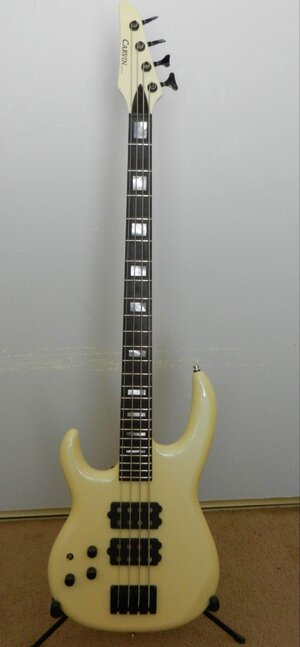
Carvin LB-20 1.JPG Well, you did ask.. I don't have any 5 or 6-strings basses, and don't think I ever will. However... this '06 Carvin LB-20 is currently strung BEAD (old picture); so yes, I actually do use the B string. When I play it. Which is not real often. I bought it - apparently unplayed - around 2010, for next to nothing. '06 was the year Rickenbacker stopped making lefties, and wasn't saying if they'd make any more - ever. The Carvin's original owner spec'd it out to mimic a Rick 4003 (both the humbuckers can be split); and it actually does come very close. I know; I have 2 real Ricks and I've A/B'd it.. Nice as it is, I didn't really need a faux Rickenbacker, so just to do something with it, I strung it BEAD. But, it doesn't get played much. Neither of my bass amps deal with a low B very well; nothing I like to play really needs it; and being strung this way doesn't make playing anything I want to play any easier, anyway. I do like the tapewounds that are on it, though; they're going to be replaced with a "normal" EADG set in the very near future. So, thus endeth my B string experiment...:thumbsup:
 
Last edited:
I have an older one with a more Fenderish headstock. The neck is straight, adjustable and stable. The tuners are nothing great but it stays in tune. The bridge is your basic bent plate Fender style. The frets are a lot better than you might expect and are a lot better than some basses I paid a lot more for. The pups aren't any noisier than other single coils and sound like, well single coil pups. The controls are vol, vol, tone. I haven't noticed any scratchiness. I have mine strung with flats. I found a bridge cover in ebay that hides the foam mute I've added. It has a great MoTown tone.
View attachment 2896993SX Jazz 5 by TOM STRAIGHT, on Flickr

View attachment 2896994SX Jazz 5-2 by TOM STRAIGHT, on Flickr

View attachment 2896995SX Jazz 5-3 by TOM STRAIGHT, on Flickr

View attachment 2896996SX Jazz 5-5 by TOM STRAIGHT, on Flickr
Awesome , thanks for the feedback. Much appreciated.
 
  • Like
Reactions: GreyBeard
I didn't read the entire thread, but I'll say the same thing I usually say (some folks have mentioned this).

Four, five, six, seven strings... I don't really care. They're all instruments with different sounds and in my opinion people should care more about sound than all that other stuff. I'll avoid the B string if I can for anything above a low Eb, anything above that and the B gets a bit muddy (to my ears). I have world class instruments with "the best B strings in the business" ... but I still prefer the sound of the other strings and I'll typically do whatever I can to get the best tone and best timbre out of a note. If that means an extra shift down to the low F on the E string even though the B is more convenient... then I'll make it happen so it'll sound correct (to my ears, at least). If I'm playing something that's technically demanding where a shift is not the best idea, then I might use the low B in that case. And there again, sometimes you might want to avoid the sound of your hand changing positions because maybe it's a quiet part of the tune... so using the B is the better choice, even though you might prefer the sound of the E string. Or maybe you get more sustain from your E string than the low B, so if you need to hold a long F# the correct choice might be the 2nd fret on the E rather than 7th on the B. The same is true on an instrument with a high C -- I'll almost always prefer the sound of the higher registers of the D and G over the sound of the lower register of the high C.

Dropped tunings or any of that other stuff never really enters my mind, though I'll add that, in my opinion, the correct decision is sometimes to drop your tuning rather than using the low B. Again, because the sound of a big open-string Eb might be the sound you want... not a fretted note on the low B. Green Day could be an example here -- I grew up playing their stuff and they were tuned in Eb for years. Whenever I get the urge to revisit any of those tunes I'll always tune down rather than using a 5-string because playing an open Eb with a hard pick is a way better tone than fretting the B string. But again, just my opinion.

Anyway, You'll be fine. It's music... go out and make some!
.....mic drop
 
Whew!!!! :wacky:!! Just so everyone knows, I am the op, and I read every post, lmfao!!
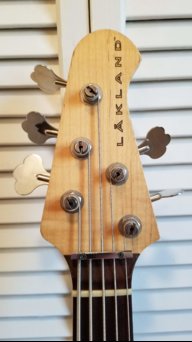
This post turned into a lot of fun for me personally, who knew basses and submarines were related?!? Honestly, i’ll probably buy it if only for the price, it’ll make an inexpensive experiment. I have played it exclusively for a few days, I see the benefit of the b string for ease of mobility, but it does sound hella floppy to my ears. If it does become mine i’ll NBD the heck out of it!!! Thanks to everyone who bothered posting helpful info, very much appreciated. Who knows, maybe i’ll end up with one of those 5 or 6 multi scale basses, apparently their low end is better sounding and more defined.....
And...... go!!!
 
I didn't read the entire thread, but I'll say the same thing I usually say (some folks have mentioned this).

Four, five, six, seven strings... I don't really care. They're all instruments with different sounds and in my opinion people should care more about sound than all that other stuff. I'll avoid the B string if I can for anything above a low Eb, anything above that and the B gets a bit muddy (to my ears). I have world class instruments with "the best B strings in the business" ... but I still prefer the sound of the other strings and I'll typically do whatever I can to get the best tone and best timbre out of a note. If that means an extra shift down to the low F on the E string even though the B is more convenient... then I'll make it happen so it'll sound correct (to my ears, at least). If I'm playing something that's technically demanding where a shift is not the best idea, then I might use the low B in that case. And there again, sometimes you might want to avoid the sound of your hand changing positions because maybe it's a quiet part of the tune... so using the B is the better choice, even though you might prefer the sound of the E string. Or maybe you get more sustain from your E string than the low B, so if you need to hold a long F# the correct choice might be the 2nd fret on the E rather than 7th on the B. The same is true on an instrument with a high C -- I'll almost always prefer the sound of the higher registers of the D and G over the sound of the lower register of the high C.

Dropped tunings or any of that other stuff never really enters my mind, though I'll add that, in my opinion, the correct decision is sometimes to drop your tuning rather than using the low B. Again, because the sound of a big open-string Eb might be the sound you want... not a fretted note on the low B. Green Day could be an example here -- I grew up playing their stuff and they were tuned in Eb for years. Whenever I get the urge to revisit any of those tunes I'll always tune down rather than using a 5-string because playing an open Eb with a hard pick is a way better tone than fretting the B string. But again, just my opinion.

Anyway, You'll be fine. It's music... go out and make some!
Exactly.
 
I use mine regularly for both low notes (used sparingly for extra impact on bridges, final choruses and ending notes) and hand position benefits.

One of the earlier posts mentioned the b string being less punchy which has not been my experience at all.
 
I recently switched to five string after more than 40 years of being a four banger. I wish I had switched ten years ago. I started playing in a band a few years ago that plays in drop d and lower almost exclusively. I also play in bands that use standard tunings exclusively, so I decided to try a Dingwall fiver and have not looked back.