• TalkBass has been independent since 1998. Add your voice.
    Create a free account to reply to discussions, view embedded media, and browse with fewer display ads.
    Join freeLog in
    Want zero display ads or expanded classifieds tools? Compare plans.

Does a Bass’s Sound Change as it Ages?

Today I pulled up a 40-year-old recording of a big band concert I played with my 1965 Fender Jazz Bass. I was pleased with the bass’s bark & bite; it had flatwounds, was through a mid-1970s Fender Bassman 100 with 4x12s, everything on the bass was wide open, and the amp was set with a lot of treble and almost no bass (the band director like the hear the notes, not the boom). We were in a concert hall and I think the recording was a mix of the room and a direct box. But I was in high school and the Sony Walkman cassette player was the pinnacle of technology, so what did I know about how it was recorded?

Listening got me wondering … does a bass’s sound change much as it ages? The only changes to the instrument between 1981 and 2021 are a rewound bridge pickup (Lindy Fralin wound it back to factory specs), and one volume pot and the tone pot died and were replaced. The bass has been retired for many years and I don’t have a recent recording of it in a similar auditorium.

What’s the likelihood that the bass sounds today like it sounded 40 years ago?

Here’s what I was listening to - four tunes are with the Fender and two are with an Englehart upright with a Barcus-Berry screw-on pickup through the same amp, but no pre-amp: Dropbox - Parkersburg High School Stage Band 1981 - Simplify your life

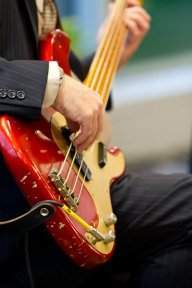
1965_Jazz_Bass_Circa_2011.jpg
 
Its a great sounding Jazz Bass which you clearly hear on Chiapas. Jazz bass burpy bark... This is a high school jazz band? Kudos to the Band Director. He had you guys playing above your grade level.

So the magnets in the pickups lose their strength over time so, sure, there is going to be some change as the bass ages. How much? I think it's probably more subtle than dramatic. If the Fralin rewind was hand done to spec using the original magnet, I am sure that would damn close to the original. The Brazilian Rosewood FB is the magic on 65 Fenders.
 
Last edited:
How was it recorded? And is the setup you have today comparable to that to be able to tell any real difference in the sound then and now? And don't rely on memory as echoic memory is minutes, not decades.
I'm not certain how it was recorded. I know I had went from the bass into a Direct Box and then there was a cable to the Bassman 100 Amp. I was told to set my volume as usual. I recall a bunch of mics set up on booms around the stage because the festival included an orchestra, choir and show choir. The recording was originally on a cassette which was sold immediately after the concert, and I transferred it to digital using GoldWave around 2009.

My setup today is a Markbass Little Mark Tube 800 and an Ampeg SVT 4x10, or a 1970s B-15N, or a 1965 B-18N (which is on loan to a recording studio here in Richmond, Virginia). I can't recreate the amp or hall sound.
 
Why would you retire this bass? This bass is coveted by bassists around the world. Its does no one any good sitting in a case, unplayed. It's collectablity has been somewhat diminished by altered electronics but it his still highly desirable. Looks like you put a brass nut on there too, is that correct? I am sure is its worth $7k-ish
 
Last edited:
Why would you retire this bass? This bass is coveted by bassists around the world. Its does no one any good sitting in a case, unplayed. It's collectablity has been somewhat diminished by altered electronics but it his still highly desirable. Looks like you put a brass nut on there too, is that correct? I am sure is its worth $7k-ish
As I’ve got older I’ve preferred the feel of a Precision Bass. I played a Nash PB 57 for along time, then a 1967 Precision 4 years ago.
 
Listening got me wondering … does a bass’s sound change much as it ages?
My guess is "very little."

It's not like the wood will gain or lose density, or change its molecular structure. Messing with the pickup or electronics might change it a bit.

It is far more likely that you'd play it through a different amp, or in different spaces, or with different effects, or with musicians who produce a very different sound.

Recording technology also changed significantly over the past 40 years.

And... Your hearing changes over time. As you get older, you lose some of the high frequencies. Your perceptions of sound, and what sounds good, also very likely changes over time.
 
Why would you retire this bass? This bass is coveted by bassists around the world. Its does no one any good sitting in a case, unplayed. It's collectablity has been somewhat diminished by altered electronics but it his still highly desirable. Looks like you put a brass nut on there too, is that correct? I am sure is its worth $7k-ish
Yes the brass nut was installed in 1980, when the original nut broke on the G string side. At that time brass was the way to go. I’ve thought about going back to one more original but this one does it’s job.
 
I missed this before as I was reading on my phone, but why retire it? You like the bass, play it.
I was playing a lot of country in the 1980s and the 1987 Stingray I bought sounded right for the times. After that being my #1 for 12 years I tired of its bright tone. That’s when I picked up the Nash. The rock cover band I was in played a lot of parties and bars - gigs where you put your guitar on a stand and left the area, and by that time the Jazz had went from being “just an old bass” to something with some value, and I didn’t want to take it to a gig and worry about it growing legs and walking away. When I found the 1967 Precision 4 years ago I found “the sound in my head.”
 
does a bass’s sound change much as it ages?

Not half as much as the bassists ears do.


BTW, I love that interpretation of 'My funny Valentine '.


Talking of great school bands, about 15 years ago somebody unearthed a 1970's recording of a Canadian school, where the music teacher had got bored of the usual standards, and in an effort to engage with his 11/12 year old students, had taught them his own amazing interpretation of contemporary songs, by the likes of Bowie etc.

It got picked up by an independent label, and released as 'The Langley Schools Music Project'.

I doubt you'll find an original copy now, but it's bound to be on YouTube, and well worth checking out.
 
In the world of orchestra instruments , there’s a belief that stringed instruments age , and the sound changes (getS better /more complex / whatever). My upright bass teacher believed this (he even mentioned one of his instruments “losing sound” through the years).

Although in many of my posts I always basically say that you can get anybody“stereotypical sound “ out of any bAss, And although I constanTly say that I’ve stopped collecting Because the squier VM and CV are absolutely fantastic... I have to admit that:

yes , I believe the sound changes as the instrument ages.
 
What do you hope to determine comparing it to a 40 year old recording to tape...via who knows what rig?

If it sounds good...it sounds good. That's all you need to know. And I would venture to guess that it does, simply because the Jazz Bass is a simple, versatile, classic instrument that anybody can get to sound good with a few simple knob tweaks.

Pickup magnets aging, Brazilian board mojo...all nonsense. If the electronics work, your amp works, and you are good at controlling your tone, you can make it sound however you want.
 
We once had a discussion about this, and Alembic felt that it took around 5-8 years for the woods, finishes, etc., to 'gas off' any remnants of the build and the wood (just think of how many glued-faces in a complex axe like an Alembic) to once and finally age out of any remaining sap or chemical reactions and reach an equilibrium with its environment, a more-or-less steady state of being as a piece, and at that time there may be slight changes to the tone for guys with really good ears, as well as it becoming fairly tame in terms of setups, etc.

This can be more noticeable in acoustic instruments (we hear it in box guitars and fiddles, etc.), but they felt in a small way it might be noticeable in small increments in their solid body instruments. These are very fine, almost arcane considerations, but it's not unusual for recreations of 30's or 40's acoustics to use hyde glue while chasing tone. But so much of this comes down to how well your ear can notice these subtle nuances.