• TalkBass has been independent since 1998. Add your voice.
    Create a free account to reply to discussions, view embedded media, and browse with fewer display ads.
    Join freeLog in
    Want zero display ads or expanded classifieds tools? Compare plans.

Double Bass Double-bass orchestral part playability

the exile

Guest
Feb 17, 2017
28
4
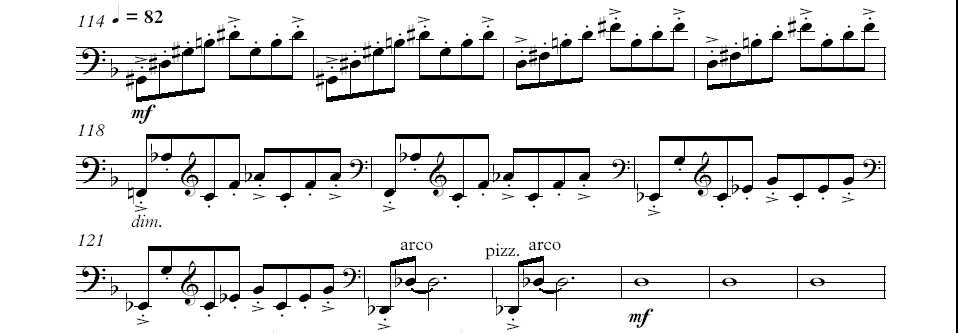
I have written this part for double basses (for orchestra) but I am wondering if bars 118-120 in particular have leaps that would make playing rather difficult? (Just to be pedantic - notes will sound an octave lower than written as per normal).

Sorry - please note that the part is played pizzicato.

CB_PART.png
 

Attachments

  • yPEcKd.png
    yPEcKd.png
    95.5 KB · Views: 85
  • CB_PART.png
    CB_PART.png
    26.3 KB · Views: 76
  • UElK8f.png
    UElK8f.png
    45.6 KB · Views: 75
  • CB_PART.png
    CB_PART.png
    26.3 KB · Views: 66
  • dPltrN.png
    dPltrN.png
    46.2 KB · Views: 88
  • AZBGVX.png
    AZBGVX.png
    103.8 KB · Views: 76
  • CB_PART.png
    CB_PART.png
    26.3 KB · Views: 78
Last edited:
I have written this part for double basses (for orchestra) but I am wondering if bars 118-120 in particular have leaps that would make playing rather difficult? (Just to be pedantic - notes will sound an octave lower than written as per normal).

Sorry - please note that the part is played pizzicato.


View attachment 3102778
The high Ab at the end of m. 119 going into the low extension Eb on the downbeat of m. 120 is not really playable (since the gate will be on the Db and not the Eb). Even at quarter note = 82 and pizz, it's still unplayable and those that heroically try to play it with a standard set-up, are going to be giving you clacks and other noise along with the little tone they will be generating. It's even problematic on a 5-string. You're also assuming that the bassist has a gated extension, which sadly, is not universal. The rest of the passage, however, is well-done.
 
If it's a solo bass, yeah maybe you'd do well to get with the bassist and give it a listen. But a section's a different animal. They have the option to split up in wost case scenarios. If that's the line you have in your head, I'd be inclined to just leave it and let the players figure out how to make it happen. There's plenty of stuff in the rep that's far from sitting comfortably under your fingers
 
  • Like
Reactions: neilG
I can play it. You can make it a lot easier by making those lowest F's, E flats and d flats an octave higher. The jump from low F to Ab in the first two notes of 118 is the hardest part. The higher octave will have more presence and ring.

Are you playing a 5 string? I do intend to keep the notes in that low range.
 
I agree with the above (mostly). 1) I don't see the high Ab to low Eb as possible in 119-120. The other leaps from high G to low Eb and F are also pretty impractical. 2) It would indeed be way easier to read if it were all in bass clef. 3) in 122-123, its not possible to get the bow into position that fast at that tempo, even if it's already in your hand. If this is an orchestra part then all can be done divisi. Best to write it out yourself and prevent arguments in the section!
 
Last edited:
This is very playable. Just tried it and there are some challenges but nothing unplayable. If this is how you are hearing it don't change it.

Personally I like the clefs changing where you have them changing. I'm not a fan of leger lines. With the way that you wrote it there is plenty of space for the performer to make any necessary notes in the part.
 
You can jump from an Ab above octave G to a contra Eb at that tempo? You can pluck a contra Db and play the Db on the A string with the bow an eighth note later? This I would really like to see.

If I get a chance sometime in the next few days I'll post a video : P

The notes are marked staccato so they don't need to be super connected. That space is plenty of time to get to the next note in the specified tempo.

It's not the most sight readable part but if you can play the standard orchestra audition rep this should be playable.
 
One thing, besides the playability thing. I would avoid the constant clef-changes. Makes it very difficult to see the contour of the line, and to read in general.

Totally agree. I hate constant clef changes exactly for that reason. You see that way too often and most of the times it is not necessary at all.