• TalkBass has been independent since 1998. Add your voice.
    Create a free account to reply to discussions, view embedded media, and browse with fewer display ads.
    Join freeLog in
    Want zero display ads or expanded classifieds tools? Compare plans.

Double trussrod to prevent twisting, overkill?

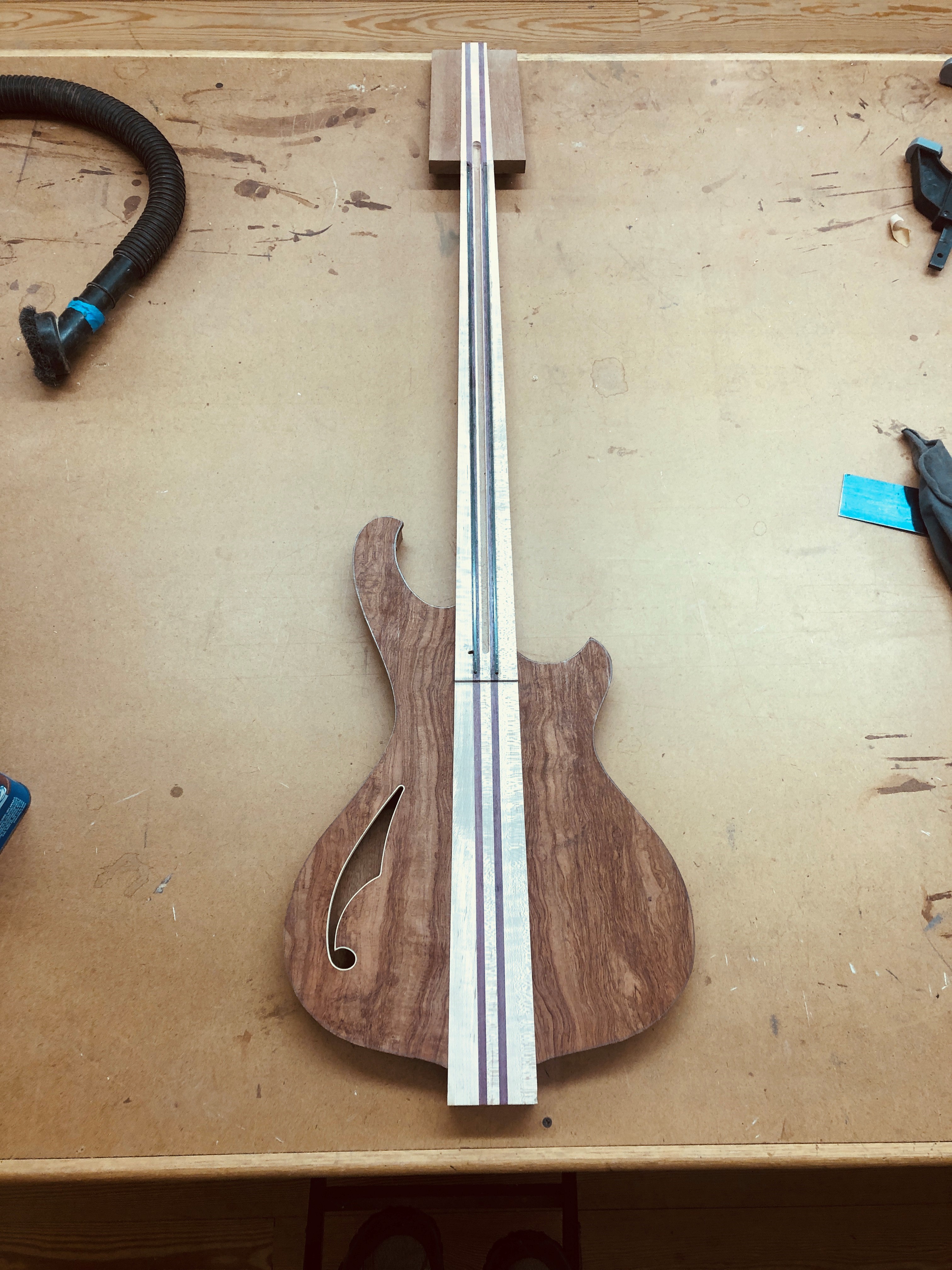
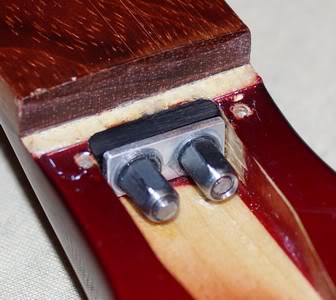
I am currently building my first bass. It'll be a headless 5 string 34-36" multiscale single cut. I'm worried that the neck may twist, so should I install two Trussrods, or just one with two carbon fiber rods?

I'll be using the stewmac hot rod, non low profile. The neck through body is made of 2 pieces of walnut in the centre and hornbeam on the outside (2cm width each)

I already have two of those Trussrods at home. So no point saving money now.

If I use two Trussrods, not only would the trussrod not be sitting in the central glue joint, but I'd also likely use 1 or 3 carbon fiber rods.

Am I overthinking this? One of the hornbeam pieces (bass side) has an upward bend, which I couldn't fix with heat bending. The bend starts at about where the 7th frett will be, and is at 1,5cm at the nut. The grain follows that bend, but is relatively straight. Only about 7milimeter will be left at the end.
 
Last edited:
  • Like
Reactions: Beej
Others will chime in as well I'm sure. :) I know this is sort of sidestepping what you've asked, but when I approach a neck, I consider potential twist in the wood when I select and mill the pieces to shape. And orient and glue them in such a way as to avoid stresses in the wood and help them remain stable in service. I avoid pieces that change shape when cut, as that's an indicator of the forces that are acting inside the grain and may impact it's stability over time.

Stiffening rods help to keep things stable and can help the neck bend into the desired relief more evenly from side to side (thereby also reducing twisting). The truss rod holds the neck when it's moved forward and back. I'm back and forth on more than one truss rod. Nearly all of my designs use one TR. Both types of rods will help, but won't be able to entirely prevent twisting of the neck if the wood is oriented in such a way as to dry into a twist, cup or curve.

There's good information in this thread too, newer posts have discussions along this same topic: About That Quartersawn Maple.....

I tend to select neck stringers that have relatively straight grain with little runout (grain ending along the cut edge). When viewed from the end, I tend to orient my stringers like this: \\||// or this \\||=||// etcetera. That way the stresses in the grain will work against each other and as the neck ages it will theoretically remain stable. It's panned out in my necks so far. :D

I'll guess I'll clarify too that IMHO if things are oriented in such a way as to optimize stability, then a single rod like that and two CF stiffeners should be plenty enough to make that neck work and stay stable. :thumbsup:
 
Others will chime in as well I'm sure. :) I know this is sort of sidestepping what you've asked, but when I approach a neck, I consider potential twist in the wood when I select and mill the pieces to shape. And orient and glue them in such a way as to avoid stresses in the wood and help them remain stable in service. I avoid pieces that change shape when cut, as that's an indicator of the forces that are acting inside the grain and may impact it's stability over time.

Stiffening rods help to keep things stable and can help the neck bend into the desired relief more evenly from side to side (thereby also reducing twisting). The truss rod holds the neck when it's moved forward and back. I'm back and forth on more than one truss rod. Nearly all of my designs use one TR. Both types of rods will help, but won't be able to entirely prevent twisting of the neck if the wood is oriented in such a way as to dry into a twist, cup or curve.

There's good information in this thread too, newer posts have discussions along this same topic: About That Quartersawn Maple.....

I tend to select neck stringers that have relatively straight grain with little runout (grain ending along the cut edge). When viewed from the end, I tend to orient my stringers like this: \\||// or this \\||=||// etcetera. That way the stresses in the grain will work against each other and as the neck ages it will theoretically remain stable. It's panned out in my necks so far. :D

I'll guess I'll clarify too that IMHO if things are oriented in such a way as to optimize stability, then a single rod like that and two CF stiffeners should be plenty enough to make that neck work and stay stable. :thumbsup:

Well, I guess I'll just use one, and chuck this as a learning experience. I did my best to arrange the boards as you depicted. It's just the outer hornbeam on the bass side that has me worried. However, since the stress seems to be equalized now, I'll look when I got the neck planed and carved down.

Damit... Now I got an extra trussrod... Guess I need to build another bass at some point? XD
 
LOL

I find a wood scrap that will make a good pickup surround, and boom, I need to build a new bass around it. :D I don't think I'm alone here with that affliction. :roflmao:

You could always use two rods anyway - there are people on here who do that regularly and could better speak to the dual rod pros/cons.
 
  • Like
Reactions: Gilmourisgod
I'm on my third bass with (2) CF stiffeners and (1) DA trussrod, so far so good, though two of them are 34" scale and one 32". I was actually worried the necks would be TOO stiff, but it hasn't been a problem. All three seem to adjust smoothly and hold a setting well. I can only think of two companies that routinely used double trussrods on a 4-string, Rickenbacker and Alembic, and Ric has just switched to a single DA rod on new production. In theory that allowed you to dial in different relief on the E and G strings, though I'm not sure why that would be desirable, isn't that the definition of "neck twist"? Two trussrods with headstock adjust means a lot of wood hogged out at the neck/headstock joint too, if you do go for two rods, maybe consider heel adjust? I set the CF rods, which are 1/8" wide x 3/8" deep, parallel to the trussrod and 1/8" away from it. I don't know if this the "best" way, but it seems to work.
zBRii37.jpg


@Bruce Johnson has invented his own proprietary trussrod, and uses carbon fiber TOW strands epoxied into the skunk stripe on his Ampeg bass builds. This prevents the neck wood from "stretching" along the back strap over time. If nothing else, fascinating reading about neck design, wood selection, grain orientation, etc, check his stuff out.
 
Just keep in mind the forces that a truss rod exerts. Dual action dual rods (probably what you have?) exert a force in the middle that is opposite of the forces at the ends. In typical use to counteract string tension, it is pushing down at the ends and up in the middle. In general, none of those forces will specifically counteract twist so having two rods won't even solve that issue.
 
I’ve never built an instrument but do a lot of woodworking - IME if I have a choice piece of wood in mind for key placement in a piece of furniture and it ends up twisting in the process of preparing it - then I am better off putting it aside and finding another suitable piece. If there are gremlin forces inside a piece of wood that keep it from being straight, then generally in the long run it does end up well. Although I don’t design nor have I built instrument necks, it does seem to me that having two truss rods that are adjustable could present its own set of problems with counter-pressure forces. Sounds like you’ve already decided against it, which is what I would do in your shoes.
 
  • Like
Reactions: Beej
The ability of 2 truss rods to counteract twist is pretty limited. They do, however, take away wood in the weakest area of the neck, so a headstock break is more likely. If you're going to use 2 truss rods, you should think about that.
Ric basses are (used to be anyway), the poster child for cramming too much into too little space with two rods, leaving narrow "bridges" of short-grain wood either side of the TRC pocket, and requiring the use of a narrow wall socket or driver to even get onto the truss rod nuts. Alembic avoided that by using heel adjusters, but that also requires a big wad of wood to be hogged out. I've been using LMI DA rods because they are slightly less deep in the slot than the Stewmac ones, and I like to shave my necks to leave a bare minimum of 1/8"-3/16" between bottom or rod and back of the neck. I'm curious what other people are leaving so they don't accidentally shave through to the rod?
dEnUVej.jpg
 
Last edited:
  • Like
Reactions: Beej
I've owned Alembics that had the paired truss rods. I was never entirely convinced that they would counteract a developing neck twist (and I'm sure I'm not skilled enough at repair to spot it until it's way out of shape). In fact I'm not sure incorrectly tensioning each would not contribute to the neck twisting.

I kicked around any number of ways they should be adjusted, only to finally settle on doing a setup on the E/B, then going to the other side and repeating the process on truss rod two to match the settings on the G/D.

To me, strictly from a users point of view and NOT a real guitar tech, to me it's one of those things that seems like a good idea but probably isn't necessary. I could certainly be wrong, but I think it's telling that few builders use them.
 
  • Like
Reactions: Beej
There are loads of Rics in the world and only a few are reported as having neck issues, so that suggests they haven't got it wrong for the past half-century+.
However, RIC are now producing single-rod instruments, so maybe they've decided it's not worth the effort.
 
Also loads of Rics that did have neck and trussrod problems, and if you dropped one, they tended to break right where you'd expect it to, at the weak point around the TRC pocket, like a Les Paul. I witnessed that in person (not my bass, thank god). At any rate, they voted with their feet and finally dropped the double rods, leaving only Alembic AFAIK. Given how close they were together, i never understood how it was supposed to work to provide variable relief. Try bending a piece of rock maple across its face with two pressure points 1/2" apart using mild steel rods. One nice thing about the old Ric hairpins was that they could be removed fairly easily for replacement, but there's no reason a modern DA rod couldnt be too by extending the truss rod slot out until it "daylights" out the angled headstock face. I dont think that would work with a Stewmac rod though, they have a big shoulder of brass that extends under the adjuster. They look very well made though, I think you'd have to work pretty hard to break one. The LMI and some other rods are consistent dimension through the whole length, so no reason they couldnt pull out through the headstock.
 
  • Like
Reactions: Jeff Siddall
it's one of those things that seems like a good idea but probably isn't necessary
This is how I look at it.
Before I knew the first thing about how necks were built, someone probably could've talked me into 2 truss rods.
Now that I understand a little more about materials and neck construction methods, I'm in the camp of 2 truss rods being unnecessary and having more cons than pros.
 
I agree with most of the sentiment here. On a neck under 2 1/4" wide, at the nut, two truss rods aren't worth the trouble. If you build the neck using good general practice, you shouldn't have problems with twisting. And if the two rods are tightened unbalanced, they may even cause some twisting. If the rods are that close together, it'll be very touchy to adjust them. Like the classic Ricks.

I've built a few crazy wide necks, 7 and 8-string unison monsters, that were 3" wide at the nut. In that case, I did use two truss rods that were spaced about 1 1/2" apart. They were necessary to counteract the load from all those strings. And it was helpful to be able to bias their loading a little bit, to even out the relief on either side of the neck. Not fixing serious neck twist, but fine adjustments to the relief.

My general rule is: single truss rod for necks up to 2 1/4" wide.
 
On a neck under 2 1/4" wide, at the nut, two truss rods aren't worth the trouble

I've built a few crazy wide necks, 7 and 8-string unison monsters, that were 3" wide at the nut.

Wow, 3" at the nut! I am working on a 6 string right now, and it seems like it will be really wide from the perspective of a historical 4 string J-style player. But it will be only 55 mm (2.17") wide at the nut. The string tension will still be there, and less wood in the neck than a 2-1/4" wide nut, so I am also planning dual rods for that build.
 

Latest posts