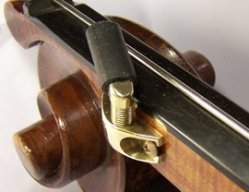
1) Every DB I have owned had the fingerboard edges aligned flush with the side of the neck. Ditto the DBs examined in shops. A smooth join.
2) Every separate (replacement) DB fingerboard I have purchased displays a 1/16" to 1/8" overlap on both sides of the neck, the presumed inference being that after the 'board is attached the overlap is to be dressed down to flush with the sides of the neck.
Then, on page 250 of Chuck Traegar's book (in David Brownell's Chapter 47), I read
In those days, the violone was also fitted with this sort of neck installation. [i.e., surface mount fixed into position with glue and nails] Referring to Baroque basses pressed into service in contemporary orchestras the chapter continues, Some of these necks have had a wider fingerboard installed for use with today's four orchestral strings . . . .
????? If the new fingerboard is wider (i.e., untrued to the neck) then it seems to me it's got "Dunlop's Disease": the fingerboard edges have done lopped over the neck since they were not trued to flush. But if the edges are trimmed back then the new fingerboard no longer is wide enough to accommodate four strings.
I have always thought than a non-flush fingerboard edge connotes either sloppy workmanship or a factory cost-cutting measure. The quoted passage suggests otherwise.
What goes on here?
2) Every separate (replacement) DB fingerboard I have purchased displays a 1/16" to 1/8" overlap on both sides of the neck, the presumed inference being that after the 'board is attached the overlap is to be dressed down to flush with the sides of the neck.
Then, on page 250 of Chuck Traegar's book (in David Brownell's Chapter 47), I read
In those days, the violone was also fitted with this sort of neck installation. [i.e., surface mount fixed into position with glue and nails] Referring to Baroque basses pressed into service in contemporary orchestras the chapter continues, Some of these necks have had a wider fingerboard installed for use with today's four orchestral strings . . . .
????? If the new fingerboard is wider (i.e., untrued to the neck) then it seems to me it's got "Dunlop's Disease": the fingerboard edges have done lopped over the neck since they were not trued to flush. But if the edges are trimmed back then the new fingerboard no longer is wide enough to accommodate four strings.
I have always thought than a non-flush fingerboard edge connotes either sloppy workmanship or a factory cost-cutting measure. The quoted passage suggests otherwise.
What goes on here?