I'm attempting to improve my ear rapidly, and its become the main focus of my practice sessions. I'm trying to figure out methods that will help. I'm mostly transcribing, but I hear singing really helps. What specifically do you, or did you do that you found effective.

Enjoy the benefits of a premium membership!
Upgrade Account
-
TalkBass has been independent since 1998. Add your voice.
Create a free account to reply to discussions, view embedded media, and browse with fewer display ads.
Join free Log in
Want zero display ads or expanded classifieds tools? Compare plans.
You are using an out of date browser. It may not display this or other websites correctly.
You should upgrade or use an alternative browser.
You should upgrade or use an alternative browser.
Double Bass Ear Training.
- Thread starter Zarathustrah
- Start date
More options
Who Replied?
Z,
Sing all the basic arps and scales with a piano. Sing the melody of any tune you're working on. Sing along with the radio. Sing basic xmas songs and nursery rhymes on solfeg or number. Be slow and methodical and most of all patient. Can you sing a m6th from a starting pitch ascending as well as descending? We do need *all* the intervals, after all.
How you transcribe matters too.
1. Listen
2. Sing
3. Play
4. Write
Don't do a whole piece at a time. It's like trying to learn Spanish paragraph by paragraph. Start with simple basslines, one note at a time, writing at most ONE bar at a time. Then go back and sing along.
Cheers.
Sing all the basic arps and scales with a piano. Sing the melody of any tune you're working on. Sing along with the radio. Sing basic xmas songs and nursery rhymes on solfeg or number. Be slow and methodical and most of all patient. Can you sing a m6th from a starting pitch ascending as well as descending? We do need *all* the intervals, after all.
How you transcribe matters too.
1. Listen
2. Sing
3. Play
4. Write
Don't do a whole piece at a time. It's like trying to learn Spanish paragraph by paragraph. Start with simple basslines, one note at a time, writing at most ONE bar at a time. Then go back and sing along.
Cheers.

Have you done much interval recognition at the piano? Play all intervals (min 2nd, 2nd, min 3rd, maj 3rd, perf 4th, perf 5th, etc), ascending and descending, and of course sing along as you play them. Spend a good bit of time on each before moving on to the next to really get the sound of each one in your head/ear. Practice this every day, and the next time you transcribe, use a piano or bass to get only the very first note of the solo/melody you're transcribing, and transcribe the rest using only your ear and your ability to recognize the intervals from one pitch to the next. Start with something simple and easy and gradually increase the level of difficulty as you get better at it.
All good advice. Maybe try shedding with a friend, have them play intervals, isolated chord qualities, short melodies, long melodies, chord changes, 2 part dictations, rhythms and sight-singing unfamiliar material are all good things to work on with a partner. Of course you can work on all of these on your own but I like practicing with another person for certain types of things. As the others have said definitely take your time learning everything really solid and be honest with yourself about what you need work on. That's one of the reasons why I like doing this stuff with another person, if I'm having trouble with something, it will become very apparent to them, so you can help each other out.
I've done interval training. My main problem is rhythmic dictation. I get the pitches and spend 15 minutes trying to write down the transcription. I mostly use online melodic dictation websites, and I'm trying to sing everything.
I've done interval training. My main problem is rhythmic dictation. I get the pitches and spend 15 minutes trying to write down the transcription. I mostly use online melodic dictation websites, and I'm trying to sing everything.
Aha. Your problem is actually the opposite of most players I help. For your situation, I'd suggest reading practice.
The main reason people use singing to teach pitch is that you have to produce the sounds yourself. You have to think of the interval/chord/etc and then produce it, which is harder and deeper than just recognizing an interval or chord quality. So I'd do the same for rhythm. Get a book of music with the kinds of rhythms in it that you'd like to be able to hear. Could be a classical etude book. Rich Appleman has a good book called Reading Contemporary Electric Bass Rhythms or something like that. Works for acoustic bass too. The book of James Jamerson transcriptions is good for syncopated 16th notes. Anyway, go through each piece, analyzing the rhythms. I once was learning to read some very syncopated 16th note stuff, and I actually rewrote it as 8ths, just to get the relationships down. So what this process will do is help you connect the written rhythms with what you hear, and you have to be right, you have to internalize it, because you are producing the rhythms yourself (just like singing intervals etc). Work on it until you can comfortably produce the parts, looking at the music. I think once you can read all those things, you'll be much better able to hear a rhythm and know what it's supposed to look like on paper.
Good luck,
Brent
John Goldsby
Supporting Member
- Mar 4, 2003
- 1,172
- 2,160
- Disclosures
- Bassist @ WDR Big Band Cologne, Discover Double Bass, Conservatorium Maastricht, NL
There are a lot of online ear training programs that you will find by googling "ear training online."
If you are trying to improve your jazz hearing, one of the best ways is to just put classic recordings on with no music in front of you and try and play along. You mentioned transcribing, but this is like transcribing on the fly in real time -- like on the bandstand.
If you are trying to improve your jazz hearing, one of the best ways is to just put classic recordings on with no music in front of you and try and play along. You mentioned transcribing, but this is like transcribing on the fly in real time -- like on the bandstand.
.....If you are trying to improve your jazz hearing, one of the best ways is to just put classic recordings on with no music in front of you and try and play along. You mentioned transcribing, but this is like transcribing on the fly in real time -- like on the bandstand.
What Chop_1992 is suggesting really does work. When I played with Jose Feliciano, he used to pull out all kinds of songs in front of rather large audiences that I didn't know. Talk about focusing your mind. Funny that the added pressure actually helped me learn intervals much faster than in the classroom.
In no way do I want to undersell the importance of ear training but advanced ear training should come after or durring getting your basic technique in place.
Having a good ear and playing things at all costs technically can ingrain very bad habits that can be VERY hard to break as well as putting technical limits in place that can be hard to move past.
Music is an aural art but your hands get the sound out of the bass!
Having a good ear and playing things at all costs technically can ingrain very bad habits that can be VERY hard to break as well as putting technical limits in place that can be hard to move past.
Music is an aural art but your hands get the sound out of the bass!
Gotta disagree with that last comment. Technique means nothing if you don't have a feel for what you're playing. and that takes ears, and practice in using your brain to listen. For a young player, you may have to, for a period, work technique and ear training separately. But you need both to learn.
I am, for the record not a DB player. I was raised on trombone (eventually bass trombone). NO frets, no fingering over a valve or hole. Fretless electric became easier to get a grip on from my trombone ear training.
Good ear training makes life easier for muscle memory in note accuracy (Intonation!!), any other string player will surely tell you this.
Good Hunting!
I am, for the record not a DB player. I was raised on trombone (eventually bass trombone). NO frets, no fingering over a valve or hole. Fretless electric became easier to get a grip on from my trombone ear training.
Good ear training makes life easier for muscle memory in note accuracy (Intonation!!), any other string player will surely tell you this.
Good Hunting!
I am, for the record not a DB player.
Good Hunting!
There lies the problem. I certainly agree with the fact that playing entirely by ear can cause major technique problems, as I know many other players that it has wrecked havoc with, and it did to an extent with me. Certainly, the technical aspect of playing double bass is just an important one to focus on as the aural, considering maneuvering one's way around the instrument is an ordeal in itself, no?
Of course, all opinions here. I guess it wouldn't be any fun if we didn't disagree every once in a while.

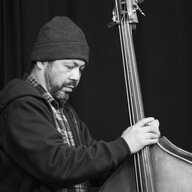
Ear training IS a technical aspect of playing bass. To separate the two is silly. Introducing one without the other is a recipe for going nowhere fast. Training the ear solidifies the hand and vice versa. Both should be practiced in conjunction with each other. The point is to become a musician who plays bass and not just some technician. As my teacher always says "A monkey can play the bass its playing music that's difficult." YMMV
Ear training IS a technical aspect of playing bass. To separate the two is silly. Introducing one without the other is a recipe for going nowhere fast. Training the ear solidifies the hand and vice versa. Both should be practiced in conjunction with each other. The point is to become a musician who plays bass and not just some technician. As my teacher always says "A monkey can play the bass its playing music that's difficult." YMMV
Agreed. But, you can "hear" in tune all you want, if your left hand can't make the hairline adjustments quickly and fluidly it won't help.
Working on them at the same time is a good plan.
In my experience, very often those picking up the double bass are already musicians if not bass guitarists - that is where a separation is already in place - in that situation taking some time to focus on basic left hand mechanics particular to the double bass is probably the best plan in order to catch up to the already developed ear.
Agreed. But, you can "hear" in tune all you want, if your left hand can't make the hairline adjustments quickly and fluidly it won't help.
Working on them at the same time is a good plan.
In my experience, very often those picking up the double bass are already musicians if not bass guitarists - that is where a separation is already in place - in that situation taking some time to focus on basic left hand mechanics particular to the double bass is probably the best plan in order to catch up to the already developed ear.
If you can't hear in tune you can't play in tune period. It is the same thing. Learning to hear where the note is and where its going is exactly the same as putting your hand in the right spot. The bass' positions move all the time. Your ear needs to be able to compensate for it. There are more players with "poor" left hand technique and a good ear that play with good musicianship than the other way around. If you don't teach aural skills the left hand will never develop.
Besides notes don't exist on their own they exist in relationship to others. I've said it before. A B in G chord is not the same as a B going up to a C or down to an A. This is true no matter how atonal you get. Your ear needs to know that and adjust. Intonation is both components the hand and the ear and nothing less. To take one from the other is just not sensible.
I do hear where you're coming from in regard to the other instrument thing. But bass guitar is fixed in equal temperament though where as double bass is capable of so many different tuning systems. As such in most jazz contexts equal temperament will suffice, but in new music, classical music and other forms of music systems such as just intonation, Pythagorean mean temperament and microtonalism just to name a few are used. If you are teaching exclusively jazz than equal temp is fine. But what do you do about the rest? That is why, like you said a wholistic approach is necessary. In a lot of ways my college musicianship classes were nearly as important to my development as bass lessons. Scratch that, equally as important. My teacher makes me sing everything I don't play in tune. Everytime, the passage I play out of tune, is being sung out of tune. Once I tune it up singing, I play in tune.
Playing bass is just playing bass. Playing music is the whole enchilada. In the end that's what its all about right? YMMV.
If you can't hear in tune you can't play in tune period. It is the same thing. Learning to hear where the note is and where its going is exactly the same as putting your hand in the right spot. The bass' positions move all the time. Your ear needs to be able to compensate for it. There are more players with "poor" left hand technique and a good ear that play with good musicianship than the other way around. If you don't teach aural skills the left hand will never develop.
Besides notes don't exist on their own they exist in relationship to others. I've said it before. A B in G chord is not the same as a B going up to a C or down to an A. This is true no matter how atonal you get. Your ear needs to know that and adjust. Intonation is both components the hand and the ear and nothing less. To take one from the other is just not sensible.
I do hear where you're coming from in regard to the other instrument thing. But bass guitar is fixed in equal temperament though where as double bass is capable of so many different tuning systems. As such in most jazz contexts equal temperament will suffice, but in new music, classical music and other forms of music systems such as just intonation, Pythagorean mean temperament and microtonalism just to name a few are used. If you are teaching exclusively jazz than equal temp is fine. But what do you do about the rest? That is why, like you said a wholistic approach is necessary. In a lot of ways my college musicianship classes were nearly as important to my development as bass lessons. Scratch that, equally as important. My teacher makes me sing everything I don't play in tune. Everytime, the passage I play out of tune, is being sung out of tune. Once I tune it up singing, I play in tune.
Playing bass is just playing bass. Playing music is the whole enchilada. In the end that's what its all about right? YMMV.
Agreed. I think in general there tends to be an imbalance and most often people go toward the side that comes easier to them.
As a bass teacher I have more often gotten students who can play 20 (hard) beatles songs or something by ear more or less in tune with whatever fingers and a rough left hand. Or a good ear getting them through Simandl with no attention the the mechanics of the hands - at that point I might even have them finger the exercise without sound.
So I guess the real point is to try to equalize the ears and hands.
Besides notes don't exist on their own they exist in relationship to others. I've said it before. A B in G chord is not the same as a B going up to a C or down to an A. This is true no matter how atonal you get. Your ear needs to know that and adjust.
On this point I sometimes notice something when I'm playing a walking line, say comming down the G string from thumb position, all the way to half position with a target in mind.
If I go astray on the first shift or two and hear myself off, I find the line works better if I try to work my way back in tune over the entire phrase, instead of trying to jump back in tune as soon as possible.
For me it's one of those intreasting phenomena (which happen so often in life) where it seems right to break the rule. Dividing the error through the heart of the phrase, seems to come more naturally to me, and helps the line maintain it's original shape. More notes may be techincaly "out of tune" but if each note becomes more and more in tune the line seems to hold up better, an effect jilting back to reality suddenly seems to not to have for me.
By splitting the difference, even if imperfect, the line still has it's intent.
Most musicians who haven't taken those musicianship classes think they are unnecessary classical music stuff. You right on about this. One wouldn't know what you are talking about unless they were enrolled in a B.M. program at one time or another and were forced to sink or swim through solfegio, dictation, conducting, piano etc. for 4 or 5 years. The singing part is exactly what the Italians and Hungarians teach. No wonder they're the best.In a lot of ways my college musicianship classes were nearly as important to my development as bass lessons. Scratch that, equally as important. My teacher makes me sing everything I don't play in tune. Everytime, the passage I play out of tune, is being sung out of tune. Once I tune it up singing, I play in tune.
Playing bass is just playing bass. Playing music is the whole enchilada. In the end that's what its all about right? YMMV.
ps
(The stuff about the Italians,(it's true)that was for you Vito Liuzzi
 )
)
The singing part is exactly what the Italians and Hungarians teach. No wonder they're the best.
ps
(The stuff about the Italians,(it's true)that was for you Vito Liuzzi
Not to push it too far OT, but Italians always playing so well really makes you reconsider that 134 Billie fingering system!


