• TalkBass has been independent since 1998. Add your voice.
    Create a free account to reply to discussions, view embedded media, and browse with fewer display ads.
    Join freeLog in
    Want zero display ads or expanded classifieds tools? Compare plans.

Early 1950s P-Bass, anybody here with first hand experience?

Apr 26, 2019
40
161
Hi, I'm a noob here, just a hobby bass player. I just acquired a 1953 P-Bass, first generation slab body.

These have a flat pole single coil pickup (obviously). Due to the 7.25" fingerboard radius, the two outside strings are significantly closer to the magnetic pole pieces than the center strings. No matter how I balance the pickup, the G string is significantly louder than the other three strings. Just to be clear, there is nothing wrong with the pickup, and the magnetic strength of all four poles is the same (checked with a Gauss meter). Played unplugged, the strings are perfectly balanced sounding.

I tried a few different sets of strings. T-I Flats are my favorites, but while more balanced than others, the G string still sticks out.

I'm a full time guitar repair guy specializing in vintage guitar repair and restoration, so please don't suggest there's something wrong with the bass. It's set up perfectly..

I'm really hoping to hear from some of you who have actually owned a real vintage '51 through '53 P-Bass. Did you run into this issue? Have you found a solution? I'm starting to develop a different touch for the G string and getting it to not stick out so much, but I switch back and forth between this one and other basses...

Gratuitous pictures for attention:
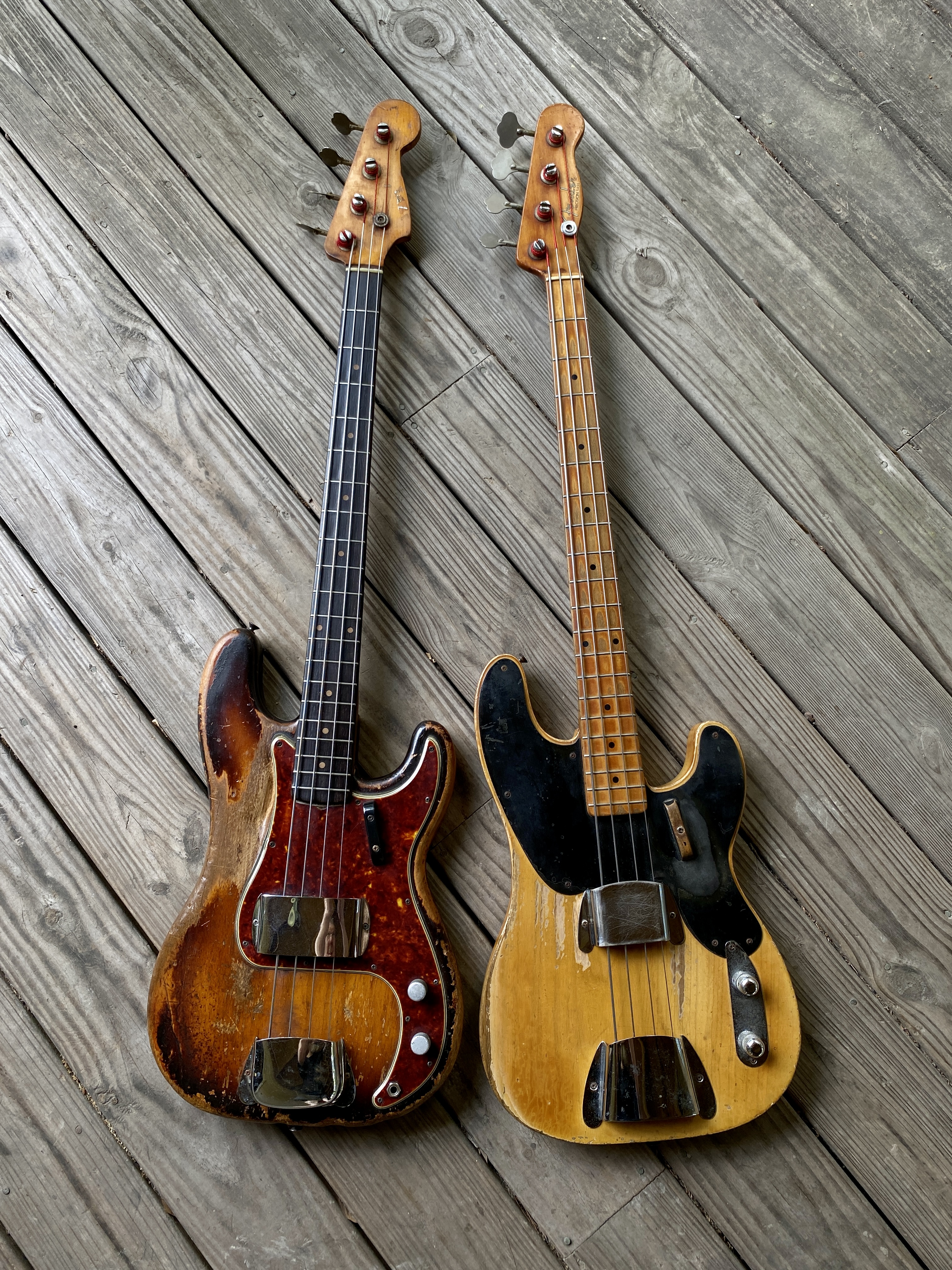
jLlj3Lk.jpg


gxMWXGV.jpg
 
Feel free to ignore all "that tech nerd stuff". That still leaves the G string twice as loud as the rest. Did you notice that on your bass?

Not in a band setting, but it was quite a while ago.

Don't remember it being that noticeable by itself, and I'd guess it would be.

Wish I still had it to check.

Kidding aside, it seems as if that will be tough to mitigate without changing anything vital.

Different "G" string, maybe? Different saddle?

Mute on that string?
 
Unlikely and very risky.
Maybe a pro like Lindy Fralin could do it but obviously not with a guarantee.
I think you can get used to playing it like the weak G string on Stingrays.
OTOH, the Duncan replacement will probably fix everything and sound extremely similar.
 
Would it be possible to adjust the pole pieces on the original pickup without breaking it?

No. The magnets have a rough, sand cast surface and the coil wire is wound directly onto them, with no barrier or bobbin. The two outside magnets especially are under tension, and any attempt to push them down is guaranteed to break the wire.

What can be done is to degauss the G string magnet slightly. I've done that before. It's also reversible. But mainly my motivation to post here was to see if somebody had found a different solution, such as a specific set of strings.

I played another '51 P-Bass yesterday and it has the same issue, so it's inherent to the design (which makes sense). Truth be told, it's mostly an issue playing quietly at home. Once you get up to stage volume (especially with a tube amp, which is what I use), compression takes over and balances things better. A compressor pedal helps with low volume playing.

I'm most definitely not going to change the pickup.
 
  • Like
Reactions: Ghastly and claudel
Interesting problem.

I had Rotosound flats on my modern P Bass for a while. I thought they sounded pretty quiet for the energy you put into them when playing.

My 2nd half to this thought comes from chatting to a violinist who mixed string brands on their violin. They favoured the inconsistency of one bright string, one mellow string, etc. The solution for this bass might be to either mix and match strings to balance the output or to lean into the inconsistent output as a desirable artistic tool.


Edit: ...or stick button magnets on the A and D poles? I juiced up the output of a Mustang bass pickup with neodymium button magnets epoxied onto the back of the stock polepieces.
 
Beautiful basses! Sounds like you’ve discovered it’s a characteristic of these early fenders. I’m wondering how old your strings are? My TI Flats took hours of playtime and gigs before the G String mellowed out and evened up with the rest of the strings. At first it was pretty loud and twangy compared to the other strings. I’ve experienced this with a lot of new string sets…certain strings being louder until they broke in. If you’re not playing it that much it could take some time. Maybe in the meantime put a little bit of foam under the strings at the bridge and see if that evens it out a little.
 
  • Like
Reactions: claudel
You're tech savvy as a restorer and tech, so if swapping the pickup is not an option, the only thing left would be to lower the pickup on the G side, though I'd doubt that would help much.

This is one of those cornerstone instruments with no real predecessors, when they were just starting out writing the first chapter of the book. Mr. Fender was an inveterate tinkerer and inventor, so a few years later we see the staggered pole pieces.

Critical listening in the 1950's, with this through a Bassman and a 212 cabinet was not a thing vs today where we can hear everything.
 
  • Like
Reactions: Stylee Mousse
Damn......that's gorgeous!

The beefier E & G strings are kinda baked in on these early slabs. In fact, I prefer this and use it to my advantage. Nothing better than a thundering E and a G that you don't have to fight w/ to be heard. Give it time and I'm sure you'll be able to easily compensate. Full disclosure: I use TI flats and a Seymour Duncan Stinger Stack.

My 51/55, which I used last night.
IMG_2271.jpeg
 
Beautiful basses! Sounds like you’ve discovered it’s a characteristic of these early fenders. I’m wondering how old your strings are? My TI Flats took hours of playtime and gigs before the G String mellowed out and evened up with the rest of the strings. At first it was pretty loud and twangy compared to the other strings. I’ve experienced this with a lot of new string sets…certain strings being louder until they broke in. If you’re not playing it that much it could take some time. Maybe in the meantime put a little bit of foam under the strings at the bridge and see if that evens it out a little.


The strings are a few years old. I had them on a different bass for a while. The TI Flats on my main bass have been on there since 2003, so I'm familiar with how they age and behave with time. They did break in and then matured into the sound they have now, but the magnetic output and string-to-string balance certainly never changed.
 
  • Like
Reactions: brandau
So flatwounds help. . . . have you tried foam under the strings?

This sounds like Leo needed several attempts before he got it "right first time"!

You're tech savvy as a restorer and tech, so if swapping the pickup is not an option, the only thing left would be to lower the pickup on the G side, though I'd doubt that would help much.

This is one of those cornerstone instruments with no real predecessors, when they were just starting out writing the first chapter of the book. Mr. Fender was an inveterate tinkerer and inventor, so a few years later we see the staggered pole pieces.

Critical listening in the 1950's, with this through a Bassman and a 212 cabinet was not a thing vs today where we can hear everything.


Well, it is the best sounding electric bass I have heard, at least for what I like. Super woody, airy, resonant and clear. It even has a surprising amount of power given the smallish single coil pickup, not far from a later split-pickup P-Bass in terms of output. So I would argue Leo did get it right the first time.

There's a bit of a mystery of what these basses used for strings. According to Fender historian Terry Foster they were NOT flatwounds, but roundwounds made by the V. C. Squier String Company. He has original samples from the period. There was essentially no fretted electric bass before this. I know that some existed, such as the Audiovox 760, but weren't common. So the strings would have been newly designed for this instrument, or possibly repurposed, modified piano strings. That's kinda where my question originated. There's no way of knowing if the perceived imbalance in string volume existed the same way with the strings of that time. I was hoping somebody here might have figured out a set that balances better, maybe even a mix of different brands and/or gauges.

Tilting the pickup away from the G string also tilts it away from the other strings. So that's not really a solution.
Come to think of it, I wonder if the post '57 split pickup was at least partially away of dealing with string imbalance. By having one pickup per pair of strings, the balance is perfectly adjustable.

Not to nit-pick, but the 2x12 Bassman was still almost 10 years away at this point. The first bass amp would have been a 1x15 "TV Front" Bassman combo with a ported, semi open back. I really have no idea what Leo would have initially heard this instrument played through when he developed the Precision Bass in 1950. Probably a TV Front Pro?
 
Well, it is the best sounding electric bass I have heard, at least for what I like. Super woody, airy, resonant and clear. It even has a surprising amount of power given the smallish single coil pickup, not far from a later split-pickup P-Bass in terms of output. So I would argue Leo did get it right the first time.

There's a bit of a mystery of what these basses used for strings. According to Fender historian Terry Foster they were NOT flatwounds, but roundwounds made by the V. C. Squier String Company. He has original samples from the period. There was essentially no fretted electric bass before this. I know that some existed, such as the Audiovox 760, but weren't common. So the strings would have been newly designed for this instrument, or possibly repurposed, modified piano strings. That's kinda where my question originated. There's no way of knowing if the perceived imbalance in string volume existed the same way with the strings of that time. I was hoping somebody here might have figured out a set that balances better, maybe even a mix of different brands and/or gauges.

Tilting the pickup away from the G string also tilts it away from the other strings. So that's not really a solution.
Come to think of it, I wonder if the post '57 split pickup was at least partially away of dealing with string imbalance. By having one pickup per pair of strings, the balance is perfectly adjustable.

Not to nit-pick, but the 2x12 Bassman was still almost 10 years away at this point. The first bass amp would have been a 1x15 "TV Front" Bassman combo with a ported, semi open back. I really have no idea what Leo would have initially heard this instrument played through when he developed the Precision Bass in 1950. Probably a TV Front Pro?
The 51 Pbass was sold with the 51 Pro Amp with a 15 inch speaker. The the bassman wasn't sold until 1952 also with a 15 " speaker.
 
If I had to guess. the electromagnetic coupling of the g magnet with the wires wrapped touching 3/4 of the magnet and the g string vibrating above it cuts more dense lines of force than the a and d magnet just touching the windings on the top and bottom and the strings a and d cutting a less dense number of lines of force could be your volume problem.......maybe
 
one more comment on this zombie thread!! If you swap the G string and D string position, the D would become louder than the G proving the pickup is designed that way............;)