Happy holidays!
I picked up a backup bass the other day that needs some work. Dead spots on the fingerboard, open seams, shot strings... I know I will need to set a bit of money into it to get it together but I can't figure out this and one other thing:
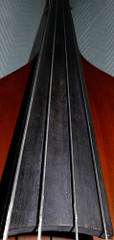
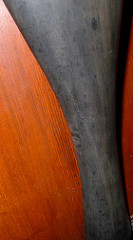
1) I have been searching the forum for pictures that show different ebony/ebonized fingerboards to be able to see and ID myself and after 1/2 hour, I couldn't find any real good photos, only descriptions of dying and paint. Just a few pictures that didn't help me with what I am trying to ID. Can anyone help me out on this? here is a few pictures of the trimmings on the bass:

You can supersize them here:
http://www.flickr.com/photos/91150765@N03/
So, any thoughts? Does anyone have any pictures of various ebonized fingerboards that they could share? Maybe I am uber dense, but I could not find any. I think it would be helpful if we posted a bunch here so they could be easily found in a search.
2) Relief in the neck:
I have read a lot on this over the past week and I do have one question, but first my findings. I read that for pizzing, a luthier will set less relief in the neck (generally speaking). I can see this with my other bass. The fingerboard is pretty darn flat on the E (beveled board) then A/D/G there is more relief about a string to string and a half deep centered at the neck mortise. Now I have read in orchestral setups, that the relief is greater, but is it usually set in the same spot. I know there is the bass to take into account, but on this bass, the relief is deeper than I have ever seen on a bass and the center of the relief is centered about an inch behind the heel toward the scroll and it averages 2 1/2 to 3 times the string height when I press in front of the nut and at the end of the fingerboard. Could this be an orchestral setup? It seems excessive and the bass is hard to play and all I read was the relief is usually centered at the middle of the neck by the mortise/heel area.
I suppose the relief will be a non issue because I know it needs work, well, at least I think it does because it doesn't feel right. There is a huge dead spot on the A string 4 to 5 inches long, big rattles on the E and I can't get into the high action due to the scoop and bridge height. Sorry if some of this has been covered and it was a draw with what sub-forum to post this in due to the two questions. I couldn't find the answers, but if you have any thoughts, I would appreciate them lots.
I picked up a backup bass the other day that needs some work. Dead spots on the fingerboard, open seams, shot strings... I know I will need to set a bit of money into it to get it together but I can't figure out this and one other thing:
1) I have been searching the forum for pictures that show different ebony/ebonized fingerboards to be able to see and ID myself and after 1/2 hour, I couldn't find any real good photos, only descriptions of dying and paint. Just a few pictures that didn't help me with what I am trying to ID. Can anyone help me out on this? here is a few pictures of the trimmings on the bass:
You can supersize them here:
http://www.flickr.com/photos/91150765@N03/
So, any thoughts? Does anyone have any pictures of various ebonized fingerboards that they could share? Maybe I am uber dense, but I could not find any. I think it would be helpful if we posted a bunch here so they could be easily found in a search.
2) Relief in the neck:
I have read a lot on this over the past week and I do have one question, but first my findings. I read that for pizzing, a luthier will set less relief in the neck (generally speaking). I can see this with my other bass. The fingerboard is pretty darn flat on the E (beveled board) then A/D/G there is more relief about a string to string and a half deep centered at the neck mortise. Now I have read in orchestral setups, that the relief is greater, but is it usually set in the same spot. I know there is the bass to take into account, but on this bass, the relief is deeper than I have ever seen on a bass and the center of the relief is centered about an inch behind the heel toward the scroll and it averages 2 1/2 to 3 times the string height when I press in front of the nut and at the end of the fingerboard. Could this be an orchestral setup? It seems excessive and the bass is hard to play and all I read was the relief is usually centered at the middle of the neck by the mortise/heel area.
I suppose the relief will be a non issue because I know it needs work, well, at least I think it does because it doesn't feel right. There is a huge dead spot on the A string 4 to 5 inches long, big rattles on the E and I can't get into the high action due to the scoop and bridge height. Sorry if some of this has been covered and it was a draw with what sub-forum to post this in due to the two questions. I couldn't find the answers, but if you have any thoughts, I would appreciate them lots.