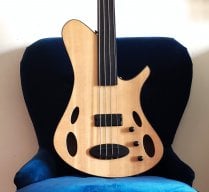
Plain Old Barry is right. For a fretless board, my top choices would be, in order of preference:
1) composite ebony type substitute (like Ebonol, Richlite, or Rocklite)
2) Wood stained with India Ink (like Higgins)
3) Dyed wood (Fiebings, ColorTone, etc)
Rationale:
Composite will wear better on a fretless fingerboard, and the color will be uniform and consistent all the way through.
Dye or stain will not penetrate very far into a hard, dense, non-porous wood like ebony.
At some point, it's almost inevitable that someone who doesn't know how to play a fretless instrument is going to pick up your fretless instrument and attempt to play it. When they do, they will bend notes up and down, perpendicular the the strings, as you look on in horror. They won't be able to help themselves. They'll call it "vibrato". This will happen.
When they bend the notes up and down, perpendicular to the strings, they won't be rubbing the nickel or steel string against a piece of nickel or steel fret wire. They'll be rubbing the nickel or steel string back and forth against the dyed wood surface of your fingerboard, which is much lower on the Mohs scale of hardness than the nickel or steel string. The net result will be to wear little spots into your fingerboard, which will stand out compared to the rest of the board due to the dye on the surface being worn off in spots. It will look ghastly. It will scream at you from its stand across the room. It will haunt you in your sleep. You will weep and gnash your teeth.
Okay, I may be over-stating it just a little bit, but the composite will be more consistent in feel, look, and tone.
Although Fiebings leather dye has been the go-to for decades (carried over from gut-stringed instruments), it tends to have a cold, unnatural bluish sheen to it. If you're going to go the dyed wood route, Higgins India Ink will give you a warmer, more natural black tone.
.