• TalkBass has been independent since 1998. Add your voice.
    Create a free account to reply to discussions, view embedded media, and browse with fewer display ads.
    Join freeLog in
    Want zero display ads or expanded classifieds tools? Compare plans.

Electric bass for small hands?

People forget that most who come on here with this issue are mature, adult learners who are likely teaching themselves the rudiments. Their hands cannot "grow into" playing longer scale instruments as easily as those of, say, a child learner who is receiving formal technical instruction or even those of a teenager who is learning songs to play in bands. So it is pointless to compare these experiences. People should play whatever instrument will encourage them to keep playing. And besides, given the wide array of eminently giggable shorties available right now, it is not as if 34" basses are the only "real" basses out there.
I agree wholeheartedly with your comment. However, there is a recurring theme of threads discussing that topic. My concern is that there seems to be some kind of Urban Legend that you need huge hands to play bass and this is simply not true. There are techniques that can help cope with the stretches.
 
  • Like
Reactions: bassobrutto
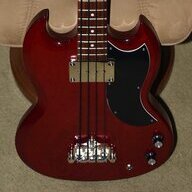
I have small hands, and short fingers, but I've never had too much of a problem playing basses with Precision size necks. I do however prefer the Epiphone EB-0. A short scale, 30.5" neck, with a 12" radius fretboard, and a Jazz size 1.5" nut.

C1u3XHy.jpg
 
People forget that most who come on here with this issue are mature, adult learners who are likely teaching themselves the rudiments. Their hands cannot "grow into" playing longer scale instruments as easily as those of, say, a child learner who is receiving formal technical instruction or even those of a teenager who is learning songs to play in bands. So it is pointless to compare these experiences. People should play whatever instrument will encourage them to keep playing. And besides, given the wide array of eminently giggable shorties available right now, it is not as if 34" basses are the only "real" basses out there.

There are parts of your post that I agree with and others that I disagree with. Playing with whatever instrument will encourage someone to keep playing is important and it is vital to keep motivation alive.

Having said that, I'm not sure why an "adult learner's" hand will not grow into a standard length instrument? There are plenty of videos around that teach students how to shift position rather than stretch. The one question I asked the OP in my first reply was "Do you finger frets one, then three with your index and ring finger- or index and pinky?". Most guitar players who cross over to bass usually make the neophyte mistake of trying to use the index and ring finger, when most seasoned bass players will almost certainly use the index-pinky. I think I was guilty of that at one point. That's one thing that can make all the difference in the world.

As an "older" adult with the beginnings of arthritis in both hands, I can attest that after one month my hands "grew" into a 35" scale bass that I though was too big for my hands only 30 days earlier. I know from my acoustic guitar playing that some of the stuff I needed to play required monsterous stretches. Yes, it took my hands some time to "grow" into those stretches, but eventually they complied. But you're right, if patience is lacking and supervision isn't available, of course taking the easier route of buying a shorter scale bass is the preferable course of action. And starting with a short scale bass doesn't preclude moving to a longer scale down the road. And to that point I would stipulate to the thought that a person should go as far as they can as fast as they can, before the enthusiasm fades.
 
  • Like
Reactions: upgroove9
npbassman’s pic holding his iPhone; man, that was like looking at my own hand. My first reaction was a double take - "What’s my hand doing there!", lol. If the iPhone had been silver, things would have gotten weird.

Anyway, my main bass is and has been for years a Precision (after starting out on a Jazz).

Nevertheless, it’s simply easier for me to play a short scale. I play the Precision for two reasons - 1) it’s the most accessible for me (it’s the only bass I have at home, so it’s the most accessible one) and 2) it’s my favorite sound of all basses - and I can play it fine, so...that’s what I play. However, in my practice space I share with a friend, I have 4 basses to choose from, 2 short scales and 2 full scales, and a short scale is what I usually reach for, especially for a long jam session, but really just in general. But my acoustic in my apartment is full scale and I do fine with that, too — I do like both.

Those saying to use proper technique, well, the fact is I probably could use better technique; however, I’ve been playing a P (or J) fine for 20 years, so it can’t be too bad. Regardless, it’s just easier on the tendons and joints to play a short scale, not to mention simply the reach out to the nut on a long neck and the stress it puts on one’s shoulder. When I was in my teens and 20s, I was indestructible. Now, not so much. No arthritis, but the body ain’t what she used to be. Short scale just makes everything easier, especially the next day...

OP, the main thing is to play a bass that makes you want to play, not to play a bass that makes some poster on TalkBass (including me) happy. If you want to play a short scale, don’t let any TB orthodoxy or videos of ultra flexible young prodigies playing relatively giant instruments dissuade you. If I had truly understood how short scales are fully "real" basses back when I was starting out, I would have never played a full scale bass (but I did and discovered the Precision sound, so I’m never gonna be without my full scale Precision!) and would have been fully happy and fine. If you become interested in a full scale though, as others have said, you might find that with proper technique you can manage it well enough.

Also as others have said, bright round wounds can help, as could putting a better J pickup in your current bass and working on your technique a bit (including not following the guitarist "1 finger per fret rule", especially up by the nut).

Good luck and keep thumping’!
 
Last edited:
  • Like
Reactions: upgroove9
Everybody's different - both physically and psychologically. I think those who have made the point about keeping motivation going before mastering advanced technique have made a great point.

I have very small hands AND short fingers. I used to believe my hands and fingers were inadequate to play long scale after failing to get to grips with a Warwick 5-string Starbass - pretty wide neck! So I decided I had to go to short-scales.

Got me a 500/01 Hofner Beatle bass - very thin neck - and strung it with flats to get smoother sound. Only problem is it sounds thin and poopy through some amps/cabs. But since I swtiched from a MarkBass 250w combo to an Ashdown ORIGINal with 2 Ashdown cabs (2 x10; 1 x 15), it sounds fab. Lovely, easy instrument to play.

For more grungy sound and to go deeper, I use an Ibanzed Artcore 205 with rounds. With a 145 B-string that's deep. Great sound with a touch of drive - can make the room shake with thunder. The 145 means there's no 'floppy B' syndrome...but it's not the easiest instrument to play: the strings need quite a bit of force.

When my Artcore was damaged and in for repairs, I needed another 5-string urgently for rehearsal - so picked up a Music Man Sub 5-string in a hurry. It felt comfortable in the shop and sounded OK. I thought it would do until the Artcore came back. I was in such a hurry, I never thought about scale length. Somewhat to my surprise I found I loved it. Doesn't rumble quite like the Artcore - but a punchier sound. But, with medium gauge rounds on it, I found I could do things like bends much easier than on the Artcore. I've used it for about 5 months and decided that I might be OK with thinner-necked long-scales. Now using a Jack Casady with flats for the smoother stuff. No probs.

I'm 66 and it's been 5 years since I first took up bass. So maybe I'm evidence that you can grow into long scales with small fingers and short hands...but whether I would have persevered without 3.5 years of playing mainly short scales....
 
  • Like
Reactions: upgroove9 and dmt
how small are we talking...?

anything within the range of "normal humans" - so, birth defects or genetic disorders aside, you do not "need" a short scale.

that said, you may like them and stuff, and definitely use one of that is the case. but also don't under value what your hands are likely capable of on a normal 34" bass.

i haven't played the 30" stingray but it's definitely the top of my list for cool 30" basses. I also have a cheap jay turser beatle bass that is under $200 new and sounds great if you like that type of sound.
I do have a minor birth defect, but my classic series MiM P bass is my most comfortable bass. I move my hands a lot and hardly use my little finger at all. I had an AVRI 63 P bass, but that was painful after a half hour and I sold it despite its fantastic tone.
 

Attachments

  • 60F2591B-F05C-42A3-AD63-CEE90E284979.jpeg
    60F2591B-F05C-42A3-AD63-CEE90E284979.jpeg
    296 KB · Views: 64
Last edited:
My hands are not small - in fact, XXL gloves are usually kind of tight. But, my fingers are disproportionately short - and very thick. So, I'm one of those people who appreciates a pretty thin, pretty skinny neck. I don't absolutely need a neck like that, but any bass that I pick up that has one, has already scored points with me - even before I plug it in. And, I prefer 34' scale basses, too; that's never been a problem. However... if you feel you have to have a short scale bass, with a thin, skinny neck?
EA-260.JPG It's getting hard to find a good one, but lots of early '70s Japanese basses - like this Matsumoku-made Epiphone EA-260 bass, have really thin, narrow necks. Lots of them - like this one - are short scales, too. Or,
DSCN0349.JPG violin basses are notorious for their little necks. And, although they're long scales,
'73 Ric 4001-3.JPG some year's runs of Rickenbackers have thin necks (they're always fairly skinny). And,
Dano DC bass-2.jpg Dano Longhorn (2).JPG Danelectros - both short and long scale - have very nice, slim necks. This silver DC59 Pro, in fact, has the neck I like the most...
Other basses? I couldn't say. I haven't played them - and, a lot of them don't make lefties, anyway...:cool:
 
Haven’t noticed any post on the new EB short scale stingray, but that might be an option worth considering. Great build quality but at a cost. I was able to snag one from Sweetwater but the cost was about $2,000. And it looks like the model is currently sold out nationwide. I think they produced a limited number so might be difficult to find on the secondary market, at least for the time being.
 
Thanks for all the great responses! My other bass is an Ibanez GSR200 I am starting to play instead of the Jaguar since I can get more harmonics out of it and it just sounds better. Am using your suggestions as well shifting my hand instead of the big stretch! Can’t afford a teacher right now. Lucky to have survived long enough (I’m 57) to have the internet! Still kicking myself for selling a full scale Squire that I got sounds out of I’ve never been able to duplicate .
 
I have been genetically cursed with small hands. I’m also a beginner and have a Squire Jaguar bass that I’m unhappy with because can’t get much harmonics response , or anything much else I like except when playing metal gets fat dark sound. Board is still a bit big too. Something easier to play plus with brighter sound for slapping and picking. Ideas?
Are you talking a good bass or a great bass?
20200108-070708.jpg

G&L Fallout.. the short-scale the world was waiting for!
 
Wow I have learned so much reading all these thoughtful responses, including ideas for playing and technique I’d never thought of since I’m basically a drummer trying to learn bass because I think I can do more with that than drums, possibly. I started 40 years ago in high school with a few lessons from our band director using a Precision bass. Don’t remember problems with that then. I will keep up my quest. Anyone have ideas re websites concerning techniques for players with small hands? Thanks again.,
 
I'll second everyone else in saying that you'll get it figured out in regard to technique eventually if you keep trying. I don't have particularly small or large hands, but I still DRAMATICALLY prefer slim, Jazz Bass style neck profiles and play best on them. I know that from going to every music store I find and noodling around on all the basses when I was starting out.

That said, I'll also second everyone who said you should try an Ibanez SR. They are indeed easy basses to play, with small, thin, fast necks and usually sufficient fretwork to take a VERY low/fast setup. I think they have some damn nice models in the $400-600 range. Active, passive, different pickup arrangements, and so on.

I imagine the Ernie Ball Music Man/Sterling by Music Man short-scale Stingray would be a very small/inexperienced player-friendly instrument. I've never played one, but I play Music Man basses and have heard enough reviews that I pretty much know what they're about, and I think would fit your needs fairly well. I sorta want one myself.
 
I have an Ibanez GSR 200 I got at a pawn shop but it needs repairs. Are we talking about the same MM Stingray? The ones I’m looking at run $200-$300 brand new. I’ve heard so many good things about the more expensive EB Stingrays so was wondering if it would be a good way to go tho inexpensive. I’m a beginner at chords and reading music tho have played along with records etc most of my life. I’m a transplanted drummer so anything that would help play good rhythm would be ideal.
 
I have an Ibanez GSR 200 I got at a pawn shop but it needs repairs. Are we talking about the same MM Stingray? The ones I’m looking at run $200-$300 brand new. I’ve heard so many good things about the more expensive EB Stingrays so was wondering if it would be a good way to go tho inexpensive. I’m a beginner at chords and reading music tho have played along with records etc most of my life. I’m a transplanted drummer so anything that would help play good rhythm would be ideal.
I think you're referring to the Sterling by Musicman Ray 4 SUB series basses for $200-300. Not to be confused with the Ernie Ball by Musicman Stingray which is over $1000.
The budget Sterling by Musicman Ray 4 SUB series is a great option for those who do not want to spend a lot of money. While not of the same quality obviously, you do get a good bass for your money. Sterling Ray 4 basses also have slimmer necks than the regular US made EBMM Stingray.
I currently own a US EBMM SUB Ray, have owned a Sterling Ray 34 and about five Sterling Ray 4 SUB series.