
• TalkBass has been independent since 1998. Add your voice.
    Create a free account to reply to discussions, view embedded media, and browse with fewer display ads.
    Join freeLog in
    Want zero display ads or expanded classifieds tools? Compare plans.

Elixir Nanoweb coated comparison after 3 months of use

Hello my friends,
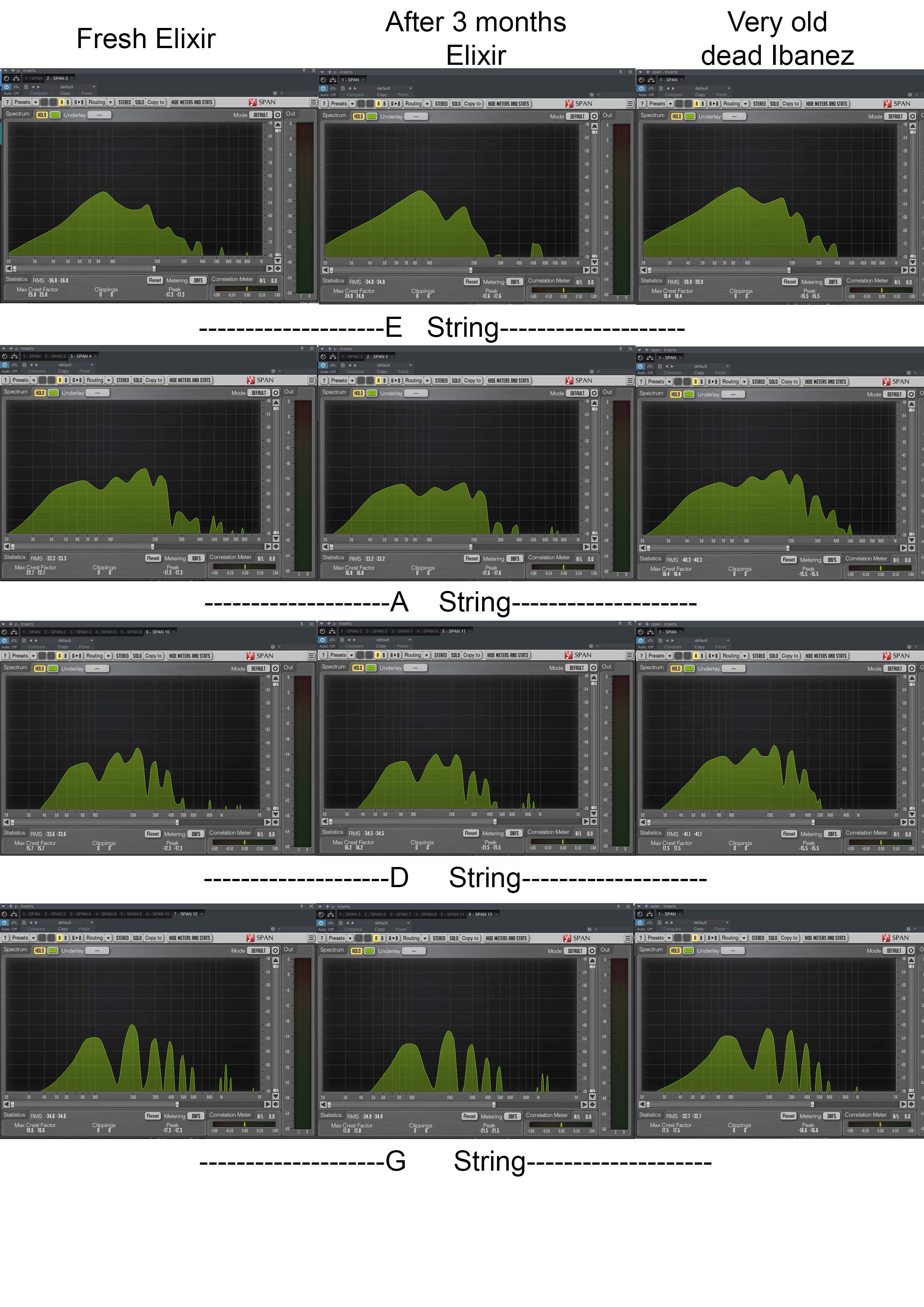
there is results of spectrum analyzing for Elixir Nanoweb Stainless steel 45-105 in fresh condition and after 3 Months use (4 hours daily with sweaty fingers and only finger style)
also i add an old dead string from another brand just for observing whats going on when a string got dead.
Untitled-1.jpg

1-higher overtones are weaker or disappeared.
2-less clarity between overtones happened.
3-lower frequencies got stronger specially for E string(in some cases even lower Freqs has been produced)
4-in fresh condition overtones are more sharp and peaky.
fresh strings sound more like a Piano to me.
I think the Elixir was a good choice for me and their coating technology really do the job.
audio comparison (open strings, Fresh elixir,after 3 months and old dead respectively):


i have a question, we know the freq of E1 is 41Hz but in spectrum i have lower than that. undertones are not exist and they are just mathematical concept. what is wrong?
 
  • Like
Reactions: dralionux and Pier_
(in some cases even lower Freqs has been produced)
(...)
i have a question, we know the freq of E1 is 41Hz but in spectrum i have lower than that. undertones are not exist and they are just mathematical concept. what is wrong?

Those frequencies you detected are sometimes referred to as "sub(-)harmonics" over at TB:Amps. Incorrectly, that is: as you implied, they can't be mathematically related to the fundamental and also be lower than the latter, because such a concept is just theoretical. So they must be something else, and not "harmonic": they are produced by the movement of the string inside the magnetic field at and even before the note attack, because of how the plucking finger and also the anchored thumb handle the string.

A forum search in the Amps and Cabs subsection, for
subharmonic
sub-harmonic
sub bass
vlf
should yield some results, but also a number of unwanted ones.
["Sub+bass", "subharmonic-" etc. will dig up hits about subwoofers, and also onboard octave-down generators such as those found in Ashdown amps; "VLF", which stands for "very low frequencies" is also, often, users misremembering and conflating the names of the two preset EQ shaping knobs in MarkBass amps, namely VLE ("vintage loudspeaker emulator" = a low pass filter cutting treble) and VPF ("variable preshape filter", a midrange-cutting, bass- and treble-enhancing contour knob).]

Adding the word "HPF" to each of the searches should narrow them down to more useful results; high-pass filters come installed in many bass amp front-ends - and/or sometimes added by players in the signal chain to compensate for their absence or as extra - because, among other things, they remove those sub frequencies we're talking about, which take up amp power for nothing and are harmful to speakers. The [sfx] Thumpinator is one such outboard HPF unit.

Anyway, here's one thread that touches upon these topics:
acme B2 vs GK 115MB, Question:
 
Last edited:
Cool research, and to me, the only thing that matters is what I hear. That is a fresh sound for every gig, rehearsal, practice, and casual jam that I do. It's that feeling of assurance (and/or insurance) that I get, from knowing what my sound will be, on a very consistent basis. I've used Elixir, mainly, since the late 90's, when a local shop wanted my opinion on a then new string. Aside from very few brands that I've tried for a little while, here and there, I came back to Elixir, because again, they're consistent. As long as you eq accordingly, and don't mind a stiffer feel (compared to stuff like DR Pure Blues, Labella Stainless, etc), then I can't make sense from basically wasting money on pack after pack of strings that don't even come close to the longevity of Elixir.

Believe it or not, I'm not being paid or pushed by this company in any way...just love a product that's been a very loyal part of my sound for two decades now.
 
  • Like
Reactions: Bassisteve and Mili
I couldn't get it, you are explaining something related to Amps and Cabs but i didn't mic any cab.
Signal chain: Yamaha BB>Scarlett solo AI >>DAW(studio one)>>Voxengo span plug-in.
No I'm not and no you indeed didn't get it, that's why I recommended you did a search, or at least read the thread I linked to, if you are curious about those frequencies you recorded that are lower than the fundamental. They are produced by the finger-string interaction inside the magnetic field of a pickup. Amps and cabs just reproduce them, unless something in the signal chain (either incorporated at the preamp or deliberately added by the user) filters them out.
[The Amps subforum is the only one discussing them because onstage amplification is where they cause problems: allowing the power amp to amplify them means a waste of resources, because they take up headroom, are too low to be accurately reproduced by the woofer, can drive the latter into overexcursion and put it at risk, are inaudible anyway and aren't a part of the musical part of the note in any case.]
Now, since there is no such sub-bass filter in your signal chain, those frequencies pass through and are recorded. Unsurprisingly, since they're there from the start, at the finger-on-string stage of the chain. Amps and cabs, if present, only pass them down the chain or they don't, but they don't cause them.
 
  • Like
Reactions: Mili
No I'm not and no you indeed didn't get it, that's why I recommended you did a search, or at least read the thread I linked to, if you are curious about those frequencies you recorded that are lower than the fundamental. They are produced by the finger-string interaction inside the magnetic field of a pickup. Amps and cabs just reproduce them, unless something in the signal chain (either incorporated at the preamp or deliberately added by the user) filters them out.
[The Amps subforum is the only one discussing them because onstage amplification is where they cause problems: allowing the power amp to amplify them means a waste of resources, because they take up headroom, are too low to be accurately reproduced by the woofer, can drive the latter into overexcursion and put it at risk, are inaudible anyway and aren't a part of the musical part of the note in any case.]
Now, since there is no such sub-bass filter in your signal chain, those frequencies pass through and are recorded. Unsurprisingly, since they're there from the start, at the finger-on-string stage of the chain. Amps and cabs, if present, only pass them down the chain or they don't, but they don't cause them.
Thank you, very helpful. Now I'm super curious to find exactly what's going on.
 
  • Like
Reactions: HaphAsSard
Thank you for sharing your experiences, I'm beginner and i can't afford fresh strings so i decided to use coated strings (for atleast 9 months using). I like to try another coated brands but I'm concerned maybe Elixir is the best. Any advise will be appreciated.

I've gotten to points where I'd play a lot every week, up to 4 or 5 shows, and still only change strings about once a year.
 
  • Like
Reactions: Mili
Thank you for sharing this info and demo! I am an Elixir believer! They last long long long time and still have nice clarity to it! I slap a lot so can not stand dead sounding rounds! Elixir lasts for a 3-4 month for me during summer (summer in Japan is very hot and humid so you sweat a lot), and for 6 month if I install strings in October
 
  • Like
Reactions: Mili
Thank you for sharing this info and demo! I am an Elixir believer! They last long long long time and still have nice clarity to it! I slap a lot so can not stand dead sounding rounds! Elixir lasts for a 3-4 month for me during summer (summer in Japan is very hot and humid so you sweat a lot), and for 6 month if I install strings in October
You are welcome,I'm glad it was helpful for you, actually my last set was 18 months on my Bass. Excellent strings for my needs.
By the way I love your country.
 
Yes, maybe they are less bright than other brands but only for first two weeks. :laugh:
I always use stainless steel which I guess that's most bright material for strings.

I had both stainless steel and nickel Elixirs, and I find them to only have few differencies, I prefer the nickel overall because the 40-95 aren't offered in Stainless Steel, and that light gauge gives more brightness in the end !

I agree with you after the 2 first weeks haha
 

Latest posts